A Company You've Never Heard Of Is Suing You Over a Card You Closed in 2019
A debt lawsuit rewards a missed deadline. How to read the summons, protect your response date, check the debt's history, and prepare questions before negotiating.


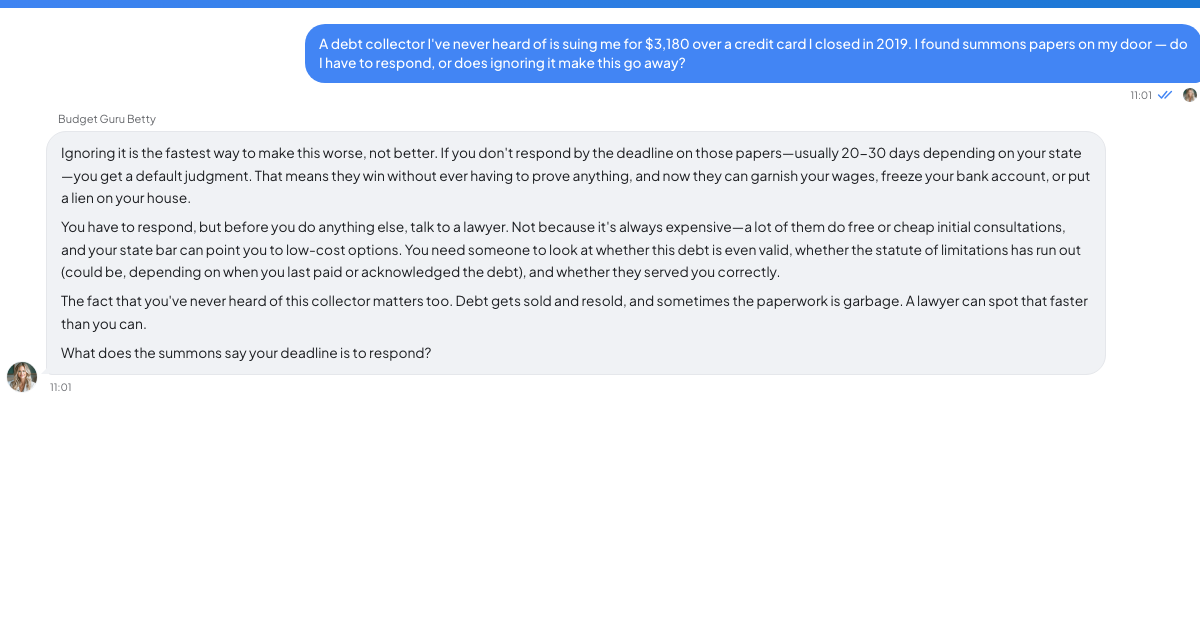
The papers on your door name a company you have never done business with
The amount is $3,180, say; write it at the top of your notes. The plaintiff is an LLC named like a small law firm crossed with a hedge fund, while the only familiar detail is the last four digits of a card you closed years ago.
You may have read the first paragraph nine times already. Somewhere in that paragraph is a number of days. It may say twenty, possibly thirty. You may not know whether counting starts at the door or pickup, after losing an evening to eleven law firms seeking consultations and a 2014 forum thread about a state where you do not live.
Begin with the genuinely urgent item, then work backwards.
The date is the whole game
Everything else here is secondary. The deadline is not.
A lawsuit gives you a short deadline for a written response. The CFPB says to respond by the date in the court papers and that responding does not admit the debt (CFPB guidance). In the US it's commonly somewhere around twenty to thirty days, but it varies by state, by which court the case is in, and sometimes by how you were served. The papers in your hand say which — and the papers beat anything you read online, including this.
If you miss it, the plaintiff can ask the court for a default judgment. The plaintiff may win by walkover for the amount requested, without proving the debt is yours or that they own it. No one argues the file for you. No one examines the file.
Some people fear that answering wakes them up. They fear that appearing admits it is theirs. They assume silence is safer.
Answering is what gives you a chance to prevent a default judgment. Silence is the outcome the plaintiff is prepared for: the cheapest, fastest, and most reliable route to a favourable result. The Pew Charitable Trusts found that, in jurisdictions with usable data, more than 70% of debt collection suits ended in default judgment (Pew report).
So whatever else happens this week: find the date, write it on something you'll see every day, and treat it as fixed.
A judgment is not necessarily the end. Depending on the state, enforcement can reach wages, bank accounts, or liens, while some states sharply restrict wage garnishment for consumer debts. State law determines which protections apply and what is exempt. That's a question for someone who practises where you live.
Read the paperwork like a document, not a threat
Sit down with a pen and take inventory before looking for an escape route.
The plaintiff's name. If it isn't the bank you had the card with, this is likely a debt buyer — a company that bought a portfolio of charged-off accounts, often for a fraction of face value, and sues on them. Look for language like as assignee of or successor in interest to. That phrase is doing legal work: it's the claim that the right to sue travelled from the original creditor to this company.
Check the amount and its breakdown. Is it a flat balance, or does it include interest and fees added after charge-off? Whether those are recoverable at all depends on the original cardholder agreement and on state law.
Check the dates. When was the last payment you actually made? When was the account charged off? Every state has a statute of limitations on suing over a contract debt, and it varies a lot. Two things about it that get missed. In most places it's a defence you have to raise — the court generally won't spot it for you, and it certainly won't if you're not there. And in some states making a payment, or acknowledging the debt in writing, can restart the clock. Which is one very good reason not to phone anyone and offer twenty dollars to show goodwill before you've worked out where you stand.
Check what is attached. Sometimes it's an affidavit and a single line of account data. Sometimes there's a bill of sale, statements, the original agreement. Sometimes the file contains almost nothing. Portfolio sales arriving with thin paperwork is well documented, and the chain from the original bank to the company suing you isn't always easy for them to produce. Note what is and isn't there. Don't build a plan on it — that's a lawyer's assessment — but note it.
The questions to write down before you talk to anybody
These questions are not for the internet. For the person who is going to advise you.
- What is my actual deadline, and does my court have a fillable answer form?
- Is this debt mine at all, or is it a name mismatch, an old joint account, or identity theft?
- When was my last payment, and what's the limitations period in my state?
- Was I properly served, or did these just appear? (Improper service is a real problem in these cases. It's also not a reason to ignore what's in your hand.)
- Do I have any counterclaim — did the collector do something in the run-up to this that consumer law addresses?
- If I lose, what can actually be collected from me here, and what's exempt?
The validation rights you may have read about — the ones with a thirty-day window — attach to a debt collector's initial communication and run on their own track. A collector can file or carry on a lawsuit while that window is open. They are not a substitute for answering, and confusing the two is a common and expensive mistake.
If there's going to be a settlement
Sometimes settlement is possible, so consider a realistic offer before an unexpected phone call.
Work out the honest number: what you could pay as a lump sum without borrowing to do it, and what you could pay monthly for a stated number of months without missing rent. Those two figures are your whole negotiating position. Write them down while you're calm. An AI is useful here for working out those two numbers with you — Budget Guru Betty on TrueTalk can help. The free tier includes ten conversations and one hundred messages per day. She's an AI, not a lawyer, and she can't tell you what to file.
Then handle the terms that matter more than the number. Get any agreement in writing before money moves, never on a phone call, never as a verbal promise from someone in a call centre. Understand whether you're agreeing to a dismissal or to a stipulated judgment, because those are very different animals and one of them leaves an enforceable judgment sitting against you. And know that forgiven debt can be reported to the tax authorities as income to you — worth asking a tax professional about now rather than discovering it the following January.
Where the real help is
Start with legal aid in your area, a consumer attorney, or your state bar's lawyer referral line. Many state court systems publish self-help materials, and some include answer forms. The National Association of Consumer Advocates maintains a directory of attorneys who work on the consumer side. Some of them take these matters on terms cheaper than you'd expect, because consumer statutes can shift fees onto the losing side — ask about that specifically, and ask early, because a lawyer with three days left has fewer moves than a lawyer with three weeks.
The deadline has not moved while you read this. Find it on the paperwork now, then put it somewhere you cannot avoid seeing it.