Fourteen Months Postpartum and I Flinch When He Touches Me
Touch saturation can turn a kind hand into another request. Rule out clinical problems, then use a two-week no-pressure reset without setting a sex deadline.


The hand on your waist at the sink
You are rinsing the beaker when he comes behind you and rests a hand on your hip, the same hand in the same place as for years. Your body stiffens before you decide anything. You pull away half an inch; he notices, removes his hand, says something light about dinner, and leaves the room.
You remain at the sink, hating yourself. Low libido is only part of it. For the next ninety minutes you ask what kind of wife flinches from a kind man. This has lasted fourteen months. He has stopped initiating, which was what you wanted, until it began feeling as though he had quietly filed you away. Neither of you has said one true sentence about it.
Put pain and persistent low mood with a clinician
Burning, tearing, a deep ache, or any pain that makes you brace during sex is a medical question rather than a mindset problem. This is very often fixable, and a GP and, in many places, a pelvic health physiotherapist are the right people. Do not push through pain and hope it improves; repeated painful sex can teach your body to expect pain and make later intimacy harder.
The NHS says there are no rules about when to restart sex after birth and that pain, dryness, and tiredness are reasons not to rush. Hormonal changes after childbirth can cause vaginal dryness, and lubricant may make sex more comfortable. While you are breastfeeding, oestrogen is generally low; dryness and less spontaneous interest commonly follow. That physiology is not a verdict on your marriage. Ask a clinician if it persists.
Weeks of low mood or high anxiety—beyond the ordinary awfulness of one bad night—also warrant a GP appointment. Postnatal depression and anxiety can continue beyond the first year. The NHS says postnatal depression often improves within three to six months but can last much longer, so fourteen months does not make the concern too late. A health visitor, GP, or perinatal mental health service, where available, can help. The NHS describes persistent sadness, guilt, anxiety, and difficulty sleeping even when you can rest among symptoms worth getting help for.
Medical care does not erase the shame, but it keeps you from trying to communicate your way out of pain, depression, or anxiety that needs treatment.
Your capacity for touch has been used all day
Since six in the morning you have been climbed on, hung from, sat on, grabbed by the face, and had a hand down your top in a supermarket queue. A toddler treats your body as public infrastructure, as toddlers do. By eight in the evening, your capacity to receive touch is saturated. Another hand arrives and your body refuses automatically, regardless of whose hand it is.
There is also background touch: the child leaning against your leg while you cook, the lift into the high chair, the hand seeking you during a story, the body sleeping against you. No single contact explains the flinch. The accumulation means you have almost no interval in which your body belongs only to you.
Because he is the only adult in the building, the flinch looks like a message about him. After fourteen months, his hand on your waist may have stopped feeling neutral too. It has become a question you do not know how to answer. You recoil from being asked as well as from being touched, and both of you lose the ordinary contact that used to mean nothing.
Scheduling sex fails when the problem is saturation and expectation rather than an empty calendar. Four free hours on Saturday do not refill your capacity. A booked appointment may instead put dread into Thursday and Friday. Lighting a candle, hiring a sitter, or choosing a date can help couples whose obstacle is time; it does not by itself remove pain, touch saturation, or the belief that every affectionate hand is an opener. Rebuild non-demand touch before using sex as the target.
Rebuild ordinary touch for two weeks
For a couple of weeks, make some touch categorically not a request. Say out loud, once, that anything happening before you are both in bed is not an opener. The agreement may sound mechanical; say it anyway, because after this long neither of you can reliably infer what a hand means.
Then initiate some of the small contact yourself. Rest a hand on the back of his neck for four seconds while he works, or sit with your feet on his lap. When every touch begins with him, each touch can feel like a question. Contact that begins with you gives you agency over when it starts.
Keep it short and end it yourself while you still want to. The point is to prevent touch from becoming something you endure until another person decides it is finished. Give yourself an hour after bedtime when nobody touches you at all. That is a recovery period rather than rejection, and you may need it before any other contact is possible.
This two-week practice is not a trick for getting back to sex on a schedule. It restores the ordinary background touch of a couple and lets you notice what your body can receive without turning each gesture into a test. It has not failed if desire does not return by the end.
Replace the silence with accurate words
You may avoid speaking because "I don't want to" feels brutal, while silence communicates something worse. Try: "I want to want to. I'm not there yet, and it's not about you." Then add: "I'll come back to this. I'm not asking you to wait forever with no information."
If he asks when, do not invent reassurance. Desire after a baby has no published timetable, and anyone promising a date is guessing. You may notice movement after sleep, reduced feeding, pain treatment, shared workload, or restored non-demand touch, but none lets an article forecast your body. Come back to the conversation at an agreed interval rather than offering a deadline for desire.
His experience matters without letting it override your consent. He may have stopped asking because repeated rejection hurt and restraint feels considerate. From your side, that same restraint can resemble abandonment. He may fear that this is permanent or that you no longer fancy him; those are plausible inferences, not facts about what he thinks. Ask instead of guessing: "When I pull away, what story do you tell yourself?" Then tell him the story you tell yourself at the sink.
If you are the partner reading this, keep your touch clearly non-requesting. Say "This isn't me starting something" and mean it. Accept an ending without changing the atmosphere, take full ownership of the entire bedtime routine more often than feels fair, and do not treat the two-week practice as a countdown. An hour when nobody is on her may matter more than another conversation about frequency.
Find the right place for each part
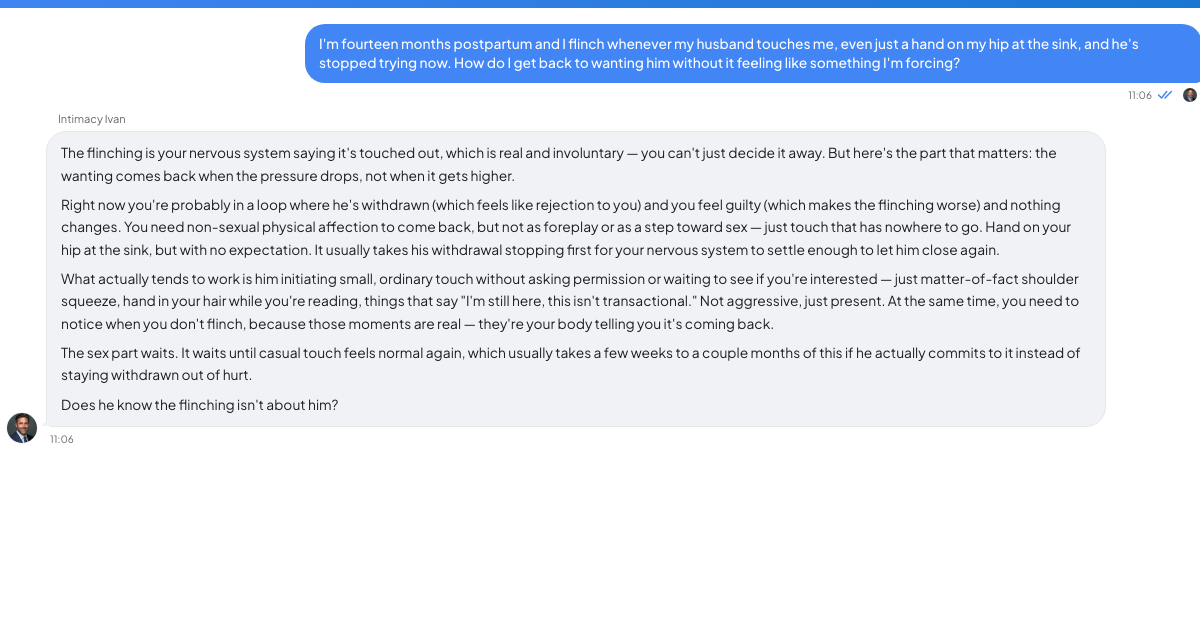
If you need to say I love him and I don't want him near me and I feel like a monster somewhere outside your marriage, TrueTalk has an AI advisor called Intimacy Ivan, focused on physical and emotional intimacy. He is an AI persona rather than a therapist or doctor and is available at whatever hour this is bothering you. The free tier includes ten conversations and one hundred messages per day.
Pain, persistent low mood, anxiety, and other clinical concerns go first to a GP, pelvic health physiotherapist, health visitor, or appropriate mental-health service. Ivan can help you find words; he cannot diagnose either partner, guarantee his reaction, or set a timetable for desire.
Fourteen months can feel enormous when everyone implied six weeks, yet it is not unusual to still be running a household on broken sleep. Protect the hand on the neck and the four seconds that carry no demand. That gives closeness somewhere safe to exist while the rest remains unknown.