He Moved Out and Stopped Paying the Card That's Still in Both Your Names
A divorce decree can assign the debt to him without releasing you from the lender's contract. Sort every account, contain joint exposure, and preserve enforcement evidence.


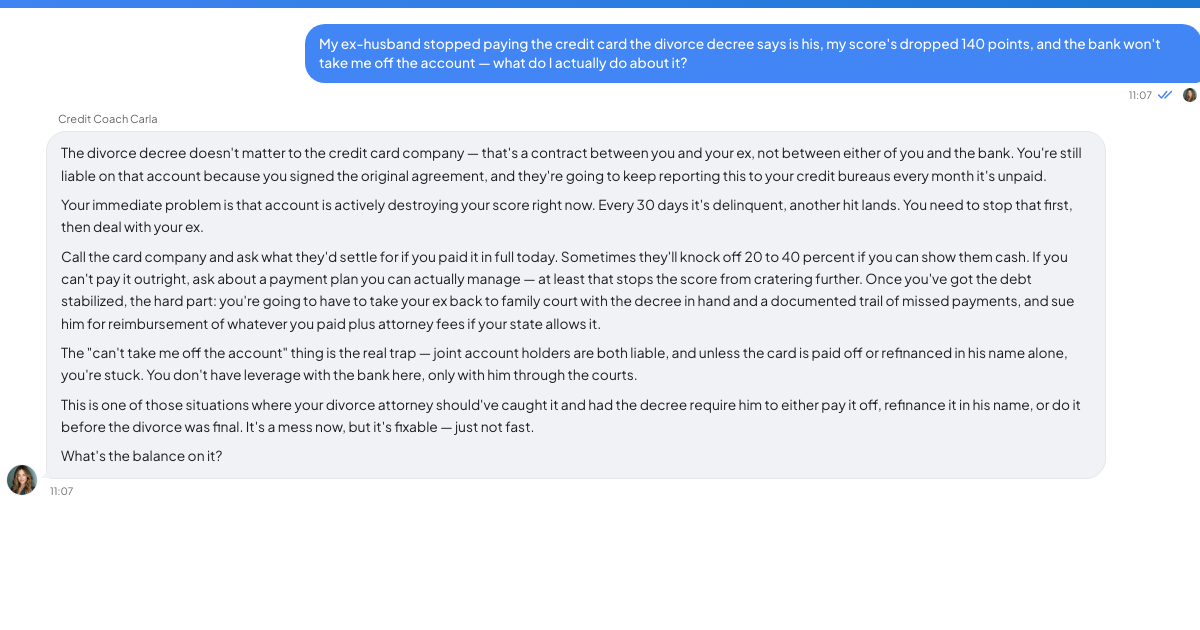
The bank sees two borrowers, even after the judge assigns the bill
You call the card issuer and explain that a judge signed an order making your ex-husband responsible for this debt. The representative is polite. The account is joint, the balance is due, and would you like to make a payment today?
Five months have passed since the last payment. The score you built over a decade has fallen one hundred and forty points, and an app notification told you before he did. The call-center screen does not contain the history, the argument, or the decree. It contains a contract with two borrowers.
A divorce decree orders conduct between you and him. A credit agreement governs the lender's rights against its borrowers. The lender was not a party to the divorce proceeding, so allocating the debt to him did not release you from the contract. It gave you a claim against him if he failed to pay.
The Consumer Financial Protection Bureau confirms that a property settlement or divorce decree does not stop a creditor collecting from anyone still named as a borrower. The CFPB says release usually requires the creditor to remove you contractually or your former spouse to refinance the loan without you. Sending the decree to the lender does not accomplish either step.
That distinction explains why a correct late payment can appear on your file every month while he violates the court order.
Pull three reports and make four lists
General credit-repair advice assumes the damaging account belongs to you and is under your control: lower utilization, dispute errors, pay on time, and wait for older marks to age. Here, the late payments may be accurate, the utilization may be outside your control, and the person ordered to pay may not cooperate.
Start by seeing the whole file. In the US, pull all three reports from AnnualCreditReport.com and inspect every line. The FTC says the three nationwide bureaus—Equifax, Experian, and TransUnion—allow free weekly report checks through that official site. You may uncover an old store card, a co-signed car loan, a phone contract, or an overdraft on a closed current account that you had forgotten.
Sort each item into one of four lists.
Authorized-user accounts. These are often mistaken for joint accounts. An authorized user can spend but did not sign as a borrower and is generally not liable for the balance, according to the CFPB. Ask the issuer to remove you; usually, that takes a phone call. The tradeline may then leave your report along with all of its history, including positive history, so inspect its effect before acting. Reverse the exercise too: remove him as an authorized user on your own cards today if you have not already done it.
Accounts you can sever. Look for debt that can be refinanced into one person's name: a balance transfer to his sole card, a personal loan in his name that clears the joint card, or a mortgage refinance or assumption by the person keeping the house. His cooperation and creditworthiness are required. When possible, though, severing ends the shared exposure rather than merely managing it. If the decree required refinancing by a specific date and that date has passed, take that concrete breach to a lawyer.
Accounts that still bind you. A joint card with a balance may remain joint until it is paid or refinanced; many issuers will not simply delete one borrower on request. Read your agreement and ask the issuer what its policy permits. This is the list that requires containment.
Accounts solely in your name. Protect every clean account here. In three years, these are the records against which you will seek credit. Do not miss their payments while concentrating on the joint account.
Contain a joint card you cannot yet escape
First, ask the issuer to close the joint card to new charges immediately. Some issuers permit either party to stop future use while the balance remains, but policies differ. Get confirmation in writing or through a secure message you can retain. Closing further spending does not erase your liability for the existing balance. Nothing except payment removes that liability; a refinance works only because its proceeds pay the joint balance.
Second, create access that does not depend on him. Use your own online login, route statements to your address, and set every alert the issuer offers. A screenshot from his account whenever he chooses to send one is not monitoring.
Third, decide whether you can cover the minimum when he does not. Paying debt assigned to him feels like surrendering the one point the decree settled. Yet the damage reaches your file now, while your right to seek reimbursement through the issuing court can survive your protective payment. If you can afford it, paying, saving every receipt, and asking your lawyer to enforce the order will usually preserve more options than allowing further delinquencies.
You can also choose to hold the line on principle. Make that choice with the cost visible: your credit report records the missed payments, and future lenders price what they see. If you genuinely cannot afford the minimum, some harm may be unavoidable. Concentrate on containment and keep the fourth list spotless so clean history remains underneath when the joint debt is eventually resolved.
Accurate negative information is generally not removable through a dispute. The FTC says most negative information remains for seven years, running from the original delinquency for an accurate delinquent account, although bankruptcy information can remain for ten; it also notes limited circumstances in which older material may appear, including a job paying more than $75,000 or credit or insurance valued above $150,000. That is why disputing a truthful delinquency is not a repair strategy.
FICO's published breakdown assigns payment history 35%, amounts owed 30%, length of history 15%, new credit 10%, and credit mix 10%. FICO cautions that those percentages describe the general population and vary by individual credit profile, so nobody can responsibly promise an exact score recovery. Payment history is still the largest listed category, which explains why one unmanaged account can outweigh fifteen years of careful payments.
Use the divorce court for the decree and a lawyer for bankruptcy
The card issuer cannot enforce the order for you. Contempt, an enforcement motion, or an indemnification claim belongs with a family-law attorney in the state that issued the decree. Keep statements, alerts, payment confirmations, the agreement, and the order together. Do not substitute a longer email or another argument with your ex for legal enforcement. Procedures differ by country and state, so this is the general shape of the problem, not advice about your case.
Bankruptcy changes the analysis and needs specialist advice. If he files, his liability to the lender may be discharged while yours remains. Chapter 13 has a narrower protection: the US Courts explains that its co-debtor stay generally prevents a creditor from collecting a consumer debt from another person liable with the debtor, unless the bankruptcy court authorizes collection. What happens to his promise under the decree depends on the chapter, the order, and other facts. Take the papers to a bankruptcy or family-law attorney rather than relying on an article.
Credit Coach Carla on TrueTalk can help you work through the report line by line at midnight. She is an AI, and the free tier includes ten conversations and one hundred messages per day. She cannot enforce a court order or give case-specific legal advice, so book the lawyer regardless.
Your score damage is not permanent, and the shared account will eventually resolve through payment, refinance, or another legal outcome. Until then, use the narrow window you can control: most creditors do not report a missed payment to the bureaus until it is thirty days past due. Your own login and alerts let you see that actionable thirty-day threshold and make a protective payment before a new mark lands, then document the payment for reimbursement.