I've Decided to Leave. Do I Call a Lawyer or Tell Him First?
Once you have decided to leave, prepare the first twenty words, get one confidential local consultation, and plan safety, documents, children, and the first fortnight.


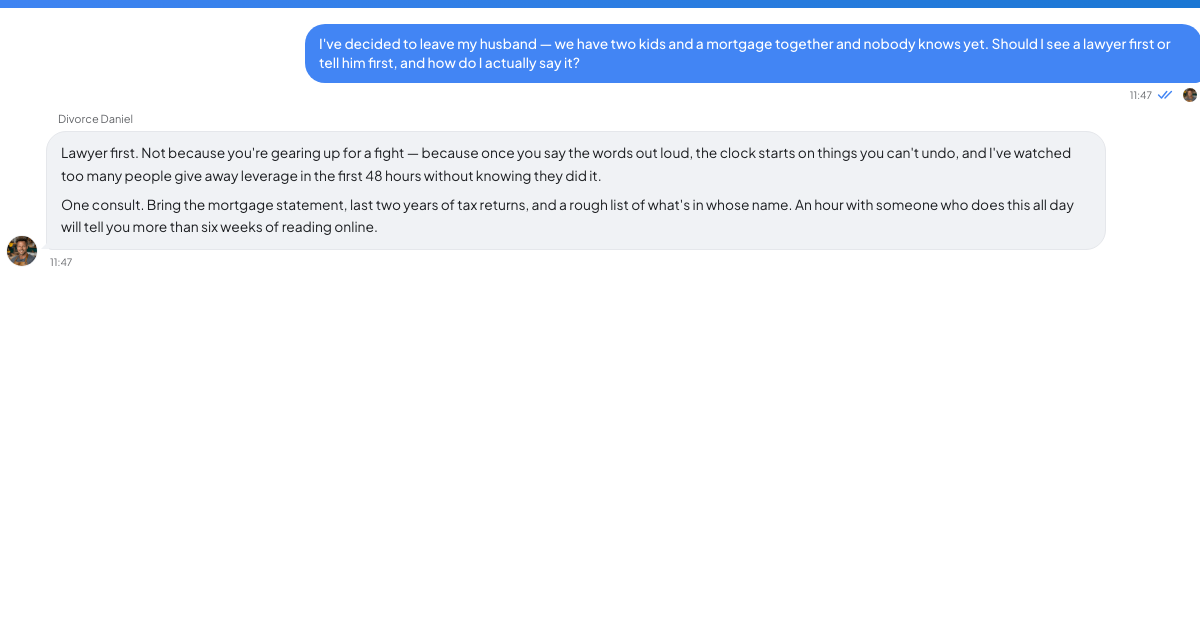
Prepare the twenty words before the legal questions
The sentence often stops you before the law does. Use something close to: I've decided I want a divorce. I'm not saying this to hurt you, and I'm not going to change my mind. We need to sort out the children and the house.
Then stop. The silence will feel awful, and filling it can turn an announcement into a negotiation. “I think we need to talk about whether this is working” invites him to debate a decision you have already made. He may accept that invitation. Four months later, you could be in couples counselling you had ruled out, explaining yourself to a stranger on a Tuesday evening.
Do not litigate every reason on the first night. If you name drinking, he may stop drinking and make that change the new reason you owe the marriage another chance. By March, you are having a more painful version of the same conversation. “I'm not going to do reasons tonight” is a complete answer, and you can repeat it.
Choose the conditions. Avoid the children, eleven at night, and, if possible, Sunday before a working week. A weekday morning while the children are at school gives each of you somewhere to go afterward. It may not feel kind in the moment; it is kinder than trapping both of you overnight.
Write the words on your phone. Reading to your husband feels absurd, but it is better than getting four words in, fighting about the dishwasher, and never finishing. That is how a February decision survives until November. Rehearse alone in the car until your voice holds through the final sentence.
Divorce Daniel is TrueTalk's advisor for this rehearsal. It is an AI, cannot give legal advice, does not know your jurisdiction, and has not seen your file. It can let you repeat the sentence forty times and organize questions for a paid hour with a real family lawyer, so the hour is not consumed by hearing yourself think. The free tier includes ten conversations and one hundred messages per day.
Put safety ahead of sequence
Fear or control changes every step. Do not announce your plan simply because an article supplied a script. Contact a domestic-abuse advocate first and a lawyer next; safety planning comes before paperwork. In the US, use thehotline.org or 1-800-799-7233. In the UK, call 0808 2000 247.
The legal rules recognize that distinction. In England and Wales, GOV.UK says you usually need to show you attended a Mediation Information and Assessment Meeting before applying to court about child arrangements, but domestic abuse is one circumstance in which attendance is not required. The current Family Procedure Rules practice direction lists specific evidence routes for that exemption, including protective injunctions, findings of fact, reports from appropriate health professionals, and letters from domestic-abuse advisers or support services. An advocate and local lawyer can help you use the route that applies rather than confronting him first.
Get one local consultation, then keep the gap short
“Lawyer or husband first?” contains an operational question and a moral one. Seeing a lawyer before telling him is not an ambush. You are obtaining confidential information about your own life, just as he is entitled and likely to do. A fortnight of information asymmetry is not deceit; hiding assets is. Keep that line clear.
Do not stretch the concealment period unnecessarily. Three weeks of ordinary domestic conversation while carrying the decision may be survivable. Three months changes how you behave in the house, and children often notice the atmosphere before anyone explains it.
Divorce law is local—often state, province, or region local rather than merely country-level. In England and Wales, applications about children or finances commonly involve a MIAM first, subject to exemptions such as domestic abuse. GOV.UK explains that the meeting assesses whether mediation is suitable, usually costs around £120, and must be conducted by an accredited mediator; it is separate from relationship counselling. In some US states, filing triggers automatic orders restricting asset moves, insurance changes, or taking children out of state. Neither example predicts your postcode. A family lawyer where you live is required, not an optional upgrade.
A consultation normally does not file a case or commit you to the firm. Confirm both points when booking, ask what the firm records, and ask the price. Bring written questions:
- What is the local process from beginning to end?
- What is the realistic range of outcomes for a house occupied by two children?
- Roughly how long will it take, and what might it cost?
- Could consulting this firm prevent it from acting for him later? Rules vary; ask the firm rather than a forum.
- What must you avoid doing during the next fortnight?
Do not book five consultations merely to conflict firms out of representing him. The tactic is transparent and starts a year-long process in the wrong register. The last question—what not to do next—is often the most valuable answer purchased that day.
Gather only documents you may lawfully access
Internet advice often says to copy everything before announcing the separation. Ask the lawyer where the boundary lies.
You can straightforwardly gather documents in your name, genuinely joint documents, and material already open to both of you in the house: bank and savings statements, mortgage balance and remaining term, credit cards, loans, your tax papers, car finance, and anything else carrying a balance. Copy; do not move.
Do not access his private papers, phone, email, locked drawer, or private study folder. In England and Wales, the Court of Appeal's 2010 decision in Imerman v Tchenguiz rejected self-help access to confidential documents; unlawfully obtained material had to be handed back unread, and costs consequences could follow. Other jurisdictions differ, which is why this question belongs in the consultation before document gathering.
Do not empty an account. Do not open a just-in-case account that you must later disclose and cannot comfortably explain. Many systems ultimately require full financial disclosure, and an unexplained transaction can become expensive regardless of its amount. If you believe money needs protection, ask the lawyer during the first hour instead of acting the night before.
Arrange the first fortnight before you speak
Tell one person who is neither your lawyer nor your husband: a sibling, friend, or GP. You are not recruiting legal advice. You are saying the sentence once in a safe room and ensuring that you will not face the following fortnight alone.
Decide in advance how you will answer counselling, a holiday, or a promise about the complaint you have made for six years. On the night, relief will be more tempting than consistency, and agreeing to a proposal produces immediate relief.
Work out where everyone sleeps for the first few nights. Ask the lawyer before moving out, because departure can affect the house or children's arrangements in some places and is easier to assess beforehand than unwind later.
Plan what the children hear, when, and from whom. Ideally, tell them together and not on the day you tell him. Beyond that, limit disclosure for a fortnight so the news does not travel back to him sideways.
He may not believe you. Grief may arrive even though you are ending the marriage, and feeling worse before better does not prove the decision was mistaken. The decision and the implementation are different burdens. Put the local order of operations and your twenty-word announcement on paper this afternoon.