"Keep Me Posted" Is Not a Maybe, and Six Investors Have Now Said It
Investor compliments do not define pipeline status. Translate each reply into a next action, ask against a closing date, and reclaim runway from soft passes.


Read the tracker as a decision record
Thirty-one meetings sit in your tracker. The notes say loved the wedge and reconnect with a bit more traction. No row says yes. Payroll runs on the 28th, and tonight you are drafting a third monthly update for a partner who did not open the second.
“Keep me posted” costs a fund almost nothing and can cost you weeks of runway. A firm rejection carries a small risk for the investor: you might be right, and the company could be worth ten times today's price in two years. A warm, noncommittal answer preserves access without putting a decision on record. Nobody must be malicious for the incentive to work that way.
The familiar line that investors invest in lines rather than dots has value when an investor already wants to observe a specific milestone. Applied to every soft answer, it turns you into an unpaid reporting function.
Research supports treating venture decisions as a narrowing process rather than decoding politeness. One longitudinal study followed 2,383 proposals at a European VC fund: 80% ended at initial screening, 16.3% at evaluation, 3.7% reached final inspection with the investment review board, and 17 proposals—0.7%—received investment. The authors caution that this was one fund, so those figures are not a conversion table for your meetings. They do show why a friendly first conversation is far from an investment decision.
There is no dependable public percentage for how often “keep me posted” becomes money. Funds do not publish pass-to-invest ratios by politeness formula. Any confident phrase-specific percentage is likely invented. Interpret the next step, and admit that any reading can be wrong about one meeting.
Translate the next action, not the compliment
“Keep me posted.” Without a named milestone or date, treat it as no for this round with the door open. If you triple in six months, the investor will genuinely take another meeting. Until then, nothing is required of them.
“It is a bit early for us.” Test the claim in ten minutes. Review the fund's last dozen deals and note their stages. If it routinely leads seed rounds, stage was not the problem. Also examine the meeting. Questions about round size, other investors, and use of funds indicate process interest. An hour spent challenging the idea means the investor was evaluating belief in the company and did not reach it.
“Let's bring my partner into the next meeting.” Partner time is scarce, so a scheduled partner meeting is meaningful progress. It remains unresolved rather than yes. VC research describes screening, detailed evaluation with the team, and investment-committee inspection as separate gates; passing one is not approval at the next.
“Send it and I'll circulate internally.” Give this about a week. Contact from a second person at the fund is evidence of circulation. If nobody appears, the sentence functioned as an exit.
“We need to see a lead first.” Take it literally. It is neither rejection nor commitment. Six investors saying it simultaneously leaves a round unable to close because no one will move first. You need a lead, which means searching for a different role among different people rather than nurturing six followers.
Silence after a good meeting. Suppose the partner told you in March to return at 40k MRR. You reached 41k in July, wrote on Tuesday, and the Friday of the following week has passed. Treat the silence as the current answer, even when the March conversation felt encouraging.
Ask for a decision against your actual calendar
Founders are often warned that asking directly looks desperate and destroys the deal. Repeated vagueness looks worse: a fourth “just circling back” with no new fact attached. A founder managing a round against a deadline looks like someone running a process.
Send one answerable message:
We're aiming to have the round closed by the end of October. I don't want to keep sending updates you don't want—is this something you'd look at inside that window, or is it a later conversation for you?
The date allows an investor to answer without discussing your feelings and makes no easy to say. People often dodge awkwardness, not because dodging itself is enjoyable.
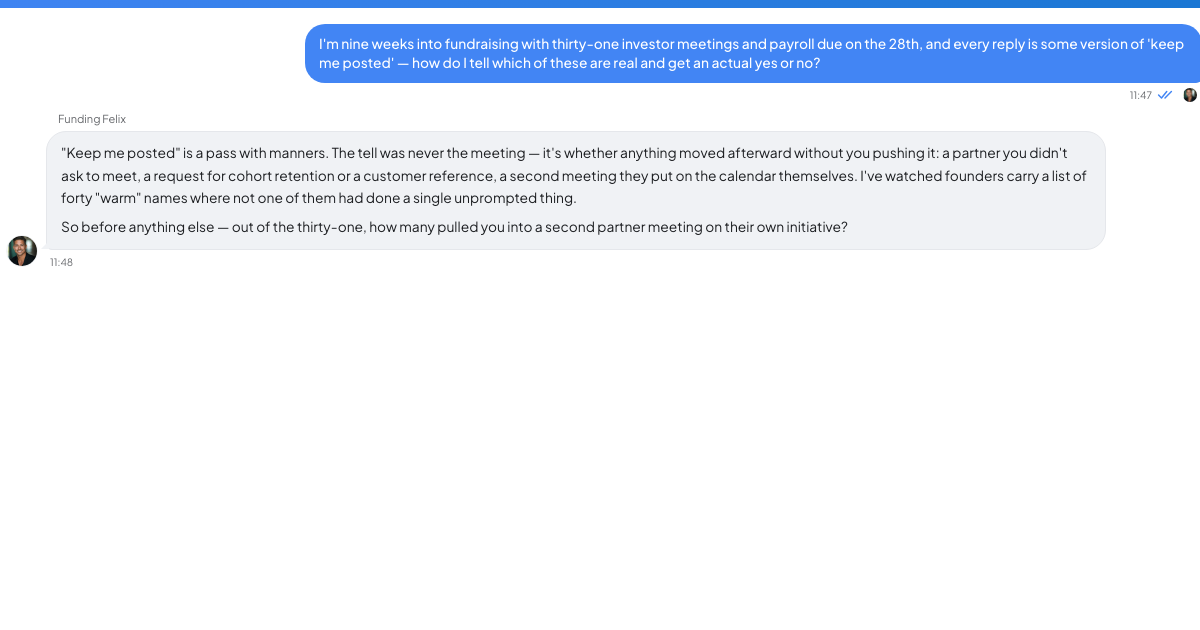
TrueTalk's Funding Felix is an AI persona specializing in venture capital and fundraising strategy. At 1am, it can give you a second read on the wording without an appointment. The free tier includes ten conversations and one hundred messages per day. It cannot introduce you to investors.
If an investor replies, “later stage, but genuinely keep me posted,” believe the timing. Move that person from monthly updates to a quarterly list and stop rewriting a private newsletter for an audience of one.
The wider market makes runway discipline more than rhetoric. Carta reported that among companies raising Series A in Q4 2024, the median interval from seed was 774 days, versus 420 days in Q4 2021—an 84% increase. That is time between priced rounds, not time to close your current raise, but it is a concrete reminder that capital timelines can stretch and that waiting has a balance-sheet cost.
Reallocate the weeks, including the unpleasant option
Removing four dead leads does not shrink a usable pipeline. Those four were not active opportunities. It returns evenings spent maintaining them to new introductions, the only fundraising activity that reliably changes the shape of a raise.
Some fundraising problems are not triage problems. Your company may not be fundable at its current price and traction, and better follow-up cannot manufacture investor conviction. Then the appropriate move is unpleasant and ordinary: cut burn, buy months, and return with numbers that create a different conversation. Carta notes that longer intervals between rounds have coincided with startups cutting costs, laying off staff, or prioritizing profitability to extend runway. That does not dictate your plan, but it makes burn reduction a real financing response rather than an admission of defeat.
Open the tracker and assign every investor one status: yes, no, or genuinely unresolved. Count silence as no. Count a warm adjective as no. Count a scheduled partner meeting as unresolved. If an internal-circulation promise produces a second fund contact within about a week, keep it unresolved; otherwise close it.
The list will become shorter. That is useful because you can work a short, truthful pipeline, while a long list of courtesy phrases only conceals where the round stands.