My Brother Draws the Same Salary and Leaves at Three
Asking to be paid more than your brother is a loyalty question, and you lose those. Asking to price the roles is a business question. How to run that conversation with a founder who won't have it.


You took the driver's call on Boxing Day and nobody in the room thought that was strange
Imagine the driver rings on Boxing Day. You take it at the table, in front of everyone, and nobody thinks it is odd, because you are the number the depot rings when a load goes wrong and you have been for nine years.
Your brother is on the same salary. In at nine-ish, good with customers, gone at three for the school run he's been doing since his eldest started, and the youngest is seven now.
About six years ago your father stated his position—my children are treated the same—and he has never moved from it.
And you cannot say anything, because the sentence you'd have to say out loud is "pay me more than my brother", and the moment that leaves your mouth you are not an operations director any more. You are a son being greedy about his brother.
So it comes out sideways. A comment at Christmas about who was around in August. A silence when someone asks how the business is going. Your wife, who has stopped pretending to be neutral.
Six years of getting nowhere, and it is not because you haven't found the right words. You have been asking a question that has no winning version.
Fairness is the losing frame and you should abandon it
Every time this gets raised as fairness, it becomes a question about the family. Who deserves more. Who works harder. Who your father loves. Which of his children is complaining about the other one at his own table.
He will not adjudicate that, because he cannot. Ruling that one son is worth more than the other is, to a man in his seventies who built the thing so his children would have it, an act of demolition. So he says we'll sort it out, which is not a plan. It is a door closing politely.
And the standard advice — have an open family conversation about fairness, get market-rate compensation, put governance in place, agree a succession plan — describes the destination beautifully and skips the only difficult part. Which is: how does a child raise this with a parent who experiences the question itself as disloyalty?
You do not. You raise a different question that happens to have the same answer.
The ask is not "pay me more than him." The ask is "let's price the roles."
One is a loyalty question, and you lose loyalty questions. The other is a business question, and business questions are the only kind your father has ever been comfortable losing.
Do the work before you open your mouth
And do it about your job, not about his.
Write out what the operations role covers. Not a moan — a job description, the sort you'd hand a recruiter. Everything you own, the hours it takes, what falls over if you are gone for a fortnight. Then find out what that role costs on the open market: the firm's accountant, what comparable roles advertise for, an honest half-hour with a recruiter about the number.
Say it comes back at somewhere between ninety-five and a hundred and ten, and you are both on eighty-two. Now it is a figure with a source behind it, and your brother does not appear in it anywhere.
Then do the same for every role in the business, including your father's and your brother's, priced honestly rather than punitively. The IFC Family Business Governance Handbook recommends clear family-employment policies and describes compensation based on performance and responsibility, with remuneration designed around managers' performance rather than family ties (IFC). If his customer work genuinely prices at eighty, write eighty. The integrity of the exercise is what makes it survive contact with your father.
The conversation
Off-site. Not the office, where three people will interrupt, and absolutely not a meal with your mother or your brother at it. A weekday morning, somewhere neutral, an hour booked in advance so it cannot be ambushed.
Open on the business:
"I want to talk about how the business is set up, not about my money. Give me an hour."
Then the ask, plainly:
"I'd like us to write down what each job here is worth on the open market, and pay the job rather than the person. Whatever that produces, I'll live with. If mine comes out at what I'm on, I'll never raise this again."
That last sentence does most of the work. You have made it falsifiable, you have taken the outcome out of your own hands, and you have offered to drop the subject permanently, which is precisely what he wants.
When he raises your brother, and he will, put it down immediately: "This is not about him. I'd be asking for the same exercise if I were the only one working here."
Then ask for the pricing to be done by somebody who is not family. The accountant, or an external adviser he already trusts. This matters more than it looks. It moves the decision from a father judging between his sons to a professional pricing a set of jobs, and it gives him a way to change the arrangement without it being a verdict on anyone.
One thing to avoid entirely. Do not bring a spreadsheet comparing your hours to your brother's. It is the most tempting document you will ever make and it detonates the meeting — the moment your father sees it, you are the son who's been keeping score, and the number stops being the subject.
If he says no
Most of the time you'll get "we'll sort it out", which is avoidance rather than refusal, so the counter is to shrink the ask down to something he cannot dodge. A date. "Fine — can we look at it after year-end? First week of October?" Then put it in an email that same afternoon, one non-confrontational line, so it exists outside the room where it was said. Then turn up in October, and turn up again in November when October slid. Being the person who keeps showing up on the agreed date is most of the work.
Occasionally you'll get the wound instead — after everything I've built for you two. Do not defend yourself against that sentence and do not apologise for asking. Tell him you are asking because you want to be here in twenty years and you want the business to work when he is not running it. Then leave it and come back in a month, because nothing useful happens in the ten minutes after that sentence.
A flat, considered no is rare. It is also real information, and it is worth more than another six years of maybe.
The thing underneath the salary
There is something under all of this that matters more than the salary, and it should be its own conversation on its own day. Salary is an annual decision. Ownership is permanent. Who holds the shares, what happens to them, whether there is a shareholders' agreement, whether there is a will and what it says about the company.
A founder in his seventies with no documented succession creates a structural risk without anyone behaving badly. PwC's 2025 US Family Business Survey says 44% of US family firms reported succession planning affecting them in the previous year and recommends separating leadership, governance, and ownership roles (PwC). When it happens, the people left are grieving and the structure has to be invented in the worst possible month.
That conversation needs a solicitor and an accountant in the room, and nothing here substitutes for either of them. What you can do first is get your own position clear, so you are not paying their hourly rate to work out what you want.
The number you keep to yourself
Somewhere in this you have to be honest with yourself about leaving.
Do it as arithmetic, and never as a threat — a bluffed resignation in a family firm poisons everything, and you have to live with these people at funerals. What you'd earn elsewhere. What you'd give up. When you do that arithmetic, treat any expectation of inheritance that is not written down as an assumption rather than an asset.
Then set yourself a private date. Two years, say. If the roles haven't been priced and nothing has been documented by then, you go. You do not announce it. The date converts a permanent resentment into a decision with an expiry, and that alone tends to make the next Christmas survivable.
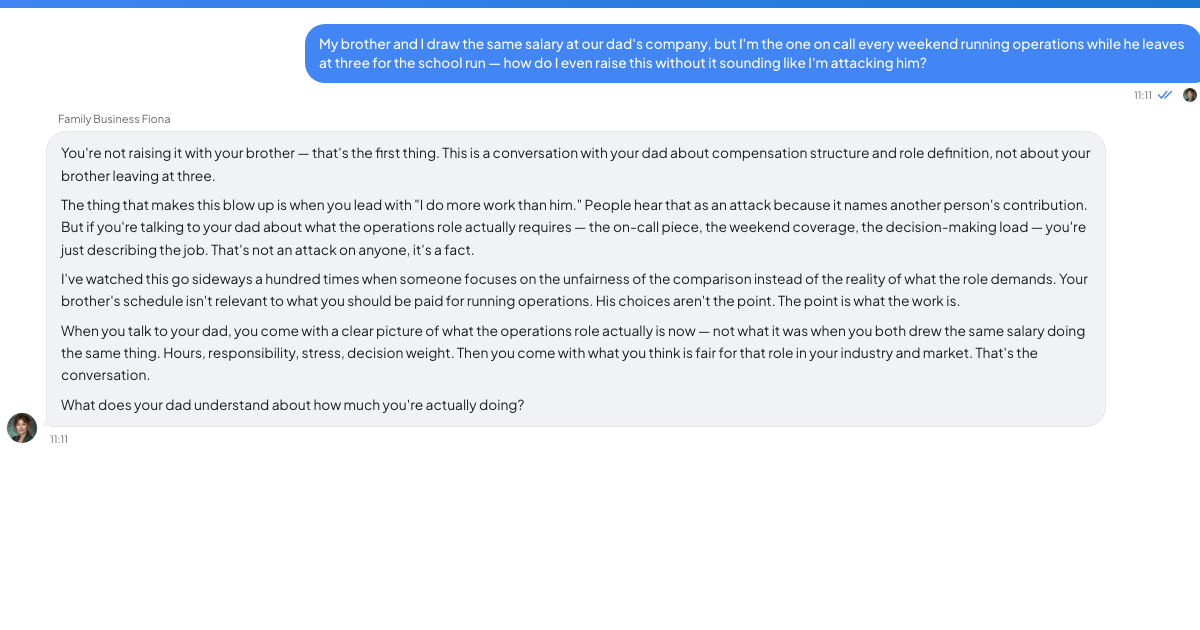
If you want to rehearse the October conversation before you have it for real, Family Business Fiona on TrueTalk is an AI persona whose subject is family enterprise — not a person, and not a lawyer or an accountant. The free tier includes ten conversations and one hundred messages per day. Fiona is awake on a Sunday night when the thing is going round your head.
One last reading of "we'll sort it out", because it changes how you hear it. For some founders that sentence is not about you at all. Succession planning asks a man to describe, in detail, a company that runs without him. Some founders avoid documenting succession because it requires them to imagine the company operating without them, even when that avoidance risks losing a son to a competitor.