She Has the Garage Code and He Says I'm Overreacting
The in-law scripts don't work because the in-law isn't the one ignoring the boundary. The negotiation is with your spouse, and there's one specific thing to ask him for this week.


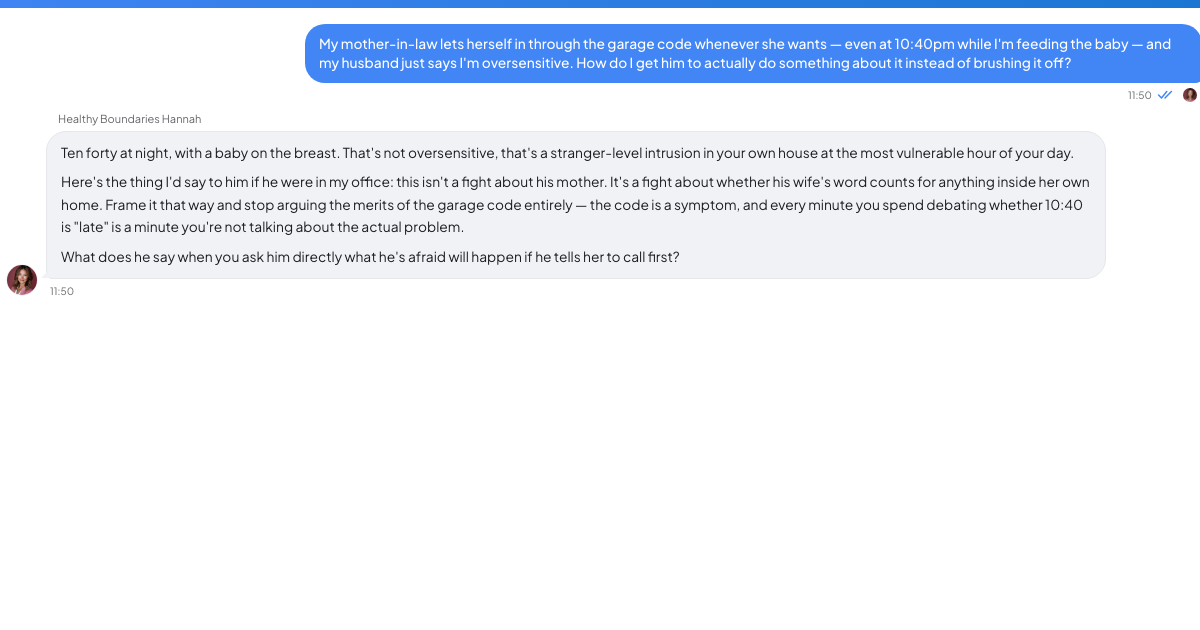
The door goes at 10.40 and you are topless on the sofa
Say the baby went down at 10.05, after ninety minutes. You had managed to get as far as sitting. One side out, cold coffee, the muslin that's been on your shoulder since yesterday.
Then you hear the keypad beep and her voice in the utility room saying it is only me.
By the time your husband gets in at six, you have had four hours of sleep across two nights, and you say it badly, because there is no good way to say it while holding a baby who's started again. And he says the thing. She means well. She's just excited about him. I think you might be a bit oversensitive at the moment.
You stand there realizing that the conversation you are having is not with your mother-in-law.
For weeks, it has been with your husband.
She is not the person ignoring the boundary. She is a woman who was given a code by her son and has never been told, by her son, that the arrangement has changed. From where she stands, she is welcome. Every time you raise it and he softens it, she has been proved right.
Which is why the phrase lists are no use to you. Please call before you come over. We are not doing visitors before noon. Say it warmly but firmly. You could deliver any of them perfectly, and it would change nothing, because the sentence was never the obstacle.
The follow-through advice is worse. A boundary only works when you enforce it, they say. Do not answer the door. Leave the room. Take the consequences seriously.
Who has the capacity to do that, exactly? You are nine weeks postpartum, sleeping in fragments, possibly still sore from a tear or a caesarean scar, and every act of enforcement means a scene in your own house that you will then be managing for four days. That advice assumes a reserve of energy you do not have; it is written by people who are sleeping.
So move the whole thing one seat over.
The only boundary likely to hold here is one your husband delivers to his own mother, in his own words, without you in the room. You can speak for yourself perfectly well; that was never the issue. A request from you is likely to land as a daughter-in-law with an opinion, and the same request from him lands as the family's own rules changing.
What "you're overreacting" actually means
He probably isn't thinking about the front door at all.
One plausible version is that he has been managing his mother's feelings since he was small. He knows exactly what happens when she's hurt — the tears, the fortnight of clipped replies, the phone call to his sister, the being told he's changed. He has spent a lifetime routing around that; it is automatic now, and routing around you instead costs him nothing.
That's the ugly part and it is worth saying out loud. Not that he loves her more. That your distress has never once produced a consequence, and hers has, reliably, for thirty-odd years. He is taking the path with the cheaper toll.
You do not fix that by proving your case harder. More evidence makes you sound like the prosecution, he will defend her, and then you're arguing about whether last Tuesday was really that bad.
One ask, this week, that he can actually complete
Asking him to have your back is a feeling rather than a task. He will agree to it sincerely and nothing will happen.
Pick a time when the baby is asleep and nothing has just happened — the day after, not the night of. Then ask for one specific action with a deadline in it:
"I need you to ring your mum this week, on your own, and tell her the code does not work any more and to text before she comes. Not me. You. And I need you to not soften it into me being tired."
That has a person, a channel, a deadline and a sentence in it. Compare it to what you've probably been asking for, which was for him to understand.
Don't ask him to make her stop being upset, and do not ask him to agree that his mother is a difficult woman. He can't deliver the first and he will defend her on the second.
About the code. It should be changed, and he should be the one who tells her it has been changed. Change it yourself and let her discover it at the keypad and you become the villain of a story that gets told for a decade. The same change, announced by him, is the family adjusting its own arrangements.
And for the fortnight in between — because he will not ring today, and she has a habit and no new instruction — the interim answer is the bolt. Put the chain or the deadbolt on the internal door during the day, and do not answer it while you are feeding. You were asleep. You were in the shower. It settles nothing and it costs you nothing, and it gets you to the day the call actually happens.
You are asking to know before another adult comes into your home. That's an ordinary thing to want.
Give him a version he can survive
He is more likely to do it if it does not feel like betraying her, so hand him the framing.
He can own it rather than relay your complaint: "we have decided to text first for a bit, it is about the sleep, it is not about you." And he can offer something in the same call — a fixed afternoon she has, every week, that nobody cancels. Some of this may be a grandparent with one grandchild and an empty week, where the unannounced visits are what she has instead of a place in the schedule. A real slot turns the ask into a swap rather than a removal.
She does not get a vote on the front door. An offer just makes the ask cheaper for him to deliver.
The line where this stops being about her
If he makes the call and holds the line — imperfectly, with backsliding, with one difficult fortnight — that's an ordinary in-law problem resolving in an ordinary way.
If you ask clearly, at a good moment, for one specific thing, and he will not do it, and what comes back is another round of you being oversensitive, then this is a marriage conversation and it deserves a professional rather than another midnight rerun of the same argument. A couples therapist is the right route for that, particularly if the pattern turns up elsewhere: your read on a situation routinely reclassified as your mood, decisions about your home made in a phone call you were not on.
And separately, because these two overlap and get confused: if what you are carrying is heavier than exhaustion — low most of the day, unable to sleep even when the baby does, numb about him, or thoughts that frighten you — take that to your GP, midwife or health visitor now. The NHS describes postnatal depression as a common condition that usually improves with treatment; its symptom list includes difficulty sleeping even when you have time to rest, and symptoms can begin up to a year after birth. If you ever have thoughts of harming yourself or the baby, seek urgent care today rather than waiting. CDC data indicate that about 1 in 8 women with a recent live birth reported postpartum-depression symptoms; the CDC advises contacting a health care provider as soon as you suspect postpartum depression and lists 988 and the National Maternal Mental Health Hotline, 1-833-TLC-MAMA, for a crisis in the US.
Healthy Boundaries Hannah on TrueTalk covers relationship boundaries. She is an AI persona — not a therapist, not a person — and one thing worth knowing before you go looking for her at three in the morning: access to her sits on the paid tier, so a conversation with her needs a subscription. TrueTalk's free tier includes ten conversations and one hundred messages per day. Access to this advisor still requires the subscription. For the clinical side, and for the couples work if it comes to that, a real professional is the answer.
Then judge the ask on one thing, and only this one: whether he said it. Not on how she took it. If she cries and he holds the line, he did the thing. If she cries and he tells her it is only a phase while the baby is small, you have learned that he still will not hold the boundary.