Six Klarna Payments, Two Afterpay Plans, and Rent Is Due Friday
Avalanche and snowball assume an interest rate. Most pay-in-four plans don't have one. The damage is timing, and the fix starts with a calendar nobody has built for you.


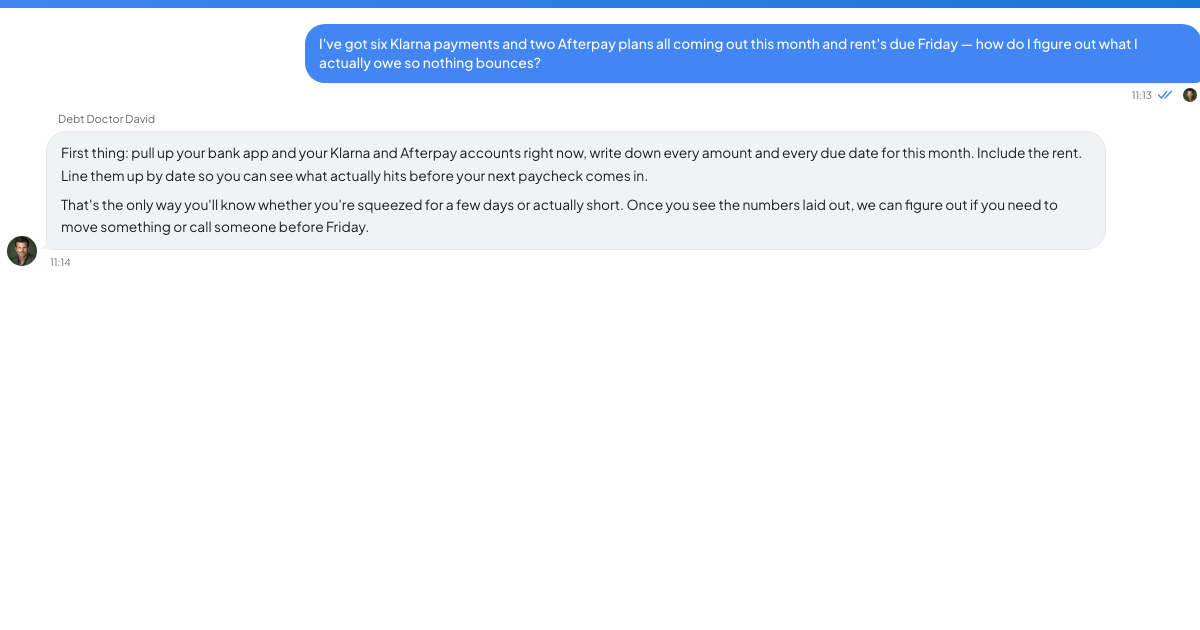
You don't know what you owe, and that isn't carelessness
Something took $18.75 on Tuesday. Something else took $34 on Thursday and you had to look at the descriptor twice to work out which purchase it belonged to. Last month you let the electric bill ride a week to cover a run of these.
Ask yourself the actual number — everything scheduled to leave your account in the next thirty days from these plans — and you cannot produce it. Not roughly. Not to the nearest hundred.
This gap is not a discipline problem. You have taken out eight small loans from four companies, each living in its own app, with no monthly statement combining their total; the borrowing felt like choosing a shipping option. In the CFPB's 2025 BNPL study, 63% of borrowers had multiple simultaneous loans at some point in 2022 and 33% borrowed from multiple BNPL lenders. The agency also notes that lenders do not typically report these loans to nationwide consumer reporting companies, which limits visibility into a borrower's total.
So the first thing to throw out is the standard debt advice, because it is built for a different animal entirely.
Avalanche says rank your debts by interest rate and attack the top one. Snowball says clear the smallest balance first for momentum. Both assume the thing hurting you is a rate compounding in the background. Most pay-in-four plans do not have a rate at all. Run the avalanche on eight zero-percent plans and the ranking returns nothing — every row ties for last place. That framework answers an interest-rate question that you do not have.
What is hurting you is when, not how much. Eight small debits, landing on eight different days chosen by eight different purchase dates, hitting an account with no buffer. Each one is affordable. The sequence is unaffordable. When one bounces, the bank fee can exceed the payment that caused it; that fee leaves the same thin account and puts the next debit at risk. The CFPB's market report found that all five lenders it examined tried failed payments again, in some cases up to eight times for one installment, creating potential bank fees and leaving less money for other obligations.
You have a cash-flow timing failure.
Build the thing that does not exist
No single screen shows all of these obligations together. Not in your banking app, not in any of the providers' apps, not on your credit report — whether these plans appear there at all depends on the provider and the product, and it's been changing. So you have to build it by hand, once, and it takes about forty minutes.
Open a calendar — paper, spreadsheet, phone, doesn't matter — and write down every scheduled debit for the next six weeks: the date, the amount, and which provider.
Get the entries from three places, because no single one is complete. Log into each provider's app and read the upcoming payment schedule. Search your email for order confirmations from providers you've forgotten you used. Then scroll ninety days of bank transactions and flag every small recurring debit you cannot immediately name — that's where the ones you've genuinely lost turn up, often under a descriptor that does not resemble the shop you bought from.
Then add the things that are not optional: rent, utilities, phone, transport to work, insurance, any minimum payment on an actual credit card.
Now you are looking at the real problem, which is a map, not a number.
Say it comes out something like this. Rent is $1,400 on the 1st. You are paid on the 28th and again on the 12th. Between the 29th and the 3rd there are four plan payments totalling $96, all landing before rent clears. Your account balance on the 28th is $1,510.
Nothing on that list is expensive. The month still fails, and it fails on the 2nd.
The fix is to move the four payments, not to pay them off. You almost certainly cannot pay them off — which is why you are here — but a date is a much cheaper thing to change than a balance.
What to actually say to a provider
Call or message the provider before the payment fails. This matters more than anything else in this article. Before it fails, you're a customer asking for a date change; after it fails, you're a delinquency being processed by a different department with different options.
Ask plainly and specifically: This payment is scheduled for the 2nd. I can pay it on the 13th. Can you move the date, or split it? Some providers have a way to push a due date or a hardship route. Some do not, and it varies by country, by product, and by how long you've been a customer. You may not find the applicable option in the help centre, so ask a human.
If a plan is attached to a return you have already made, chase that separately. A refund often has to travel from the merchant back through the provider before the schedule stops, and in the meantime the payments keep coming out. Do not assume sending the parcel back cancelled anything.
Things not to do, and I'll be blunt about each. Do not consolidate these onto a credit card as a cash advance — you would be converting zero-percent debt into the most expensive money available, usually with no grace period. Do not take a payday loan to cover a $34 debit. And be careful about telling your bank to stop the payment on your own: it may be possible, but it does not cancel what you owe, it can push the account straight to collections, and it can cost you a fee. Ask what the consequence is before you pull that lever, not after.
The harder truth underneath all of this: if the map you just built shows that your committed outgoings exceed your income every single month, no amount of resequencing fixes it. Moving dates buys you time to solve an income or expenses problem. That time is not itself the solution. Anyone who tells you a calendar fixes a shortfall is selling something.
And the reason this got away from you is not a character flaw. Splitting a $70 purchase into four payments is a genuinely reasonable thing to do once. The trap is that each decision is evaluated on its own — is $17.50 a fortnight affordable, yes — and never against the other seven, because the other seven are not on the screen when you're deciding. That is a design property of the product, not a failure of your willpower.
If you want to work through your own calendar out loud, TrueTalk has an AI advisor called Debt Strategy David, whose stated focus is debt management, elimination strategies and financial recovery planning — the sequencing question, essentially, and what to say when you call. He is an AI persona, not a licensed financial adviser, available immediately with no appointment. The free tier includes ten conversations and one hundred messages per day. If what you are really facing is collections, court paperwork, or a shortfall that repeats every month, a nonprofit credit counselling agency is the right route — in the US, the National Foundation for Credit Counseling is a place to start looking; its process includes a confidential consultation, a one-to-one budget review, and a personalized financial action plan. Talking it through first is just a way to arrive at that call with your numbers in order.
One small thing, for after the immediate fire is out.
When the calendar is empty again — and eight pay-in-four plans do empty, that's the one mercy of short terms — the useful habit is not swearing off the product forever. It's the rule that you do not open a new plan while another one is running. One at a time. The rule sounds trivial. It keeps a payment option from becoming eight simultaneous loans whose dates you cannot track.