The Adjuster Says Your Roof Is 'Wear and Tear.' You Have Photos of the Hail.
Turn an underpaid hail claim into a documented dispute: secure the written denial and estimates, check your policy, then climb the escalation ladder.


The fourth person named Brandon
Four different people have now heard your account of the hail. Every one asked when the storm happened and whether the roof had been inspected before it; every one promised a return call. You are still waiting.
On the table: an approval for $2,800, three contractor quotes averaging around $19,000, and a line in the adjuster's report describing the rest as wear and tear, or cosmetic, or pre-existing.
Start with this: a persuasive phone call rarely closes a gap from $2,800 to $19,000. You close it by moving the dispute into a documented process that a phone conversation cannot reach.
Treat the exhaustion as part of the claims dynamic, not merely a busy department's side effect. Each engagement costs you an afternoon and costs the carrier nothing, so the process will end when you stop. Build your plan for that imbalance.
Before you climb anything: get three documents
Collect all three before you escalate. Every rung below is weak without them.
The denial in writing, citing policy language. Call once more, and this time ask for the partial denial in writing, with the specific policy provisions and exclusions relied on. Not "it's wear and tear" — the clause, quoted. That request does more work than any argument: you cannot test a vague verbal denial, but you can compare a committed written position with your roof and evidence.
The full estimate, line by line. Ask for the itemised version rather than the summary; most carriers use the same industry estimating software as your contractor. Put the estimates side by side and identify each disagreement: is it the number of squares, the pitch, the underlayment, the ridge and hip, the removal of a second layer, the drip edge, the depreciation applied? Replace "they're low" with a measurable dispute such as "they allowed 22 squares and the roof measures 31."
Your actual policy. Get the complete policy, including the declarations page and every endorsement, rather than relying on the app's summary. The Texas Department of Insurance notes that the declarations page summarizes coverages, dollar limits and deductibles (TDI).
Read for four clauses, not the whole document
Replacement cost versus actual cash value. With replacement-cost coverage, the first check often subtracts depreciation and the deductible; the carrier may release the withheld depreciation after it receives the finished-job bill, subject to your policy's repair deadline (TDI). Part of your gap may therefore be recoverable depreciation, not a denial. Establish that before fighting over money already scheduled for payment.
A cosmetic damage exclusion or a roof schedule endorsement. These provisions exist and are common in hail-prone states. If your declarations page includes one, "cosmetic" may accurately apply a clause you bought. It is bitter information, but you need it before paying a contingency fee.
The appraisal clause. Many homeowners policies include an appraisal clause, so locate yours.
The suit limitation. Your policy will typically impose a deadline for bringing an action, often running from the loss date and frequently shorter than the general limitation period you might assume. Find it and write it on the folder's front. Complete every step below within it.
The ladder, cheapest rung first
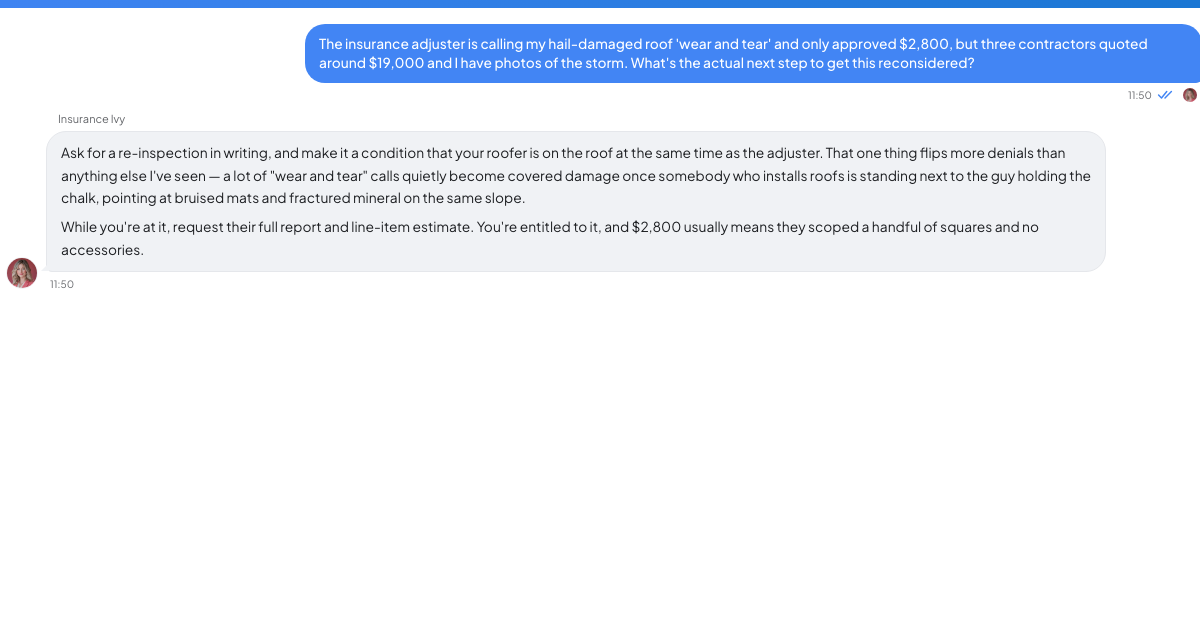
Rung one: re-inspection with your contractor present. Make the request in writing and ask for your roofer to inspect the roof alongside the adjuster. The NAIC specifically says a contractor meeting with you and the adjuster may help resolve disagreements, and advises keeping dates and notes of every conversation (NAIC). A simultaneous contractor-and-adjuster inspection of the same slope resolves in an hour what six calls will not, while creating a factual record rather than duelling reports. Your only cost is scheduling.
Rung two: a sworn proof of loss. Many policies allow the insurer to require a sworn proof of loss, and you can submit one proactively. This formal signed statement identifies the loss and amount claimed. It converts conversation into dated paperwork, which gives state prompt-response rules something concrete to attach to.
Rung three: invoke appraisal. This is contractual leverage most policyholders never use. In appraisal: you appoint an appraiser, the insurer appoints one, the two select an umpire, and agreement between any two of them sets the amount. Keep its central limit clear: appraisal determines the amount of loss, not whether your policy covers it. If they're saying "hail did this but it's worth $2,800," appraisal is aimed straight at that. If they're saying "hail didn't do this at all," you may be in a coverage dispute that appraisal can't reach, and the line between the two is genuinely blurry and litigated. Read your clause, record its cost allocation, and remember that the result binds you as well. For example, TDI says each side hires an appraiser, the appraisers select an umpire, and in Texas you pay your appraiser plus half the umpire's expense (TDI); your own policy and state control.
Rung four: the state insurance commissioner. Every state has an insurance department that accepts consumer complaints, and most states have some form of unfair-claims-settlement law with response deadlines. A complaint is free, usually filed through a web form, and requires the carrier to answer a regulator in writing. The department does not thereby order payment; the complaint makes an idle file costly to ignore.
At this point, after weeks of uncertainty about whether "cosmetic" names an actual exclusion or simply a useful phrase, TrueTalk has an advisor called Insurance Ivy, an AI persona focused on insurance planning, risk assessment and coverage. It is neither a licensed adjuster nor a lawyer; it cannot read your file or decide whether you have a case. You can use it to work through the text on your declarations page and plan the next letter whenever you finally sit down with the paperwork.
Where someone genuinely earns a cut
A public adjuster is licensed to represent you rather than the insurer, and works on a percentage that several states cap by statute. A public adjuster earns that percentage when the loss is large, the scope is contested in detail and you have neither the time nor the appetite to manage appraisal. Public adjusters are poor value on a small claim, since the percentage comes off money you might have recovered with two letters. The NAIC describes public adjusters as fee-charging freelancers rather than attorneys or government employees, and notes that states allowing them require licensing and guidelines (NAIC). Verify the licence with your state department before signing.
An attorney is the answer when the dispute is about coverage rather than amount, when the carrier's conduct looks like more than incompetence, or when your suit limitation is approaching. Only your state's law and the specifics in your file can establish bad faith; an article cannot. Anyone declaring that you have such a claim without reading your policy is selling you something.
Two things not to do
Don't sign a contractor's assignment of benefits without understanding exactly what you're handing over. In some states it transfers your rights under the claim, and you can end up a spectator in your own dispute.
Prevent further deterioration instead of preserving damage to prove your point. The NAIC says you are required to protect the home from additional damage, such as boarding it up or cleaning backed-up water (NAIC). A leak you deliberately let spread can become an argument the carrier gets to make.
Use the dated folder as your operating system: put every document inside, log each call with a name and time, and make every request in writing even when someone says writing is unnecessary. Maintaining that routine through month four matters because the people who get the disputed number moved are almost never the best arguers; they are the people still present in month four with the paperwork in order.