The Invoice Is 90 Days Late and You're Still Scared to Sound Annoying
Price the cost of a 90-day unpaid invoice, then use a clear four-rung escalation ladder—from direct confirmation through finance, consequences, and recovery.


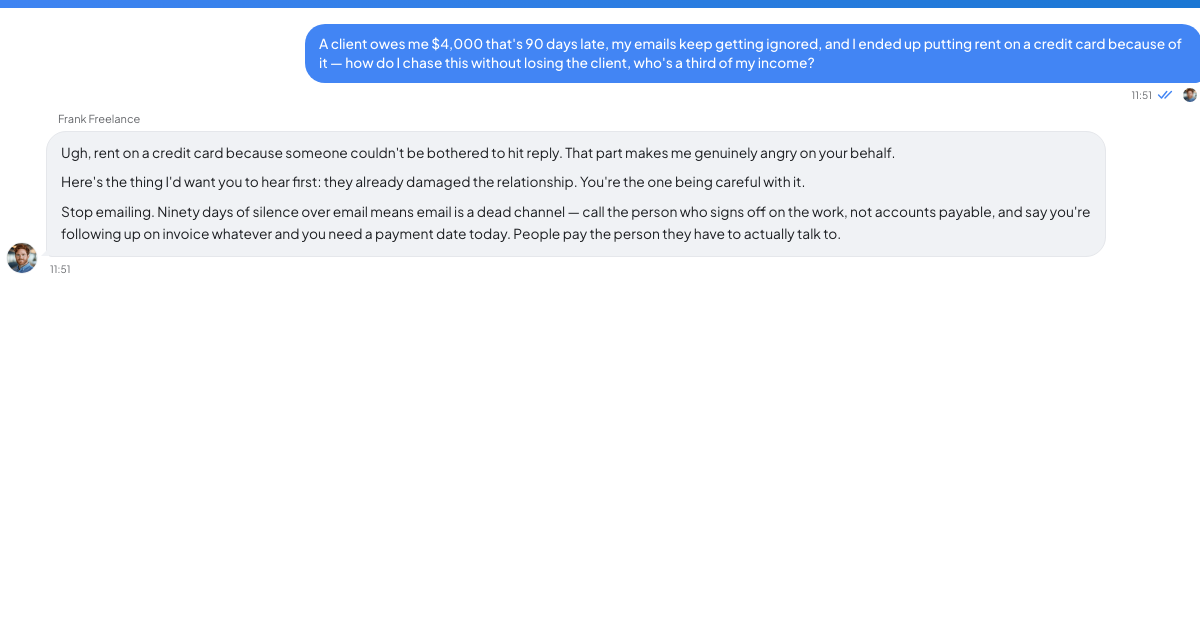
You put rent on a credit card to protect someone's feelings
The invoice is ninety days late. You sent two emails, each beginning with some version of just circling back, and neither received a reply.
That invoice was supposed to cover rent. You paid rent with a card instead, which means you now owe interest on income you already earned.
Use $4,000 as the invoice and about a third of annual revenue as the client's share. You fear that a firm request for the $4,000 could endanger that third, so you soften every request. You have made a trade without pricing it.
The arithmetic nobody does
Price the trade against the $4,000.
At a card rate of, say, nineteen per cent, carrying it for three months costs somewhere near two hundred dollars. You are paying a bank roughly two hundred dollars because completed work remains unpaid.
Include the evenings spent rewriting drafts to sound progressively less annoyed, plus every 3am hour lost to rehearsing the issue. Value those hours at your rate; that is their real cost.
Now include the off-statement loss: weeks when cash anxiety stopped you pursuing new work.
Compare that total first with what this client billed you last year, then with the missing client whose slot this account occupies.
The number can still justify the account. Large organisations may pay slowly because of long approval chains and finance systems, and they will still be there in five years; that delay is real without being malicious. A payer that is both slow and unreachable presents a different risk.
The obstacle was never wording
You do not lack a template: all four drafts you wrote this week were adequate. Your contract probably contains the late-fee clause you have left unenforced for two years. Keep small claims near the ladder's end because legal action usually ends the commercial relationship, even when you would win.
The operative problem is your belief that firmness ends relationships.
Usually, it does not. A clear payment request rarely causes the rupture; four months of increasingly awkward apologies followed by an explosion in month five does.
Your contact may well not be the problem
Your unresponsive contact may well be a project manager unable to release funds, who forgot to enter the invoice in March and has felt embarrassed by every reminder since.
That scenario is avoidance of an administrative task that exposes disorganisation, not theft.
Write each message below from that assumption. It helps preserve the relationship even when your generous reading proves wrong.
Before climbing, check for missed deliverables or an unresolved quality complaint in someone's inbox. The ladder will backfire if either exists. Resolve that dispute on its merits first; chasing over an unspoken quality problem is how a late invoice becomes a write-off.
The ladder, with the fear priced in
Rung one: the boring message, with no apology in it.
Read the signed terms before sending. Large organisations commonly use sixty-day terms, and you may have accepted them without noticing. If the agreed payment cycle has not expired, the debt is not yet due regardless of your cash pressure; claiming otherwise signals that you did not read the contract.
Once the date has passed, keep the message short. Remove just, sorry to chase and any account of your cash flow. State invoice number, issue date, amount and due date, then ask one question: can you confirm this has been submitted for payment, and if not, what do you need from me to get it in?
Stop after that question. It offers your contact a dignified admission that the invoice was never filed. Send it only to them; the relationship cost is nothing.
Rung two: go sideways to finance. Within a week.
Move sideways instead of upward. Ask your existing contact for the accounts-payable address, or find it on the organisation's site, then send the invoice and any PO number while requesting a payment date. Copy your contact to keep the route transparent.
Freelancers often skip this rung because it feels escalatory. It is routine: finance departments exist to process invoices and are not offended by receiving one.
Rung three: name a consequence, once, with a date on it.
Use this rung two weeks later if nothing moves, without adding theatre.
Write: this invoice is now a hundred days overdue, so I'm going to pause work on the current project from the 14th until it's cleared. Let me know if that's a problem, and who I should be speaking to.
The operational pause supplies the pressure, not your voice. Even written warmly, this works because it is your first message attaching a consequence.
Check the contract first. A right to suspend for non-payment depends on what you signed; it is not automatic, and an unauthorized stoppage can put you in breach instead. Without a suspension clause, take a painful sum to a lawyer in your jurisdiction rather than deciding from an article.
Carry out any announced pause. Failing to do so teaches the client that your deadlines are decorative, reinforcing what they already believe about your payment terms.
Rung four: the person who hired you, or your contact's boss.
Keep it factual and brief, without criticizing your contact. Say that you are trying to clear an old invoice and need help locating the correct route.
At this rung, recovery takes priority over protecting the relationship. It often survives because senior staff are generally more annoyed by their internal accounts-payable failure than by your request.
Then, and only then, use the legal route. Options include a formal demand, statutory interest where your country provides it, small claims and a collections agency. As one jurisdiction-specific example, UK government guidance says that without an agreed payment date, a business payment becomes late 30 days after the customer receives the invoice or after delivery, whichever is later (GOV.UK). The UK's Small Business Commissioner also says qualifying late commercial debts may attract statutory interest and a fixed compensation fee, but not where the invoice is legitimately disputed (OSBC). Rules vary enormously by country and contract, so verify yours; if the amount is painful, ask a local lawyer rather than a blog post.
The thing you're actually frightened of
Assume your fear is accurate and an unapologetic message about a ninety-day invoice costs you the client.
That means the client would drop you for requesting earned payment. The relationship was going to end anyway, on their schedule and probably with money outstanding.
Concentration is the underlying risk; late payment is its visible form. When one client supplies a third of your income, that client determines your terms, your tone and apparently your rent financing. Reducing concentration takes months, so begin this week rather than after another crisis. Reserve one afternoon every week for new business until no client controls more than you can afford to lose. Choose your threshold; mine would be a fifth.
One last thing about tone
Delete one sentence from every chase email:
Sorry to be a pain.
You completed accepted work at an agreed price, and its due date passed. The apology frames payment as an imposition, which a busy reader can reasonably interpret as permission to delay again.
Write the message plainly and set the next date, following the approach a plumber would have taken before stopping work in week two.
TrueTalk publishes this blog. TrueTalk is an app — on the web, the App Store and Google Play — with 164 AI advisors. Each written persona has a profession, defined expertise, a backstory and a distinctive voice. These advisors are not people, therapists, doctors, lawyers or financial advisers. Take anything clinical, legal or safety-critical to a real professional. An advisor gives you somewhere to think aloud first, whenever the problem appears. This piece is bound to Frank Freelance, a freelance business consultant persona whose areas are freelance business, client management and work-life balance. The free tier includes ten conversations and one hundred messages per day. truetalk.app