The Kids Left in September and Now We're Two Strangers in a Kitchen
Five months after your youngest leaves, separate two fused experiences: role grief and a verdict on the marriage. One of them is temporary. Test the thought privately, then open it carefully.


Dinner ends at four minutes to eight
You put dinner on the table at quarter to eight. At four minutes to eight, conversation ends while food remains. Conversation covers the car's MOT. You note again that the downstairs radiator is cold at the top. Thursday brings your mother's hospital appointment and the unresolved question of who will drive. After loading the dishwasher, one of you discovers a respectable reason to leave the room.
Neither of you committed an obvious wrong. That absence of a culprit makes the fear difficult to voice.
September was when your youngest moved out. Since then, the house has felt hard to describe: less sad than uninhabited, as though you both rent it while awaiting another arrangement. The quiet produced a thought you have told nobody: I'm not sure there's anything here.
The marriage has lasted twenty-odd years. Even forming the thought makes you feel grotesque.
Search results answer later questions
Search results fall into roughly two groups.
Law-firm pages make up the first. A page headed "grey divorce" usually assumes a decision and moves quickly to pensions and the family home. They may become useful later. Your undecided question comes before that material.
Lifestyle advice supplies the second group: book a date, share a hobby, rediscover each other. Those recommendations are not foolish. It's just an answer to a much smaller problem — a couple who still have a shared subject and have fallen out of the habit of talking about it. Your shared subject has physically left the house. The shared subject packed a duvet into a Corsa and left.
Neither genre touches the thing you actually want to know, which is whether there was a marriage underneath the parenting, or whether the parenting was the marriage.
Separate role grief from a marriage verdict
During the first year, role grief and the marriage question are almost impossible to distinguish.
First ask who you are when nobody needs you at seven each morning. That's grief for a role you held for twenty-odd years and were, by most accounts, quite good at. That role grief may ease over time. No one can promise its speed or a universal course. In an 18-year longitudinal study of women in middle age, marital satisfaction increased with the empty-nest transition through greater enjoyment of time with partners rather than an increase in the quantity of time together (Gorchoff, John and Helson, 2008); that group finding cannot predict the direction of your own marriage.
The second question asks whether you want this marriage. A marriage verdict deserves a clearer state of mind. A study of 172 heterosexual couples in the empty-nest phase found that perceived stress mediated links between the husband's view of the children as successful adults and both spouses' marital quality (Bouchard, 2018). It is one sample and not a diagnostic tool; it supports separating current stress from a final verdict.
Role grief convincingly impersonates a verdict about your husband. It shows up dressed as disappointment in your husband, because he's the only other person in the house and grief has to point somewhere.
Place the departure in September's third week and the present at February's end. Only five months have passed. Those months contained one weekend visit, one bin bag of washing and several completely empty Sundays. Asking for a marriage verdict that week mixes a legitimate question with fresh role grief.
You still need to ask eventually. For now, treat the first answer as provisional.
Think privately before making the sentence shared
Standard advice begins with talking to your partner. That is usually appropriate. This particular sentence should not be your opening move.
"I don't know if I want to be married any more" cannot be unsaid. Say it in a kitchen in February and it becomes a fixed object in your house. It gets referenced. It comes up in an argument in August, and again at Christmas, and it will be the frame through which he interprets every quiet evening for the next five years — even if by April you'd have concluded, privately, that you were mourning your daughter's bedroom.
And there is genuinely nobody else to try it on. The adult children absolutely cannot hold this; tell one of them and you've handed a nineteen-year-old a job they'll be doing for a decade. Mutual friends don't keep it either — not out of malice, they just redistribute it, and then it's in the group.
Test the thought privately for a limited period. Use two exercises during that time.
Sort what you're missing. Whenever the ache appears, name its attachment: the child specifically, the noise, the routine, the version of you who was needed and functional, or your husband. Do that honestly for a few weeks and you'll have a rough tally. If hardly any of the entries turn out to be about him, that tells you one thing. If most of them are, that tells you another — and either way it's better information than a February mood.
The Tuesday test, not the holiday test. Anyone can picture a nice week in Portugal with the right person. Picture an ordinary Tuesday five years from now. Wet, nothing on, no children in it. Now picture that Tuesday with him in the house, and then picture it without him. Don't ask which one sounds better. Ask which one you flinch at.
Do not mistake either exercise for a verdict. They're for getting your own sentences straight before you use them on someone.
Open through the shared house
When you do open it — and you should, eventually, because the alternative is another nine-minute dinner in a decade — don't announce a conversation. "We need to talk" puts a man in a defensive crouch before you've said anything at all, and then you're managing his fear instead of describing yours.
Say it sideways about the house while you are driving, walking or drying dishes together, rather than making him the announced subject.
Something in the region of: "It's so quiet now. I don't think I know what we're for any more."
That's a problem you're both standing inside. It's not an accusation, it doesn't require him to produce a verdict on the spot, and it gives him somewhere to go.
His first answer may simply be, "I know."
There's also a chance he says "I'm fine — are you alright?" and moves on to the radiator. Don't read that as the final answer. Some people genuinely do feel it less; some people can't find the sentence in the moment and find it three weeks later. Raise it again, quietly, a few weeks apart, in a different room. Treat the first exchange as an opening rather than a complete measurement.
Conditions that need professional help
If there's contempt in the house — the eye-roll, the tone, the sense that you irritate each other's existence — that's a different problem and a bigger one, and it wants a couples therapist rather than a better Tuesday. Same if there's been an affair nobody ever properly dealt with, or if one of you is drinking through the evenings.
If your partner frightens you, none of the preceding advice applies. Contact a domestic abuse service instead of attempting a conversation over the washing-up.
And if the flatness has been there for months, sits on you in the morning, and has taken your sleep and your appetite with it, that's worth a GP appointment before it's worth a marriage decision. Depression is very good at making you identify your husband as the problem, so ask the GP to assess that sustained flatness before you use it as evidence about the marriage.
Rehearse without making it household history
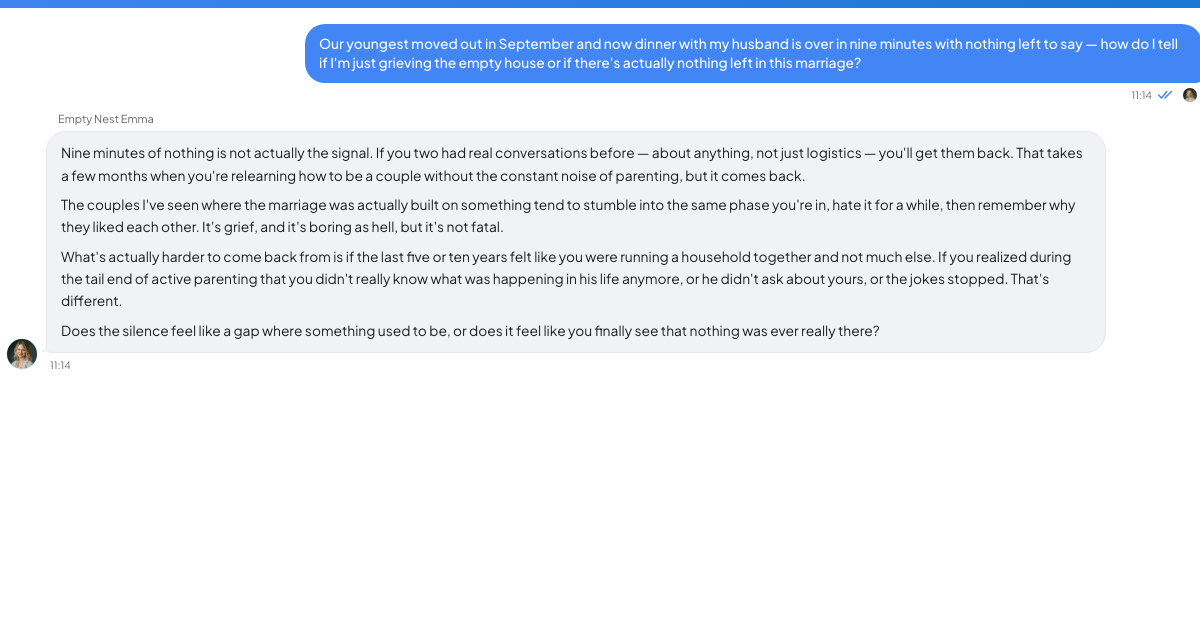
Somewhere in here you may want to hear yourself say the worst version of the sentence, just to find out how it sounds, without it landing on anybody. TrueTalk has an AI advisor called Empty Nest Emma, who is built around exactly this — the empty nest year, life transitions, and what happens to a relationship on the other side of them. She isn't a person and isn't a therapist. It's an AI persona, available at eleven at night when the house is quiet. The free tier includes ten conversations and one hundred messages per day. For the situations in the paragraphs above, a real professional comes first; this is for the ordinary, unbearable, undramatic version.
You may end up leaving. People do, and some of them were right to, and their friends were surprised.
The first year after the last child leaves puts grief and boredom beside limited evidence: nine minutes of admin over pasta. That dinner does not establish that the marriage has nothing left. It shows that after twenty-odd years of talking about other people, you have not yet tested what else you can talk about together.
Wait through another season before reaching a verdict. Put a June date in your calendar to review the missing-person tally and the two ordinary-Tuesday pictures, then decide what conversation or professional help comes next.