The School Said His Grades Are Fine. That's Exactly Why He's Drowning.
Good grades do not show the hours, distress and adult scaffolding behind them. Request written notice, document the hidden cost and choose one concrete ask.


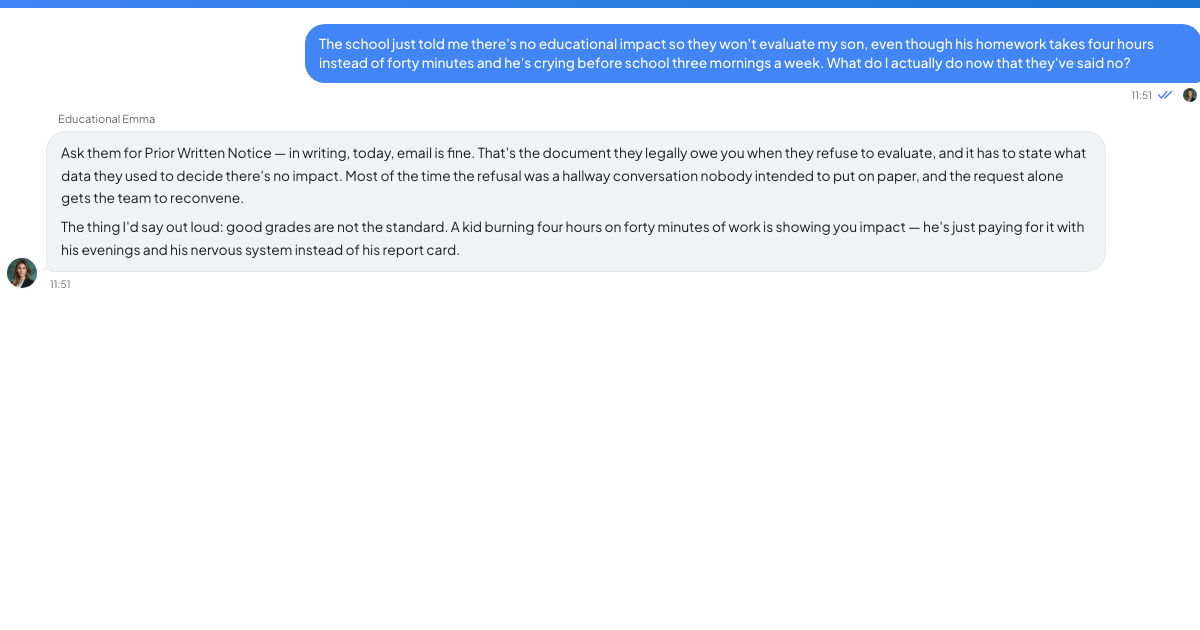
The meeting ends eleven minutes early
You keep hearing the same sentence: "There's no educational impact." Somebody said it kindly, in a small room with a table too big for it, and everyone nodded, and the meeting ended eleven minutes early.
His work sits at grade level. Most marks are Bs. The team turns those marks into a conclusion that no impact or evaluation exists.
At home, you see the cost behind each B. Say the homework is forty minutes of work and it takes four hours, three of which are spent on the floor next to the desk. Say he's cried before school three of the last five mornings. Say he's started saying he's stupid, which he isn't, and which is the thing you can't get out of your head at midnight.
The current arrangement is not fine. He is compensating with a resource that now appears to be running out.
You left without paperwork or clarity about legality, while fearing that further advocacy would mark you as the difficult parent whose emails circulate through the school your child must attend for two more years.
The procedural details below concern the US frameworks IDEA and Section 504. If you're in England you're looking at EHC needs assessments and an entirely different rulebook, and most of the specifics below won't map.
Request the refusal in writing this week
Ask for the refusal on paper.
Under IDEA, when a district refuses a requested evaluation, parents are entitled to prior written notice. The federal regulation requires a description of the refused action, an explanation of why, and each evaluation procedure, assessment, record or report used as the basis (IDEA regulation 34 CFR 300.503). That's not a favour and it isn't a hostile act to ask for it. It's a routine procedural obligation.
Send a two-sentence email today. Keep it out of legal-letter register. Something like: "Following our meeting on the 14th, I'm requesting prior written notice of the district's decision not to evaluate, along with the data the team relied on. Thank you."
Written notice changes what happens next. A spoken "he doesn't qualify" requires no durable explanation. Written notice requires someone to state a reviewable reason and the information behind it. A reason that sounded adequate in the room may look different when recorded.
If the district lacks a dated written request, create that record as well. The procedural clock depends on documented consent rather than hallway conversation. IDEA requires completion within 60 days of parental consent unless the state establishes its own timeframe; federal Education Department guidance also identifies limited transfer and parent-nonproduction exceptions (US Department of Education). None of that clock exists before the relevant consent is documented.
Bring evidence beyond the grades
The argument you were given rests on treating "performing at grade level" as the whole of educational performance. That's the part worth pushing on, and you can push on it without a single citation.
Bring four other kinds of evidence:
Time on task. Forty minutes of assigned work, four hours to complete. That rate, rather than the resulting grade, is your clearest number. Log it for two weeks — date, subject, assigned time, actual time, what happened. A two-week dated log gives the team evidence it probably has not collected.
Work samples that show the seams. The first paragraph written independently versus the same assignment with you sitting beside him. Classwork done under time pressure versus homework done with unlimited time. What you're evidencing is the gap between what he can produce and what he can produce alone, at speed, in a room with thirty other children.
School refusal. Three mornings out of five, with dates. That's attendance-adjacent and schools take it seriously in a way they don't always take reported anxiety.
What it takes to get the B. This is the central access argument. If a child is only at grade level because of hours of adult scaffolding at home, then "he's at grade level" is a description of your household's effort, not of his access to the curriculum.
There's a second route worth knowing about, because it's a different threshold and often a different person in the district: Section 504. That framework asks whether an impairment substantially limits a major life activity. The amended ADA expressly names learning, reading, concentrating and thinking and directs that mitigating measures—including learned behavioural or adaptive neurological modifications—not be counted when determining limitation (ADA.gov statutory text). A kid who holds it together at school and collapses at home is the textbook shape of that argument. A 504 plan is generally a lighter instrument than an IEP.
And if you want one authoritative thing to read, it has a specific name and you should search for the name exactly: OSEP Memorandum 15-08, dated 17 April 2015, 'Letter to Delisle: Children with disabilities with high cognition.' It's from the Office of Special Education Programs at the US Department of Education, it re-affirms OSEP's 2013 Letter to Delisle, and it reminds districts of the obligation to evaluate regardless of a child's cognitive skills. Read the document itself rather than a summary of it — mine included, and the school's especially.
Write a request the team can act on
Template letters that quote three regulations in the first paragraph do get results occasionally. They also get you filed, permanently, under a particular kind of parent, and that costs you every informal thing you'd otherwise have got — the teacher who lets him finish in the hall, the aide who checks his planner.
Use no more than one citation. Keep the request to one action. Sound like a parent who is confident this will be sorted out reasonably, because that framing is much harder to refuse than an accusation.
Something along these lines — the names below are made up, put yours in:
Dear Ms Alvarez,
Thank you for meeting with me on the 14th. I understand the team's view that Mateo is performing at grade level.
I'm writing to ask the team to reconsider, based on evidence that isn't captured by grades. Over the past two weeks I've logged his homework: assignments the teacher estimates at 40 minutes are consistently taking him three to four hours with adult support. He has been unable to get out of the car on three of the last five mornings. I've attached the log and two writing samples — one he completed alone, one with me sitting next to him.
My concern is that his grades reflect the amount of support he's getting at home rather than his independent access to the work, and that this isn't sustainable for him.
I'm requesting an evaluation in all areas of suspected disability, and I'd welcome the team's view on whether a Section 504 plan would be the more appropriate starting point.
I'd rather work this out with you than around you. Could we meet again before the end of the month?
That last line is doing real work. So is offering the 504 as an alternative — you've given them a way to say yes to something.
Choose the request you most need
You may not obtain every change this year; pursuing all of them can obscure the priority.
Choose the primary ask. Is the ask the evaluation itself? Extended time? A reduced homework load with a written cap — thirty minutes and whatever's done is done? A specific reading intervention?
Concede lower priorities visibly and early: the label, the placement, your justified but unhelpful feelings about the meeting, and the smaller accommodation that gives the larger request room to land.
Remember that the staff member opposite serves forty other children within a budget. Frame the priority so the district can grant that one item.
If you want somewhere to draft that email before you send it, TrueTalk has an AI advisor called Educational Emma, written as an educational consultant and learning specialist covering school advocacy and learning disabilities. She's an AI persona rather than a person, she isn't your district's compliance officer and she isn't an attorney — but she's available at eleven at night when the meeting is on Thursday and you've rewritten the first line nine times. The free tier includes ten conversations and one hundred messages per day.
And where it doesn't work: if you get the prior written notice and it's boilerplate, if they miss the timeline, if a second meeting produces another verbal no — that's genuinely the point to bring in a special education advocate or an attorney, and to look up your state's complaint and due process procedures. Know the clocks before you need them: a State complaint has to allege a violation that happened within the past year, and a due process complaint has a two-year window running from when you knew or should have known, unless your state has set its own explicit limit. Check your state's procedures for the detail. Nothing here is legal advice about your child; it's the shape of the ground.
The thing that gets lost in all the procedure is the kid on the floor next to the desk at 9pm, who has worked out that everyone else finds this easier and has drawn the obvious conclusion about himself.
That conclusion is what you're actually trying to interrupt. The paperwork gives you a procedural route for interrupting that conclusion.