They Offered You the Job. You're the Only Earner. Do You Dare Ask for More?
You need the job and the offer is low. The real question isn't which negotiation script to use, it's what actually causes an offer to be pulled and what almost never does.


Four minutes
The call comes at 4:12 on a Thursday. The recruiter is warm, says the team loved you, and then says the number. You hear yourself answer before she's finished the sentence — that's great, yes, absolutely, thank you — and then you are off the phone, staring at the wall, already knowing.
Say the offer is 62,000 and you would worked out, on the back of a bank statement, that you need about 67 to run the house without eating what's left of the savings. Eleven days until the start date. One income in the household and it is yours.
Four minutes to accept. Three years to live in it.
The question you are actually asking
Not "what's the best counter-offer script." You have read those. The question keeping you up is smaller and sharper: if I ask, can they take this away from me?
That's a risk question, not a tactics question, and almost nothing written about negotiation answers it — because the honest answer depends on details of your specific offer that no article can see. What follows is the general shape. Your situation may sit at the bad end of it, and you are the only one who can tell.
What actually gets an offer pulled
Offers do get withdrawn. The causes tend to be these:
A background or reference check that comes back wrong. Something on your CV that turns out not to be accurate. A hiring freeze or a headcount decision made two levels above the person you have been talking to, which has nothing to do with you and would have happened anyway. And, further down but real: a candidate who becomes expensive to deal with — going quiet for a week, adding new demands after each concession, issuing ultimatums, accepting and then reopening.
What rarely does it on its own is one polite, specific, single ask about money, made once, by someone who has already said they want the job.
Rarely is not never. It gets more likely if the company is small and the budget is genuinely fixed, if you were the second choice and they know the runner-up would say yes tomorrow, or if the manager has already fought internally to get you the number you are looking at. If any of that is true — and sometimes you can tell from how the process went — weigh it heavily.
One thing worth being precise about: in the United States most employment is at-will, and an offer can generally be withdrawn before you start. That general rule has exceptions: the EEOC's applicant guidance notes that federal equal-employment law applies to covered employers, other federal and state laws may add rights, and discrimination charges carry strict filing deadlines—generally 180 days, extended to 300 days where a state or local agency enforces a parallel law. If you have already resigned a job, moved house, or signed a lease on the strength of this offer, that changes the picture and is worth a lawyer's view. Same if you are on a work visa, under a contract with defined terms, or outside the US, where the rules are different and sometimes better. Either way it is a question for someone who knows your jurisdiction, not for a blog post.
Why the standard advice makes things worse for you
Always counter. Never say the first number. Have a competing offer.
All of that was written for someone with a fallback. You do not have one. And a script that assumes leverage, performed by somebody who has none, at speed, with a shaking voice, does not read as confident. It reads as a bluff, and hiring managers hear bluffs constantly.
The version that works when you are frightened is smaller than the standard advice, not bigger.
One ask, not a negotiation
Four moves, in this order.
Accept the job out loud first. Before anything else: you want this, you are excited, you intend to say yes. This is the piece people skip and it is the piece that removes most of the risk, because it tells the other side you are not a flight risk they need to reconsider.
Make exactly one ask, with a number. Not a range. Not "is there any flexibility." A figure, and a reason that points at the role or the market rather than at your rent. "Based on what the role covers and what I've seen for this scope, I was hoping we could get to 67."
Attach the release. Say plainly that if it cannot move, you are still in. "If 62 is where the band sits, that's genuinely fine and I'm still saying yes."
Then say nothing for two seconds.
The third move is the one negotiation guides tell you never to make, because it hands away your leverage.
You do not have leverage.
What you would be doing is manufacturing the appearance of it by leaving the offer in doubt — and you would be buying that appearance with the actual risk of an offer you need in eleven days. That is a bad trade, so take the release, ask cleanly, and accept the answer.
Things not to add: your financial situation, a competing offer that does not exist, three requests at once, or an apology.
The asks that cost them almost nothing
If the salary genuinely cannot move — and sometimes it genuinely cannot, because a band is a band — there is a second list, and it is where most of the value hides:
- A one-off sign-on payment. In a lot of companies this comes out of a different pot than base salary, so a no on base is not necessarily a no here.
- A formal salary review at six months, with the criterion written down. This is the most undervalued ask on the list and the one people forget to get in writing.
- Start date. Two extra weeks often costs them very little and can be worth a lot to you — not always, though, if there is uncovered work or a date they have already promised someone else.
- Extra leave, remote days, a training or certification budget.
- Title. Careful with this one — a title can pull a role into a different band and make it more expensive, so it is not always the cheap ask people assume.
Whatever you get, put it in the offer letter or an email from someone authorized to approve it. The U.S. Department of Labor's 2026 salary-negotiation guide models a written acceptance that records the start date, annual salary, when insurance begins, probation period, salary-review timing, and leave accrual—useful reminders that the base number is only one part of an offer. A verbal promise about a six-month review, made by a manager who's gone in four months, is not a thing you have.
Delivery does more work than wording
The words are the smaller part of it because most counters fail in the delivery: they come out too fast, or your voice rises at the end until a statement becomes a question. Worst of all, silence arrives and you fill it — you start softening, explaining, backing off the number before anyone has responded to it.
Holding the silence is the central skill. Say the ask. Let it sit. Two seconds feels like a minute, and it is the two seconds that make it land as a real request rather than a hopeful one.
You won't get that from reading it. Record it on your phone and play it back. The question mark you didn't know you were putting on the end of the number is audible, and once you have heard it you can take it off.
Choosing the one ask before you dial
The harder part is not the delivery. It is picking. One number, or one item off that second list, decided before the call — out of a set where you cannot see from the outside which one they are actually able to say yes to.
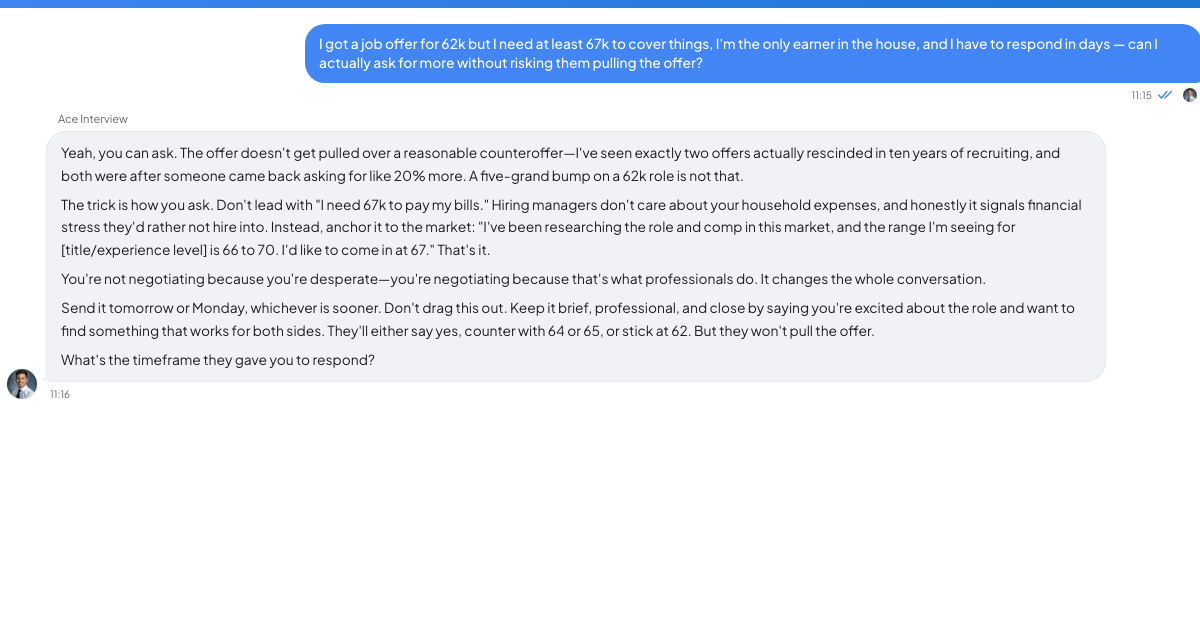
Ace Interview is one of the 164 advisors on TrueTalk, a career transition specialist covering interview preparation, which is what an offer call is the tail end of. It is an AI advisor rather than a recruiter, on the web and in the app at whatever hour you are actually awake and worrying. The free tier includes ten conversations and one hundred messages per day. The use is to have something to argue the choice out with: give it the 62, the eleven days, the single income, and make it push back on base versus sign-on, the six-month review versus the start date, and what you say if the answer comes back as a flat no. It cannot tell you what this particular employer will do. Nothing can. It can stop you walking into the call with four asks and no order.
When taking the 62 is the right call
There are situations where accepting immediately is correct and everything above is noise. These include a visa clock, a gap you need to close before it becomes harder to explain, or health cover tied to a start date. Or an offer that's actually fine and the anxiety is doing the talking.
What makes a fast acceptance a bad decision is not the speed. It is not knowing, at the time, that you were making one. Take the 62 with your eyes open — because eleven days is eleven days and the risk is not worth it this month — and that's a decision, it is defensible, and you can put the six-month review conversation in your calendar on the way out.