Three Pages a Night for Two Weeks and You're Starting to Hate a Job You Used to Love
Measure two on-call shifts before deciding whether the failure is noisy monitoring, real instability, understaffing, or missing handover—and make one specific ask.


3:12am, and it's the disk alert again
Before your eyes focus, you know the alert: the same host and threshold, followed by the clear-out-some-logs non-fix you have performed eleven times. You acknowledge it and watch the graph fall. At 3:40 your pulse remains high; around four, you dim your phone fully and open a job board without waking your partner.
This is the third night this week and day eight of a fourteen-day shift.
A one-in-three rotation occupies a third of your year.
Every post you've found was addressed to someone else
Searching on-call produces familiar, well-meant guidance on alert hygiene, runbooks, error budgets, follow-the-sun coverage and blameless post-mortems. Most is correct, but it addresses whoever owns the rotation.
You do not own it. Three people cover a system that would comfortably require five because of a headcount decision made without you. A checklist of your employer's omissions merely describes what keeps waking you.
At 4am, your question is narrower and rarely addressed: Is the rotation genuinely abnormal, or are you simply exhausted? If it is abnormal, can you change it from your seat, or is resignation your only lever?
Answer in that order because the second depends on the first.
Two weeks of counting beats six months of resenting
You currently have a feeling, which will not survive a manager focused on his own quarter. Numbers will, and collecting them is familiar engineering work.
During the next two shifts, record five fields for every page: firing time, whether it woke you, your action, whether the warned condition existed, and whether the response genuinely required a person rather than a script.
Calculate four measures from the log.
Pages per shift, split into business hours and out-of-hours. Keep those periods separate because averaging them hides the problem.
Wake-ups per week. Count wake-ups, not merely pages. A 10:40pm page while awake differs from a 3:12am wake-up; only the latter is taking your health.
Actionability. Of the pages that woke you, how many needed a decision only a person could make? When fewer than half require a human, the immediate fault lies in monitoring rather than the concept of on-call.
Concentration. Sort by alert name and by service. Concentration on one alert or another owner's service is the log's most useful finding.
Concentration changes the management conversation: "on-call is bad" receives sympathy. "Twenty-two out-of-hours pages across two shifts, fourteen of them from one alert on one service, three of the twenty-two needed a human — here's the list" gets a ticket with a name on it.
Google's free Site Reliability Engineering book says incident work—including root-cause analysis, remediation and follow-up—averages six hours, supporting a ceiling of no more than two incidents per 8-to-12-hour shift (Google SRE). Use that as a reference point because a company known for scale published a ceiling, while remembering that Google's teams have resources yours lacks.
Four shapes of broken, and they need different arguments
Classify the counts into one of four shapes.
Noisy. Many pages are not real incidents. You can mostly fix this locally, though deleting alerts others considered important can feel like vandalism. Proceed openly with the log: propose new thresholds, conversion from page to ticket, or deletion, and ask objectors to respond in writing.
Genuinely on fire. Here, a few genuine alerts all arrive at 3am because the system is breaking. Stop tuning; the decision is reliability work versus feature work, and you cannot win it alone. What you can do is make the cost visible in hours, in the same place the feature work is tracked, every sprint.
Understaffed. The pages are reasonable. Too few humans make the shift feel endless. The hardest of the four, because nothing inside your control touches it, and every proposal comes back with sympathy attached.
No handover. The pages are survivable and accurate, but shifts exchange no written context. On Monday morning, you inherit Saturday's half-finished incident and spend two hours reconstructing knowledge held by someone now asleep. Cheap to fix, and almost nobody fixes it, because it never shows up in an alert count. The log misses this failure, so record the handover gap from memory.
Your category determines the appropriate request. Asking for headcount when your real problem is one misconfigured alert makes you look like you're complaining. Asking for alert tuning when the real problem is that three people cannot cover a 24/7 system makes you look like you've solved it, and buys your employer another year.
Ask for one thing
Do not bring the entire grievance. Managers can act on one cheap, specific request.
Suppose one alert produced fourteen of twenty-two night pages and none required a person. Then your ask is: this alert stops paging out-of-hours as of Monday, it files a ticket instead, and the owning team is on the thread. Your manager can approve that in two lines. If it turns out the alert has to keep paging, you've learned something real about how the business values that service, and you can ask the follow-up question: then who else goes into the rotation?
Before raising it, quietly read your contract's on-call terms. Check pay for standby hours, compensation and rest-period rules. Country and contract change the regime, so this article cannot identify yours. Read yours. If it looks like it isn't being followed, that's a question for someone qualified in employment law where you live, not for a forum.
The reassurance I'd push back on
Someone will claim that patience and good data can repair any culture from below.
Some cultures cannot be repaired from your position. If the noisiest service belongs to a team that doesn't report to your manager, and their manager has no incentive to care, you have no lever. With frozen headcount, tuning only improves a bad rotation. Two clear proposals followed by warm agreement and no action give you an answer. The organisation can say no without hostility.
Set a one-quarter deadline before starting. A written proposal with a named owner and a date on it, and one defined thing that has to have moved by the end.
If the defined change has not moved by then, follow the decision you made while rested.
If you still wake at three during weeks without the pager, book a GP appointment. Persistent sleep disruption needs medical rather than organisational treatment. NIOSH notes that fatigue reduces attention, short-term memory and judgment, and ties work fatigue to schedules that disrupt or shorten sleep (CDC/NIOSH).
Turning a log into three sentences
Using the numbers above, it goes something like this:
"Over my last two shifts I took twenty-two out-of-hours pages. Fourteen of them came from one alert on one service, and three of the twenty-two needed a person to decide anything. I'd like that alert to file a ticket instead of paging overnight from Monday, with the owning team on the thread."
Remove adjectives, history and emotional commentary. The result fits one Slack message and permits a one-line answer.
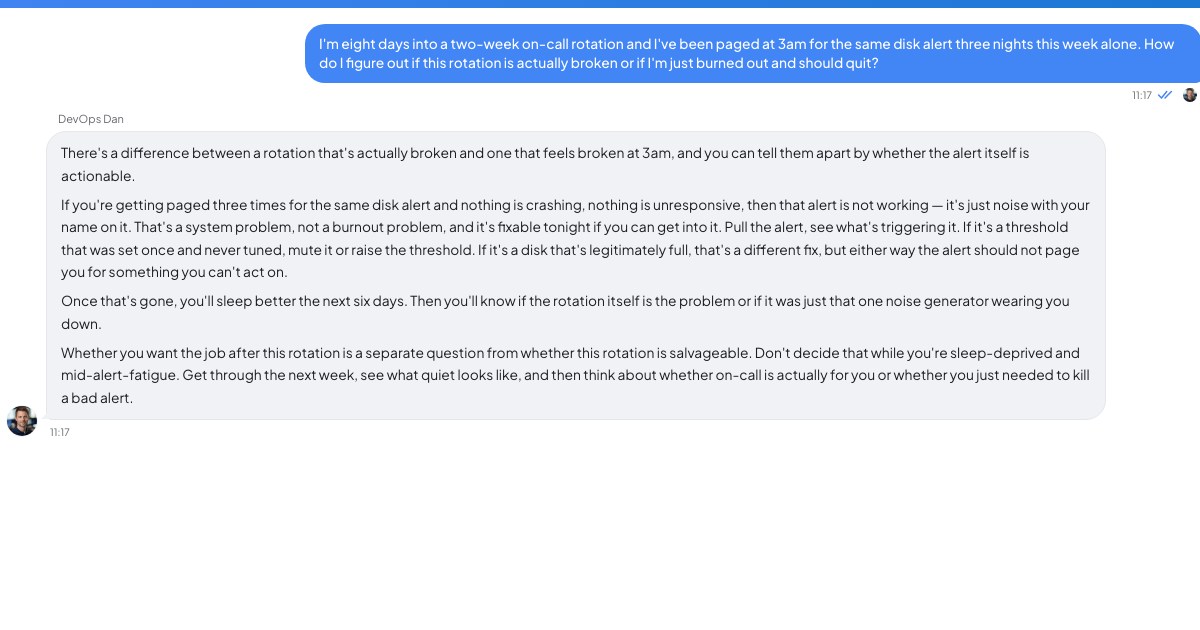
Getting from two weeks of messy notes to those three sentences is the awkward bit — particularly saying it without sounding accused or accusing. DevOps Dan is a persona on TrueTalk: a senior DevOps engineer specialised in CI/CD, infrastructure automation and monitoring. It is an AI rather than a colleague, available to debate thresholds at 4am. The free tier includes ten conversations and one hundred messages per day. Paste the alert names and counts, then identify the matching shape.
Quit on a Saturday, not at 4:40am
Leaving over on-call is completely legitimate; people do it constantly, and most do not regret it.
Do not decide during the third night while looking at a dimmed job board. Decide while rested, with two weeks of numbers visible and preferably another role available. During that interview, ask exactly how many weekly wake-ups the person doing your job receives.