We've Had the Same Argument About the Dishes for Four Years
The same fight most weeks for four years, with both of you able to predict every line. Map it as five stages, then find the one place an interruption still works.


Tuesday, about the dishwasher
Say it runs roughly like this. The details will be wrong; keep the shape.
She says the pans are still in the sink. He says he was going to do them. She says that's what was said on Sunday. He says he does not need a list. She says she wouldn't have to keep a list if things happened. He says there it is, the scoreboard again. She says something about how it is not a scoreboard, it is just that she's the only one who notices. He picks up his laptop and goes to the other room.
Nothing is resolved. It is not mentioned again. By Thursday it is gone.
And by your own count that has happened most weeks for four years. Sometimes it is the bin. Sometimes it is a text that didn't get answered, or whose parents at Christmas. Those changing subjects are different costumes for the same process.
What you have already tried, and why it didn't work
Use 'I' statements. Do not say always or never. Take twenty minutes and come back. Assume good intent.
You have done all of it. Some of it for months. It made no measurable difference, and the usual explanation on offer is that you didn't do it properly.
The likelier explanation is that this advice targets content, and by minute two your argument has no content. Nobody in that kitchen is trying to solve a dish problem. Both of you are defending a claim about who you are, and there is no phrasing of 'I feel frustrated when the pans are left' that reaches a person who has already heard 'you are lazy and I have to manage you'.
Communication technique is a translation layer. It works on a conversation. It does not work on a process that has already left the station, and the whole difficulty here is that the process has stages, and by the time you remember the technique you are three stages in.
So map the stages. Most of what follows leans on John Gottman's research on couples, and I am not going to keep saying so.
Stage one: the raise
Something gets mentioned, and tone carries almost all of the weight. A harsh opening is difficult to recover from, and the start predicts much about the ending. The Gottman Institute's fair-fighting guidance says a harsh startup obstructs listening, while flooding inhibits both listening and problem-solving; it recommends taking a break and returning when both partners are calmer.
True, and close to useless as advice, because after four years of this nobody opens softly. The raise is already loaded before the first word, because both of you know what's coming.
Stage two: the translation
This is the actual hinge, and it happens in about a second.
What was said: the pans are still in the sink. What was received: you are unreliable and I have to supervise you.
The translation is not paranoia. It is a reasonable inference drawn from two hundred previous versions of the same exchange. That's what makes it so fast and so hard to interrupt — a trained response, not a misunderstanding.
Stage three: the case
She senses it hasn't landed, so she adds evidence from Sunday, the week before, and the bin. From the inside this feels like clarifying. From the outside it is a prosecution assembling, and the moment the second example arrives he is a defendant rather than a partner.
This stage is where the argument stops being recoverable. It is also where both people are still calm enough to notice what they are doing.
Stage four: the counter-charge
'You are keeping score.'
Which is accurate — she is — and which also relocates the argument from the pans to her character. Now you are both defending yourselves and nobody is discussing anything at all. If either of you is flooded by this point, heart going and nothing landing, the part of you that could hear a repair attempt is temporarily out of service.
Stage five: the exit
Someone leaves the room. Nothing has been settled and, importantly, neither of you minds very much, because the fight has stopped and stopping was the only shared goal by minute four.
It gets dropped, not solved. Dropping works well enough that you will both do it again next week.
That's the answer to why four years.
Where an interruption is actually possible
Stage one is not a realistic interruption point because you cannot guarantee a soft opening on a Tuesday when you are tired and it is the two hundredth time.
Stages four and five are too late because anything clever said there gets heard as a tactic.
The seconds you have got are at the boundary of two and three — the moment one of you notices a case is being built, or notices they are answering something that was not said.
The interruption has to be small, agreed in advance, and not clever. Anything that sounds like therapy homework will be experienced as a move. Two that are ugly enough to work:
- 'I think I am arguing with something you didn't say.'
- A single agreed word. A stupid one. Dishwasher. Pelican. Whatever. It means: we're in the thing again. And if words are already the problem by then, make it a physical move instead — one of you puts the pan down and sits, and the other one sits too.
One rule decides whether any of that survives. It cannot be a win. If either of you can deploy it to end an argument you are losing, it'll be dead inside a month. So agree that using it means twenty minutes and then coming back — and the coming back has to actually happen, on the day, or it quietly becomes an off switch and the other person stops honouring it.
The transcript exercise
Two days after the next one, not the same night, both of you separately write down what was said, as close to verbatim as memory allows, including your own lines, especially the ones you would rather not have said.
Then compare, and look for one thing: the earliest line where the topic stopped being the topic.
It is usually earlier than either of you expects. It is usually a line that felt completely innocuous to the person who said it, which is the whole reason it keeps happening.
Honest caveat: some couples cannot do this without it becoming a new argument. If that happens twice, stop. That result is itself information, and what it means is that you need a third person in the room, not a better exercise.
What it is actually about
Underneath a four-year loop there is usually a standing question that never gets answered. Does my effort get noticed here. Am I your partner or your project. Do I have to earn approval in my own house. Is this what the rest of my life is.
I cannot tell you which one is yours. But once it is named, the dishes stop being baffling.
And there is a reframe worth taking seriously, from the same research: most of a couple's recurring conflicts are perpetual rather than solvable, rooted in temperament and values rather than logistics, and the realistic goal is being able to talk about them rather than eliminating them. If that's right, then 'we keep having the same argument' is not the failure. Having it this badly is.
The honest test: fixable loop, or not
Four questions, and they are not rhetorical.
Is there contempt in it? Eye-rolling, mimicry, the little laugh, name-calling. The Gottman Institute's contempt guide identifies contempt as the most destructive of the four horsemen and its number-one divorce predictor; examples include hostile humor, name-calling, mimicry, eye-rolling, and sneering. Gottman therefore singles out contempt as the most corrosive behavior in this framework. A loop with contempt in it is a different and more serious problem than a loop without.
Do you both want it to stop? A loop needs two dissatisfied people. The fact that you both keep returning to the pans shows engagement: people who have given up tend to do them or leave them and say nothing. If one of you finds the current arrangement basically tolerable, you do not have a communication problem — you have a disagreement about whether there is a problem, and that is the conversation to have instead.
Is there repair afterwards? A joke, a hand on a shoulder, 'sorry, that came out harsh'. Repair landing matters more than how often you fight. Couples who fight often and repair well are in better shape than couples who do not fight and do not touch.
Has anything moved? Four years is long enough that 'we're working on it' needs some evidence attached to it.
Contempt, plus no repair, plus one of you not wanting to change — that is not a loop a code word fixes. That's a larger conversation, probably with a couples therapist, possibly about whether this is the right arrangement at all.
Walking the transcript back
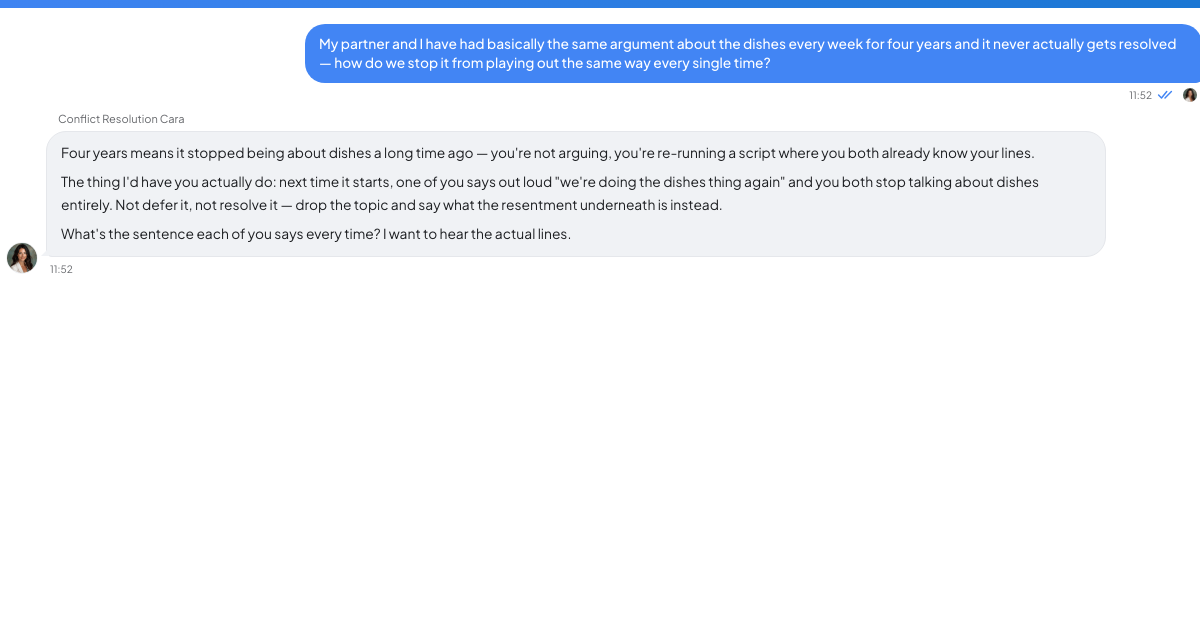
If you want a second pair of eyes on the transcript, TrueTalk has an AI advisor, Conflict Resolution Cara. The free tier includes ten conversations and one hundred messages per day. Paste the lines in as written and ask where it turned. If there is contempt in the transcript, close the app and book a couples therapist.
Decide from what happens next
This is a long time to keep having a conversation that ends the same way every time, but it is also four years of both of you coming back to it. People who've given up do not argue about pans; they do them, or they do not, and they say nothing at all.