You Bombed at Your First Open Mic and Now You Can't Stop Replaying It
Everyone bombs, keep going is true and useless. A post-mortem for a bad set: room conditions, slot position, and where in each joke the attention broke.


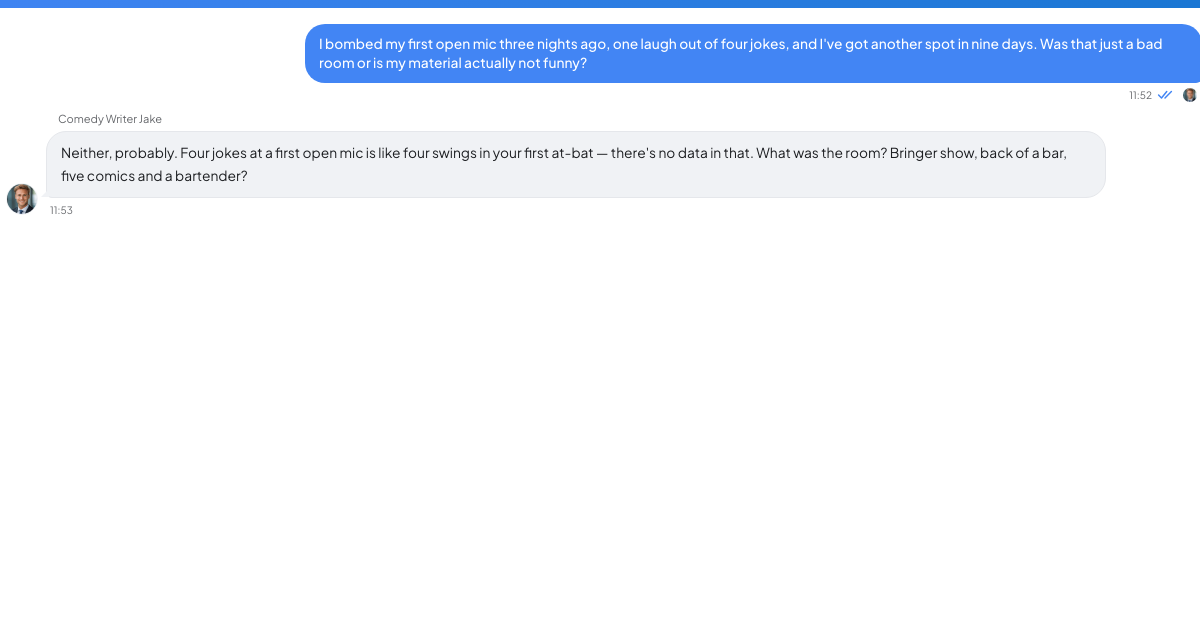
Four jokes, one laugh, and the laugh was Dan
It is the third night running you have been awake at half two with the whole five minutes playing at normal speed in your head. You can hear the specific bit where it went. Not silence — silence would almost be cleaner. It was the sound of a table near the back going back to their own conversation halfway through the second joke, and the pitch of a room deciding you were not worth listening to.
You have got a spot in nine days. Everything in you wants to email the promoter and make it go away.
And underneath that, the question you are not going to ask anyone out loud: was that just proof?
Everyone bombs is true and does nothing
It is the only response you will get, and it is said by people who are now good, which makes it unfalsifiable. Of course everyone who kept going bombed early — they are the survivors, they are the only ones still around to tell you. The comics who bombed and quit aren't at the bar giving advice.
More to the point, it is not information. It tells you to continue but not what to change, and continuing without changing anything is how people do open mics for two years and stay exactly as bad as they were.
What you need this week is not encouragement. It is a post-mortem — and if you didn't record the set, you haven't got the material for one. What you have been replaying for three nights is not evidence. Memory after a bad set is not a recording. It is a reconstruction, made three nights later by someone who felt terrible, and it will have kept the worst moments and lost the ones that went fine. So record every set from now on. Phone in your top pocket, audio only, hit record before you are announced. It costs nothing. And if you did record this one, do not listen tonight. Give it two or three days, until you can hear it as a thing that happened rather than a thing that happened to you. Then listen with a pen.
Log the room before you touch the material
This is the part nobody teaches, and it is the whole game. A bad room and a bad five minutes produce an identical feeling in your chest and require completely opposite responses.
Go through these and be honest, because the temptation is to skip them and go straight to blaming the writing.
Where were you in the running order? Straight after a strong act is a specific kind of brutal — the room's expectation got set by someone who's been doing this for six years, and you inherited it. Being fourteenth of sixteen at twenty past eleven on a Tuesday is not a test of your material either. It is a test of whether anyone is still conscious.
How long had that audience been sitting there, and what had they been drinking?
Was it a bringer or a comics' room? If most of the room were acts waiting to go on, you were scored on a different system. Comics tend to laugh at construction, at a surprising turn of phrase, at a risk taken. They're less likely to laugh at a premise simply being funny. A set that dies in a room of comics can work fine in front of civilians and the other way round.
Was there already a table talking when you went on, and did the MC do anything about it? A room the MC hasn't gathered is not a room. That's not your fault and it is not fixable from the stage in your second gig.
How many people, and how spread out? Laughter is contagious, and it spreads better when people are close together. In Martin and Gray's randomized study, 40 people—20 men and 20 women—heard the same radio comedy with or without audience laughter; those hearing laughter rated it funnier and more enjoyable and laughed more themselves. Nine people spread over forty seats won't make the sound of a laughing room however good you are. Same jokes, same delivery, everyone bunched at the front — different night entirely.
What was behind you? A screen with football on it usually beats you.
Now count. If three or more of those went against you, your material is untested, not disproved. You have a sample size of one, taken in poor conditions, and you are three nights into treating it as a verdict.
Find the second the attention broke
With the recording, mark the point in each joke where the room noise changes. Not whether it got a laugh — where it went. Different places mean different fixes.
It goes at the setup: the premise is not shared. They do not know the reference, or they do not care about the thing you are assuming they care about, or you took too many words getting to what this is even about.
It goes in the middle: too much distance between the premise and the turn. This is a very common problem in new material and one of the most fixable. Count the words. Then cut a third of them, mostly from the middle, mostly adjectives and mostly the bit where you explain something they already understood.
They were with you and the punchline landed flat: you are close. Usually it is the last five words, which are carrying almost all of the weight and are probably in the wrong order — the surprising word should be the final one. Or there is no tag, and a joke with no tag has one chance and no second one.
There was actually a laugh and you talked over it: that's not bombing, that's inexperience, and it is a delivery fix, so wait longer than feels sane.
The laugh you got—even if it came from Dan—is still data, but distinguish a spontaneous laugh from a polite one. Neves and colleagues asked 119 participants to judge spontaneous and voluntary laughs; higher emotional-contagion and empathic-concern scores predicted better detection of authenticity, and perceived contagiousness was associated with that detection. Look at what it is doing that the other three aren't. Usually it is shorter, and usually it is about you rather than about a subject.
You can do that pass out loud at three in the morning with Comedy Writer Jake, an AI advisor on TrueTalk. The free tier includes ten conversations and one hundred messages per day. It won't be at the bar tomorrow.
What to do in nine days
Do not rewrite; run the same four jokes. Make only two changes: cut the words between premise and turn, and open with the one that worked.
The reason is that if you write five new minutes, you will have two data points from two different sets in two different rooms and no way to compare them, and you will do that again and again and learn nothing. Three runs of the same five minutes in three different rooms teaches you more than fifteen different five-minute sets ever will. You need to see the same joke die twice before you are allowed to conclude anything about the joke.
A few mechanical things while you are there. Get on early if you get a choice. Stand still — new acts pace, and pacing reads as apology. Hold the mic close. And do not open by telling them it is your second gig. My argument against it: you buy one sympathy laugh and then spend the remaining four minutes performing to people you have just told not to expect much.
Where this gets genuinely hard
Sometimes it is the material. The honest way to find out is boring: the same jokes, three different rooms, at least one of which is a decent room, and the same silence arriving at the same place every time. That's the signal. It takes about a month and three gigs, not three sleepless nights, and there is no shortcut that runs through lying in the dark.
And there is an outcome nobody mentions. Some people do this for a year and discover they'd rather write than perform, and that's a real result, not a failure — a lot of the material you admire was written by people who never stand up in front of anyone.
You have now lost three nights to five minutes. That's normal after a first bomb, because it went wrong in public and in front of people, and it should fade inside a fortnight. If it does not, or if you were already lying awake before the gig, that's a doctor and not a rewrite.
Keep the spot in nine days, record the same four jokes, open with the one that worked, and make only the two planned changes. Compare the recording by where attention broke; that gives you a second observation about the room or the jokes, while cancelling produces neither.