You Did the Best Work on the Team. The Promotion Went to Someone in the Office.
Audit two promotion cycles before deciding remote work is your ceiling. Then choose portable artifacts, deliberate onsite time, or a structurally remote-first employer.


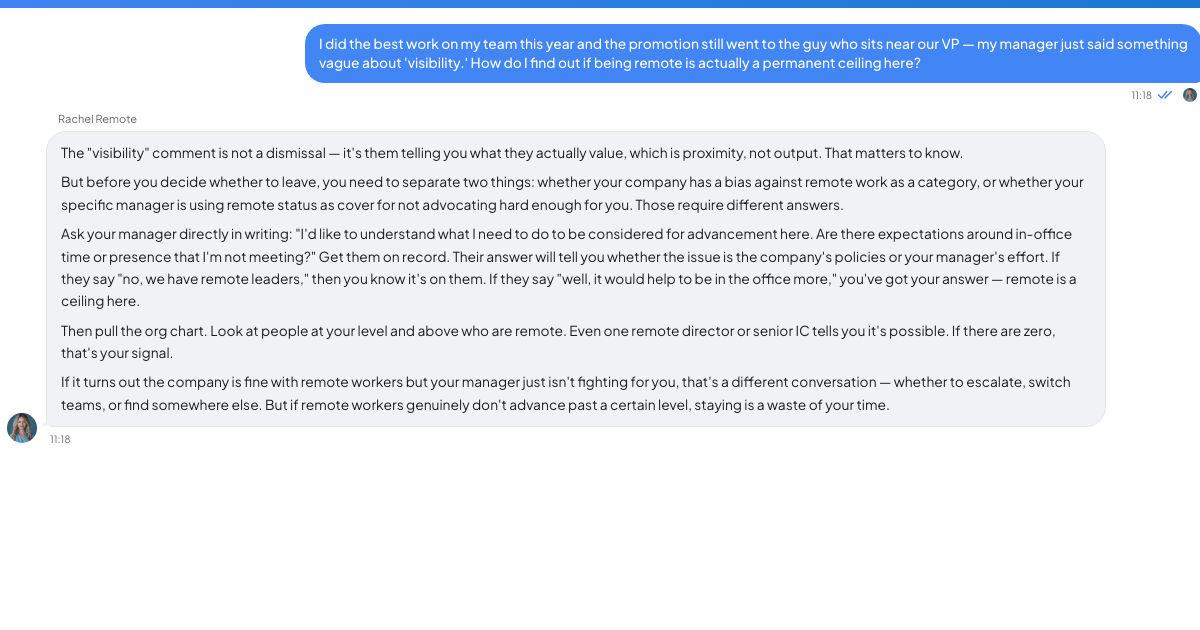
Eleven minutes and the word "visibility"
The eleven-minute call gave you visibility, followed by presence with the leadership group and a warm statement about how much your work is valued. Your manager did not mention the migration you ran, November's two-in-the-morning incident or the system the team now relies on without noticing.
The colleague four desks from the VP received the promotion.
After two days, you suspect remote work is your ceiling and that advancement requires returning to a city you deliberately left.
Don't spend the next month on the argument
Most writing on proximity bias points in the right direction: physical presence can affect how others evaluate you. Research on remote productivity remains genuinely mixed and varies by job, year and funder, so do not let one figure settle your decision. A Stanford-led randomized trial of 1,612 Trip.com employees found that working from home two days weekly had no effect on promotion or performance over two years, while reducing resignations by one-third (Stanford SIEPR).
Those population findings do not decide your case. You cannot win a fairness debate with your employer; you can document this employer's behavior and choose accordingly.
Advice to turn on the camera, over-communicate and add check-ins is basic hygiene rather than a promotion strategy. A camera alone earns nobody a promotion.
Spend an afternoon on evidence instead
Ask one answerable question: Does this company promote people who aren't in the office?
Use the org chart, your memory and the internal announcements archive to record:
- Every promotion in the last two cycles, at any level you can see.
- Where each of those people sits — fully remote, hybrid, in most days.
- Where their manager sits.
- Whether anybody above your current level, anywhere in the company, is fully remote.
- Who actually makes the promotion decisions, and whether any of those people have ever worked remotely themselves.
Give the final item the greatest weight.
Read the completed table without forcing your preferred conclusion.
Several promoted remote employees mean the problem is specific to you and can be fixed. Your work is not reaching decision-makers effectively, and you can change that mechanism.
When nobody remote has advanced above your level across two cycles and leadership has never worked remotely, your audit is a finding rather than a hypothesis. You cannot alter that structure alone; the feedback accurately described the company rather than your output.
Three routes, with their real costs
Build artefacts that travel without you.
Useful visibility comes from portable written artifacts rather than more meetings: a design document quoted six months later, the incident report used as a reference, and a quarterly shipping note your manager can paste into calibration without editing.
Suppose the exact feedback was, "I'd like to see more presence with the leadership group before the next cycle." Ask directly: what would you need to be able to say about my work, in the room where this gets decided? Produce that evidence in writing on a schedule, before the decision meeting rather than afterward as an appeal.
The route costs real work and moves slowly; it only works when decision-makers read, and some do not.
Buy presence on purpose.
Do not relocate for this experiment. Negotiate deliberate onsite time—a week each quarter—around a planning session, skip-level and pre-booked face-to-face conversations. Ask the company to fund the trip and state its purpose.
The costs are travel, time away from home and the mildly humiliating tax that office colleagues avoid. Name that cost honestly instead of calling it a development opportunity.
Accept the ceiling and leave.
An empty audit points toward a company that is remote-first in structure, not merely policy: distributed leaders, documented decisions and no privileged room.
This costs a job search and risks another employer that claims remote-first practices without using them. Test it during the interview. Ask who was promoted in the last two cycles, where those people sit and where the executive team sits. If most answers point to one building, one question has revealed the operating structure.
The thing I'd be honest about
Consider for twenty minutes whether the office colleague's work genuinely was better and nobody said so directly.
Do that before committing to the conclusion that you were robbed. Self-doubt is not the objective. If a real gap exists, you need it now rather than after a second cycle produces the same result and you blame geography again.
Ask a calibration participant who likes you enough to answer plainly. Take the first clear answer at face value.
Working through the actual words
If you need to review the feedback line by line outside your own three-in-the-morning interpretation, TrueTalk has an advisor called Rachel Remote, an AI persona specialised in remote work and distributed teams. Paste your manager's actual words and separate changeable mechanics from company structure, then draft the question for your next one-to-one. It is an AI advisor, not your manager or an HR channel, and its output binds nobody. The free tier includes ten conversations and one hundred messages per day.
Give it one cycle, not two years
Choose one route this month and set the next promotion round as the review date. If you build the artifacts, ask directly and receive the same answer, record a repeated finding rather than treating it as bad luck.
Do not spend three more years hoping while the move becomes harder to justify and the VP remains in the same office. The UK Office for National Statistics followed workers across five quarters and found that consistent home workers were less than half as likely to receive its defined promotion as consistent workplace workers, even after controls; it also cautions that work arrangement and worker characteristics complicate interpretation (ONS). Use your next promotion date to decide whether to stay.