You Got a PIP. Everyone Says It Means You're Fired. Is That True in Your Case?
A PIP lands and the internet offers two absolutes. Here is how to read the actual document you were handed, what to put in writing, and when to call a lawyer.


Twelve tabs open on a Saturday night
The meeting was Friday at three. Your manager, someone from HR you had never met, twenty-two minutes. Afterwards a PDF landed in your inbox: sixty days, four objectives, two of which contain the word "consistently."
Your manager said, more than once, that this is a genuine opportunity and he wants you to succeed. Then you went home and read forum threads until two in the morning, and every single one of them said the same thing: a PIP is a managed exit, start applying tonight, nobody survives it.
Those two accounts cannot both describe the same document, while only one can describe yours.
The two absolutes are both marketing
Search the term and a lot of what comes back is published by companies with something to sell around the process — performance-management software, manager training. Betterworks and Sage both publish explainers on it; so do the HR training sites. Their product only makes sense if the process is sincere, which is why the article says a PIP is a development tool and a structured path back to good performance. That is not lying. It is a description of the version of the thing they sell.
The forums say the opposite — paper trail, countdown attached — and they skew that way for a structural reason: a bad outcome generates a post in a way a quiet recovery does not. Someone who got a PIP in March, passed it, and is fine now has no particular reason to go and write about it, so that is the thread you do not end up reading at two in the morning.
Neither camp has read your plan. You have the text, so examine it from the writer's perspective.
Signals in the document
Are the goals measurable by someone who is not your manager? "Reduce escalated tickets to under three a month" is a thing that either happened or didn't. "Demonstrate consistently improved ownership and stakeholder communication" cannot be passed. It can only be judged, by the person who wrote it, at the end. A plan built out of the second kind is a plan whose outcome is already a matter of opinion.
Who actually wrote it? A manager's own words about specific work read differently from a template with your name dropped in. Template language throughout is not proof of anything on its own — plenty of companies mandate the form — but combined with unmeasurable goals it tells you the exercise is procedural.
Does anything change on their side? Look for support: training, a mentor, weekly one-to-ones, a temporary reduction in workload, a reassignment away from the account that has been on fire. A plan that requires you to change while nothing around you changes is a plan that has not been designed to work.
Is the clock survivable given your actual work? If your sales cycle runs four months and the plan is thirty days, the timeline was not set by someone thinking about whether you could pass. Same if the objectives depend on a project that ships in Q3.
What is the stated consequence? "May result in further action up to and including termination" is standard boilerplate. "Will result in termination" is a different sentence and it is worth noticing the difference.
What happened just before this? A manager who started six weeks ago. A reorg. A complaint you raised. A request for leave, a disability accommodation, a return from parental leave, or a discussion about pay requires a legal-rights check rather than an internet verdict. The EEOC's disability-performance guidance explains that an employer may seek appropriate medical documentation about whether a condition is a disability, how it affects performance, and what accommodation may address it; its examples include an employee on a 60-day PIP.
Is there a defined review cadence, in writing, with a date? Sincere plans usually have checkpoints. So do careful exits. But a plan with no checkpoints at all, where you find out at day sixty, is not set up for you to correct course.
Where the signals lie to you
These signals cannot produce a defensible probability; anyone supplying one is inventing it.
A genuinely meant plan can still end your job because your manager leaves in week five and his replacement inherits a file. A cynical one can quietly evaporate because the team lost two people and suddenly nobody can afford to lose a third. The document tells you about intent at the moment it was written. It does not tell you what the company will look like in eight weeks.
"Surviving the PIP" is the wrong goal
I would challenge the usual goal most strongly here.
Almost all the advice frames success as passing. But passing — and people do pass — does not put you back where you were. You are a name in a file now. The manager who wrote it has a documented history with you, and it is a history he'd have to contradict in order to advocate for you, so the next promotion cycle may not be yours.
So decide what you actually want out of the sixty days. A real repair, with this manager, in this team, is one legitimate goal. A clean exit — reference intact, on your timeline, ideally with the next thing lined up — is another. Both are reasonable. You can run both at once.
What wrecks people is pretending they're only doing one. Half-hearted compliance with the plan, because you have decided in your head it is rigged, produces exactly the outcome you feared and hands them a clean record while doing it. Complete the plan properly. Whichever goal you are actually chasing, doing the work is the move that serves both.
Put it in writing, and not in the room
Do not respond substantively in the meeting. You'll be flooded, you'll either argue or agree to something, and neither helps. "I would like to read this properly and come back to you" is a complete sentence.
Then email, within a day or two. Thank them for the detail. Restate each objective in your own words as you understand it. For anything vague, ask the specific question: what does success look like here, measurably, by day sixty, and who assesses it. Ask what support or resources the plan includes.
This does two things. It gets ambiguity converted into something checkable while they're still motivated to sound reasonable. And it creates a record made by you, in a normal professional tone, that reads well later regardless of how this goes.
After every check-in, send a short summary of what was discussed and what was agreed. Keep that summary to three lines without editorialising.
Keep copies of your own performance record — your reviews, your emails, your own written summaries. Do not take confidential company material or customer data on your way out. That is how a difficult sixty days becomes a genuine legal problem, and it is the one own-goal that is entirely avoidable.
The line where this stops being a work question
If any part of this touches discrimination, retaliation for something you reported, a disability accommodation, medical or parental leave, or a contract with notice and severance terms, you need an employment lawyer in your own jurisdiction. In the US, NLRB guidance on concerted activity says covered employees may act with coworkers about wages, benefits, and working conditions, and employers may not discharge, discipline, threaten, or coercively question them for protected concerted activity; individual complaints are not automatically covered, so get advice on your facts. That advice must come from an employment lawyer in your jurisdiction, not HR, whose job is the company, and not a forum, an app, or this article; none of those can advise you on your facts or carry any of the consequences.
Before assuming legal advice is unaffordable, check the price of an initial consultation where you live.
A second reading of your own document
Take the four objectives out of the PDF and work them one at a time. For each, write the sentence that would have to be true on day sixty for a reasonable person to mark it passed. Two of yours contain "consistently." Try writing the pass condition for those and see how far you get before it turns into a description of a mood.
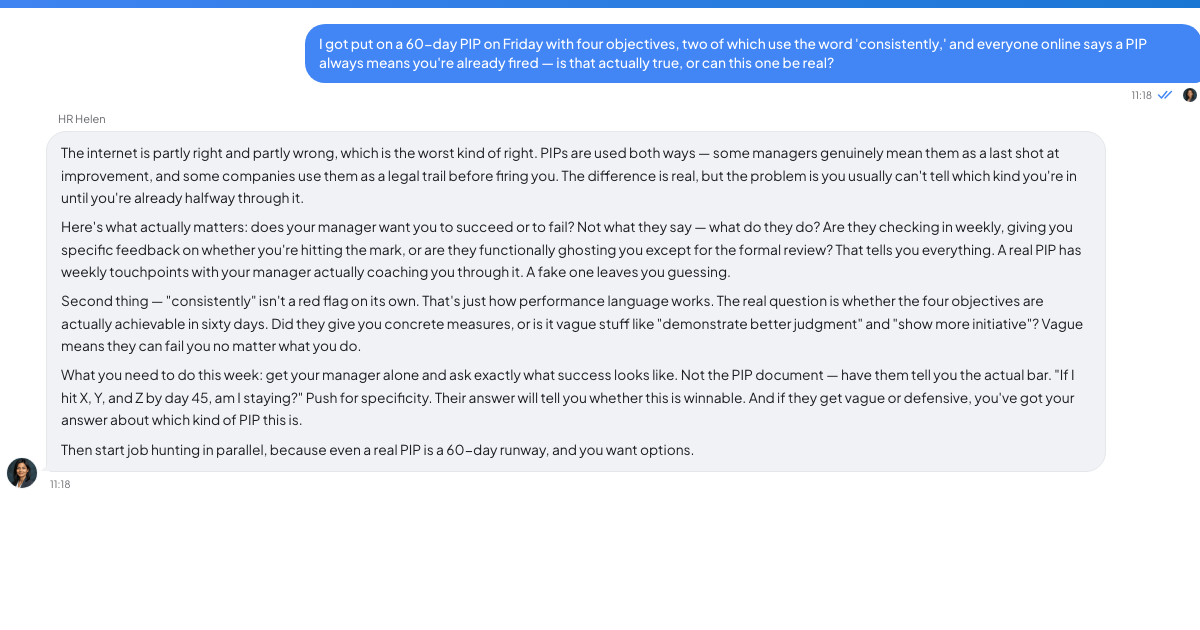
That exercise goes better with something to argue against, and on a Saturday night there is not anyone. HR Helen is one of the 164 advisors on TrueTalk, specialised in human resources strategy — the side of the table these documents get written on. It is an AI advisor rather than a person, on the web and in the app. The free tier includes ten conversations and one hundred messages per day. Paste in the exact wording, ask what each objective would have to mean in practice for you to pass it, and push back when the answer comes back vaguer than the objective was. That is an hour on the wording, and it is not the legal question above, which still goes to a lawyer.
The part nobody says out loud
Whichever kind of plan you were handed, the relationship with your manager has already changed and it does not change back. Even the good ending is a different job than the one you had in July.
Use the sixty days to document each checkpoint, meet each measurable objective, and decide whether repair or a controlled exit serves you better.