You Have an Interview Thursday and £0 for New Clothes
Thrift it and borrow a blazer are useless by Tuesday night. A triage order for what you already own — shoes first — and what each fix costs.


Shoes, first, and it is not close
Shoes are the item where condition and price separate most completely. A cheap shoe that's clean, polished, with an intact heel tip, reads as fine. An expensive shoe with a worn-down heel and a scuffed toe reads as somebody who's stopped noticing things.
Polish takes ten minutes. A worn heel tip is a few pounds at a cobbler and can usually be done while you wait.
It is Tuesday, coming up to ten at night. The interview is Thursday at 11 and you found out on Monday. You have got eleven tabs open, every one of them ending at a blazer that costs more than this week's food, and a card in the drawer with room on it and no realistic plan for clearing it. If there is any money at all in this entire exercise, it goes on the heel tip.
One thing about where that ranking comes from, before the rest of it.
I cannot point you at research that ranks which clothing flaws an interviewer registers and which they do not. As far as I know nobody has measured that in any way you could rely on. Anyone giving you a percentage for how much your outfit matters is inventing it. What follows is a judgement about what's visible, not a finding. Treat it as a triage order, not a law.
Then creases, then shoulders, then the close-range stuff
Creases, second. This is the flaw that most reliably reads as unprepared, because it is the one that could only have happened this morning. It also costs nothing. If you do not own an iron, hang the garment in the bathroom during a long hot shower and leave it there; for cotton shirts, a damp hand towel in the tumble dryer for ten minutes does more than people expect. Do it Wednesday night, hang the whole outfit up, and do not let it sit folded in a bag on the way there.
Shoulders, third, and only if you are wearing a jacket. The shoulder seam should land roughly where your shoulder ends. If it hangs past, the jacket is wearing you and nothing else fixes it, because that seam is the one part of a jacket that's genuinely difficult and expensive to alter. Too big at the shoulder is the specific look that says borrowed. If your only jacket does that, leave it at home and wear a shirt or a plain fine-knit jumper. You will look deliberate rather than swamped.
Then the small close-range things, which only register once you are sitting across a desk: bobbling on knitwear (a cheap fabric comb, or a disposable razor used carefully, takes it off), a collar that gapes, cuffs past the knuckle, a black that's washed out to a different black from the other black you are wearing. That last one is more common than people realise. Two mismatched blacks look like an accident; one colour, or an obvious contrast, looks chosen.
And last, the bag. Everyone forgets it. A knackered rucksack undoes a lot of careful work in the four seconds you are crossing reception. A plain folder with your notes in it is free and looks purposeful. The U.S. Department of Labor's interview-skills guide recommends bringing several résumé copies, a pen and paper, and a tidy folder or portfolio.
Notice what is not on that list: the garment's price, its brand, and whether it is this season. Those are the things you cannot change by Thursday, and they're probably the ones an interviewer is least likely to clock.
The two answers you have already been given are useless by tonight
Thrift it. This assumes a charity shop within reach that happens to hold your size, in a colour that works, in the two days you have. Charity shops are single-item stock. That can be a fine strategy over six weeks, but it is not a plan for Wednesday lunchtime.
Borrow a blazer. From whom, exactly. A borrowed jacket from someone of a different build sits wrong at the shoulder, and see above. It is worth saying plainly because a lot of people are about to make this mistake: wearing no jacket is better than wearing one that fits badly.
Both of those exist because they let the writer dodge the real question, which is what you should spend Wednesday evening on, given that you are wearing something you already own.
It cannot dress you as someone who already has the job
If you are moving into a sector with an actual uniform — some corporate finance, some law, some sales floors — a clean, well-fitted, plainly cheaper outfit will register as such to anyone who works there daily. I am not going to tell you it won't. That's the honest limit of everything above.
What it does do is remove the specific reading you are afraid of, which is the one underneath all of this: that the clothes will announce the job is a level up from anything you have done before you have opened your mouth. Scruffy and cheap are different signals, and only one of them is about money. Creased, unpolished and mismatched say didn't prepare. Plain, pressed and clean says prepared, on a budget, and the second is survivable in almost every room.
You are also allowed to ask. Emailing whoever booked you to ask what people in the office wear is a normal question and reads as diligent, not naive. Asking can save you from being the only person in a tie.
If it is on video, most of the above is irrelevant. For a video interview, focus on your top half, put a light source in front of you rather than behind, and use a background that is not your bed. Shoes do not exist on a video call.
For the next one, not this one
There are charities that provide interview clothing outright. Smart Works works with women and non-binary people across a number of UK cities. Dress for Success is an international nonprofit that provides women with a support network, professional attire, and development tools toward economic independence. Both Smart Works and Dress for Success usually require referrals through jobcentres, charities, or support workers rather than accepting walk-ins, so find out how each local service works before you need it. There are smaller equivalents for men in some cities — a jobcentre adviser or the local council is the fastest way to find out whether there is one near you.
None of that helps by Thursday. It might help in March.
On the credit card: do not. An outfit bought on credit you cannot clear is a cost you carry for months in exchange for a marginal improvement in something I have just argued is fourth on the list. Get the job, buy clothes with the first pay packet. Do not get it, and you will be very glad the debt is not there.
Wednesday night
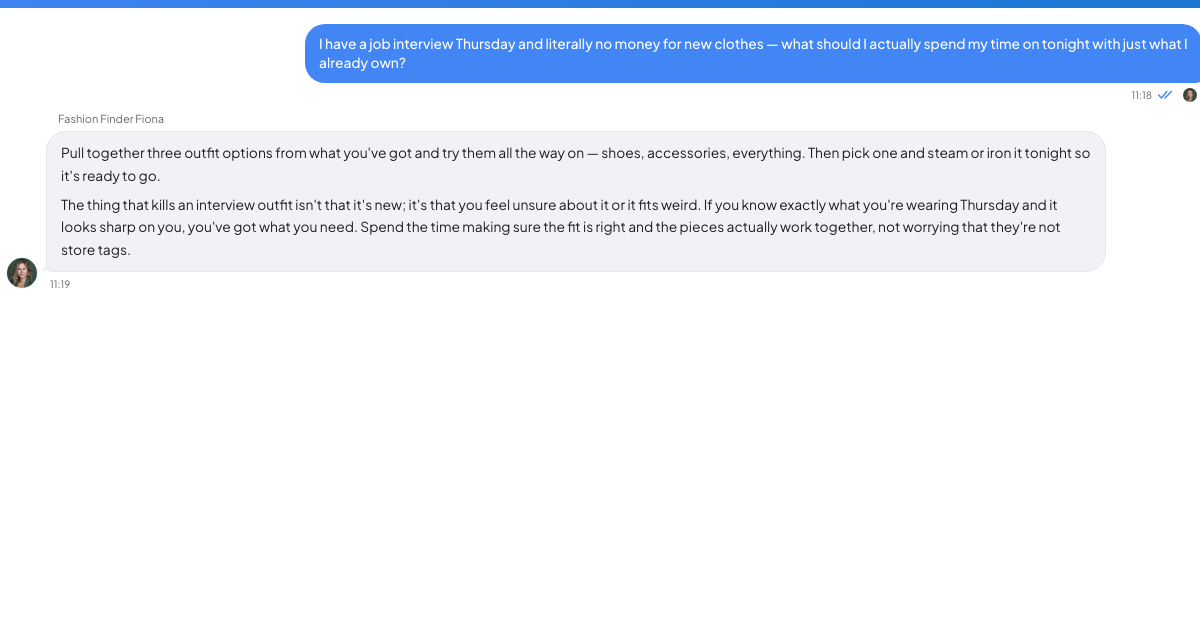
What you will actually want is not a rule, it is a second opinion on the two options laid out on the bed — the shirt or the jumper, the one pair of trousers, whether the shoes are past saving. There is an AI persona on TrueTalk called Fashion Finder Fiona, listed under personal styling, fashion consulting and wardrobe curation; it cannot see you or check the fit, but it is awake at eleven. The free tier includes ten conversations and one hundred messages per day.
Thursday morning
Give yourself fifteen minutes more than you think you need. The Department of Labor guide recommends scouting the location, anticipating delays, and arriving at least fifteen minutes early. The thing that genuinely damages an interview is arriving hot and rushed, and no outfit compensates for that.
On Thursday morning, check clean shoes, uncreased clothes, one deliberate colour story, and the folder, then leave with the extra fifteen-minute buffer.