You Made $94,000 Freelancing and the IRS Says You Owe a Penalty for Paying It All in April
A paid April tax bill can still trigger an estimated-tax penalty. Use the safe harbors, first-year exception, or annualized-income method for lumpy freelance income.


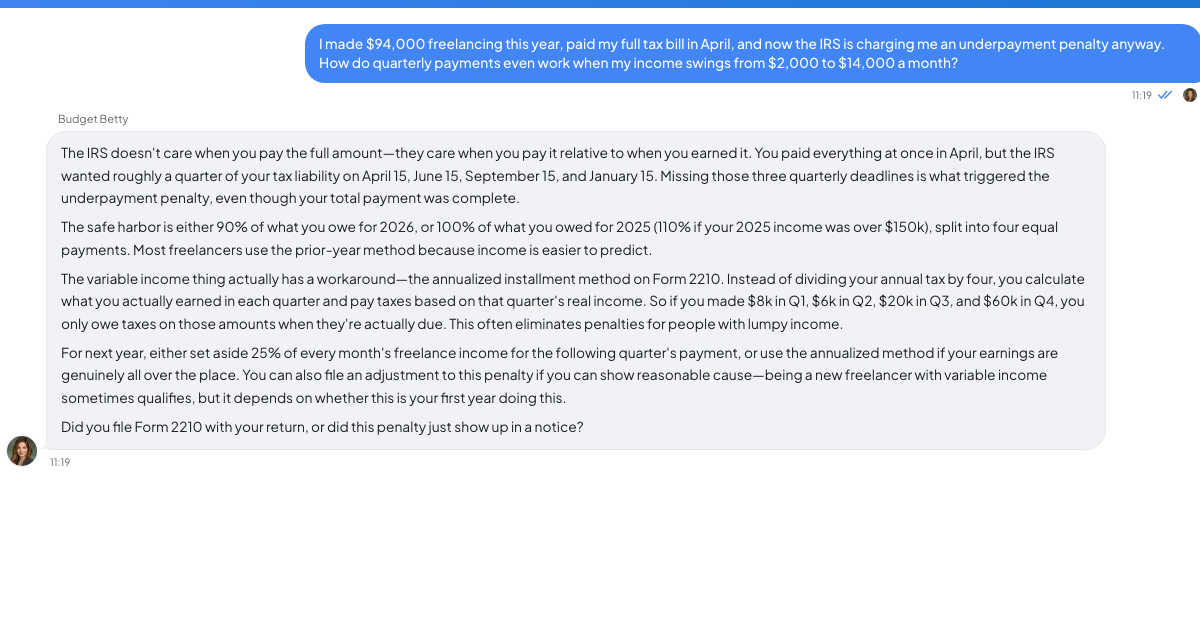
The bill you expected, and then the second one
You did the responsible thing in the end. You filed, you saw the number, you paid it, and it hurt in the specific way that only a self-employment tax bill hurts — because there is no employer half hiding in the background making it look smaller.
Then a second notice arrived. A few hundred dollars, maybe more, for an underpayment penalty.
You paid in full. On time. And you are being charged for the timing of a payment nobody ever told you was due in pieces.
That is the part that makes people angry, and the anger is fair. The federal income tax system is pay-as-you-go. Working for someone else, that happens invisibly through withholding on every paycheck. The day you started invoicing, the withholding stopped and the obligation didn't. Nobody sends a welcome email about this.
Where the money went
Two separate taxes are stacked in that bill and it is worth being able to name them.
Self-employment tax funds Social Security and Medicare—the employer and employee halves that payroll once obscured. It runs at 15.3% combined, computed on 92.35% of net self-employment earnings, while the Social Security portion stops at an annual wage base that changes each year. IRS Publication 334 breaks the 15.3% into 12.4% Social Security and 2.9% Medicare and confirms the above-the-line deduction for half of self-employment tax (IRS). Then income tax sits on top, at your ordinary rates. You do get an above-the-line deduction for half the self-employment tax, which softens it slightly, and you may be eligible for the qualified business income deduction, which has its own rules and limits worth asking about.
So on $94,000 of net earnings, a meaningful chunk is gone before income tax has even been introduced to the conversation. That is why "set aside 25 to 30%" is a rule aimed at someone whose income is smooth and whose deductions are predictable, and why it stops describing you the moment your months range from $2,000 to $14,000.
You get to choose what you are aiming at
What almost never makes it into freelance budgeting posts: the penalty is not for underpaying. It's for missing a target, and there is more than one target, and you get to pick.
Broadly, you are clear if withholding and timely estimated payments reach either 90% of this year's tax or 100% of last year's tax—110% when prior-year adjusted gross income exceeded $150,000. The IRS calculates the penalty separately for each installment, so a later catch-up payment can still leave an earlier-period penalty (IRS Form 2210 instructions). Those thresholds are in the tax code and the current figures are published; confirm them for the year you are in rather than trusting a number in a blog post, mine included.
The second target is the one that saves lumpy-income people, because it is a fixed, known figure. Last year's total tax is printed on last year's return. You can divide it by four and pay that, in four payments, and stop guessing what a wild year is going to look like. If this year turns out huge, you still owe the difference in April, but you do not owe a penalty on top of it.
The payment dates aren't quarters, incidentally, whatever everyone calls them. They fall in mid-April, mid-June, mid-September, and mid-January of the following year, with shifts for weekends and holidays. The June one covers two months. That trips people up every single year.
If this was your first year, read this before you pay anything
There is a specific exception in the code and it is under-known: broadly, no underpayment penalty applies if you had no tax liability for the prior year, you were a US citizen or resident for that whole year, and that prior tax year covered twelve months.
If you left a W-2 job mid-career, you almost certainly had a liability last year and this will not help. But if your first freelance year followed a year with no tax due — a student year, a year abroad, a year with no income — it may. It's worth ten minutes with a preparer and Form 2210 rather than paying a notice on reflex.
While you are there: withholding is generally treated as having been paid evenly across the year no matter when it actually happened, while an estimated payment counts on the day you make it. If you have a spouse with a W-2, increasing their withholding late in the year can repair an underpayment that dates from March. A check written in December cannot do the same thing. That asymmetry is genuinely useful and almost nobody mentions it.
When last year's number is a bad deal
Sometimes the safe harbor is the wrong tool. If last year was enormous and this year is quiet, paying 100% or 110% of a big number in four equal chunks starves you of cash to protect against a penalty you were never going to be charged.
That is what the annualized income installment method is for. Instead of assuming your income arrived evenly, you compute each installment based on what you actually earned by that point in the year. Earn nothing until August and everything in the autumn, and your early installments are correspondingly small — legitimately, not as a gamble. It lives on Schedule AI of Form 2210, and Publication 505 walks through it. The current Form 2210 instructions say that using Schedule AI for any payment due date requires using it for all payment dates and attaching the specified Form 2210 parts and Schedule AI (IRS).
The cost is real: it is more work, it requires you to actually close your books each period rather than four times a year in a panic, and it is the sort of thing a preparer earns their fee on. But it is the method built for exactly the income shape freelance advice keeps pretending does not exist.
Two structural fixes that beat discipline
Discipline is a bad plan for tax money because it asks you to be responsible in your weakest moment — the week a $9,000 invoice lands and the car needs tyres.
Open a second checking or savings account and treat it as not yours. The day money arrives, move a fixed percentage across. Many business banking apps will do the sweep automatically; if yours will not, do it manually the same hour the payment clears, before the balance has time to feel like income. What percentage depends on your state, your deductions and your filing status, so get the figure from someone who has seen your last return rather than from a round number.
And build the "salary." Look at your worst twelve months, take something near the low end, and pay yourself that fixed amount on the same two dates every month from your business account. Everything above it stays put. A good month does not raise your pay; it lengthens your runway. This is the single change that makes a dead quarter survivable, and it is the one people postpone because it means living, in a good month, on less than they earned.
TrueTalk has an advisor called Budget Betty, an AI persona whose catalogue description is a personal finance educator who helps users compare budgeting and planning options. It cannot file for you and it is not your accountant. Where it is useful is the sizing conversation — what a realistic personal salary looks like against your actual worst months, and what to move where when the January payment and a slow month land in the same week. It's available instantly. The free tier includes ten conversations and one hundred messages per day.
For the return itself, and certainly for anything involving annualizing or the first-year exception, get a CPA or an enrolled agent. The fee is small next to the mistakes available here.
One last thing worth knowing: if you cannot pay a bill in full, the IRS has short-term and long-term payment plans, and the failure-to-pay penalty is reduced while an installment agreement is in place. Ignoring the notice is the only option that has no upside at all.