"You Need More Executive Presence" Is Not Feedback. Here's How to Make Them Say What They Mean.
Turn vague executive-presence feedback into a meeting, observable behavior, desired alternative, and dated plan—then learn from a manager who still cannot translate it.


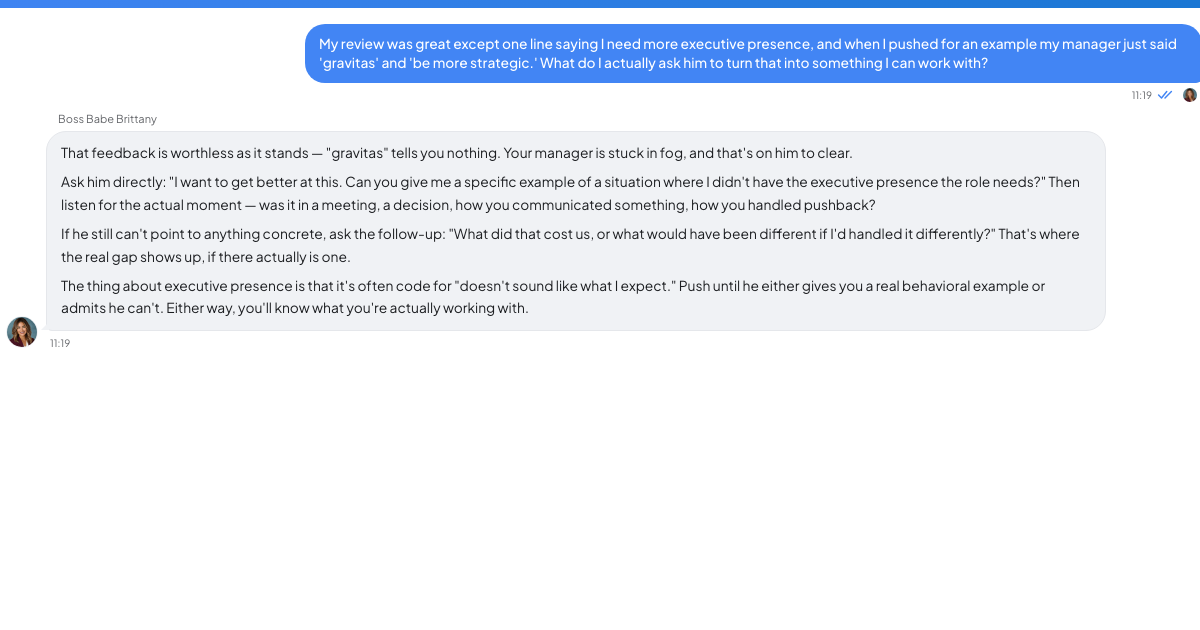
The one sentence that undoes the other four paragraphs
Say the review is good, and mean genuinely good: delivery, judgement, and the thing you shipped in March that nobody else on the team could have shipped. Then the last box on the form, the one about readiness for the next level, and it says you need more executive presence.
You ask what that means. You get gravitas. You ask for an example, an actual moment, and you get told it is not really about any one moment, it is more of an overall impression. You ask what you should have done differently in a specific meeting and you get: be more strategic.
You received three adjectives, no instructions, and a next review eleven months away.
Both of the popular answers are bad
The first takes the word at face value and sells you a fix for your body. The prescription is to lower your pitch, stop uptalking, take up space, avoid apologising, pause before answering and wear a jacket with a shoulder in it. Some of that is true at the margins, but look at the premise: the defect is that you are the way you are, and the remedy is a year-long performance of somebody else. At the end of it you are tired, still unpromoted, and now also self-monitoring in every meeting—which reads, from the outside, as exactly the thing you were told to fix.
The second answer is the essay explaining that executive presence is a coded phrase, that identical behaviour reads as decisive in one person and difficult in another, and that the standard is shaped like whoever held the job last. That analysis is often correct but completely inert: you can be entirely right about the bias in the phrase and still be sitting in the same chair next November.
The likelier explanation is duller than either. Your manager watched you in a few dozen meetings this year, formed an impression out of maybe five specific moments, forgot the moments, kept the impression, and reached for the nearest available word. "Executive presence" is a compression artifact. The original information is still in there somewhere. Decompressing it is your job, because it is not going to be his.
Ask questions that adjectives cannot answer
Avoid "can you give me more detail on that?" because an open question permits another adjective. The U.S. Office of Personnel Management says feedback should be specific and recommends anchoring it in Situation, Behavior and Impact (OPM). You want questions that can only be answered with a name, a room, or a date.
"Which meeting?" Not "can you give an example"—that lets him retreat to "it is a pattern". Ask when he last noticed it, then request the week and room. The Center for Creative Leadership's SBI guidance likewise says to name a specific time and place, describe observable behavior without judgment, and state its impact (CCL).
"Who here does this well? What did they actually do?" This is the one that cracks it open most often. People cannot define presence in the abstract and then describe a particular colleague in a particular planning session in enormous detail. Whatever comes out of that description is the real rubric, and it is usually nothing like the adjective.
"What would you have wanted me to say instead?" Ask this about an anchored moment and in the present tense. If he can answer it, you have a script. If he cannot, write that down too.
"A year from now, if this were completely fixed, what would you see me doing that you do not see now?" Future observable behaviour is much easier for people to produce than a diagnosis. Managers who cannot tell you what's wrong can often tell you what good looks like.
And one more, asked carefully: whose view is this? Not "who complained"—that starts a fight. Something closer to "is this coming from the leadership team, from peers, from your skip?" A single director who finds you irritating is a different problem, requiring a different response, from a consistent read across five people.
Turn whatever comes back into behaviour
When the phrase does decompress, it usually decompresses into one of a small number of things—not because women all make the same mistake, but because managers only have a few things in mind when they reach for the word:
- You present the analysis and stop, leaving the room to draw the conclusion. They wanted the recommendation in the first thirty seconds and the analysis behind it.
- You answer the question you were asked instead of the question underneath it.
- You narrate your process out loud—"I wasn't sure whether to look at it that way, so I also ran…"—which sounds like thinking in public rather than having concluded.
- You only speak about your own area, and they are waiting to see whether you have a view on the thing two teams over.
- You have never disagreed with someone senior in front of an audience, so nobody in that room knows what you are like under pressure.
Take the ones that match and rewrite them as behaviours with a start date. Replace "be more strategic" with "from Monday, slide one of every deck is the recommendation and the ask, and I do not walk through the workings unless someone asks for them." Choose two or three of those, not eight, because eight is just a slower way of changing nothing.
Then write it down, because goalposts move
Send a short, unemotional email to the person who signs off on the promotion.
Something like: following up on our conversation, my read is that executive presence here means these three things, and I'm going to work on them by doing these specific things, starting now. If that is not what you meant, tell me now so I'm not solving the wrong problem.
That email creates a dated record of the adjective and transfers correction to him; silence becomes agreement. OPM also recommends linking feedback to a specific development action, such as leading a named meeting, rather than giving generic advice (OPM performance roadmap). If the same blocker appears next year, you can produce the email and ask which of the agreed behaviours didn't land. It's a lot harder to move a goalpost somebody wrote down and didn't object to.
Send it as an eager report, not as a challenge. The tone matters more than it should.
When nothing translates
Sometimes you run all of this and get nothing back. After two conversations and five questions, every answer is another adjective: you get no meeting, no name and no sentence you could have said instead.
Treat that as information rather than as failure. It usually means one of three things: your manager is repeating something he heard and never observed; the feedback is a placeholder for a decision already made about headcount, budget or someone else's turn; or the discomfort is about who you are rather than what you do, in which case no behaviour change resolves it, because behaviour was never the input.
None of those gets fixed by trying harder. What they change is the question. It stops being "how do I fix this" and becomes "how many more cycles am I willing to run against criteria nobody will state, and what does leaving look like?" That is a heavier question. It's also the honest one, and answering it in month two is far cheaper than answering it in month eleven.
One caution against the opposite error: do not reach that conclusion after a single vague conversation. Vagueness on the first pass is ordinary. Most managers are bad at this, and quite a few are slightly afraid of the conversation. Give it two real attempts before you decide the feedback has no content in it.
If you want to rehearse it first
TrueTalk has an advisor pointed at this exact corner—Boss Babe Brittany, whose specialisms are women's leadership, executive coaching and the director-level ceiling. She's an AI persona, not a human coach and not your HR team, which is the reason you can paste in the literal sentence from your review at eleven at night and ask what it probably means and which question to open with. The free tier includes ten conversations and one hundred messages per day. What she cannot do is tell you what your manager actually meant—nobody can do that from outside the room. What she can do is help you build the questions, and take a pass at the wording of that email before it goes to someone who outranks you.
Put dates against the adjective
Your goal is not eventual approval of an abstract trait. Make the adjective unnecessary by moving the conversation onto things that can be observed, dated and disputed, where you actually have some purchase. Because an adjective can be reapplied to you forever, keep a dated list of behaviours that lets you determine whether each one happened or did not happen.
At the next one-to-one, ask for the meeting, behavior and desired alternative, then send the written three-behavior summary that day.