You Sent Crypto to the Wrong Address. Everyone in Your DMs Is a Second Scam.
Classify a wrong crypto send by memo, network, custody, or address; preserve transaction evidence, contact the real custodian, report deception, and ignore recovery DMs.

The transaction cleared before you finished reading the address
The explorer went green and you already knew, halfway through the string, that it wasn't the one in your head.
So you did the reasonable thing. You posted the transaction hash somewhere public and asked whether anything could be done.
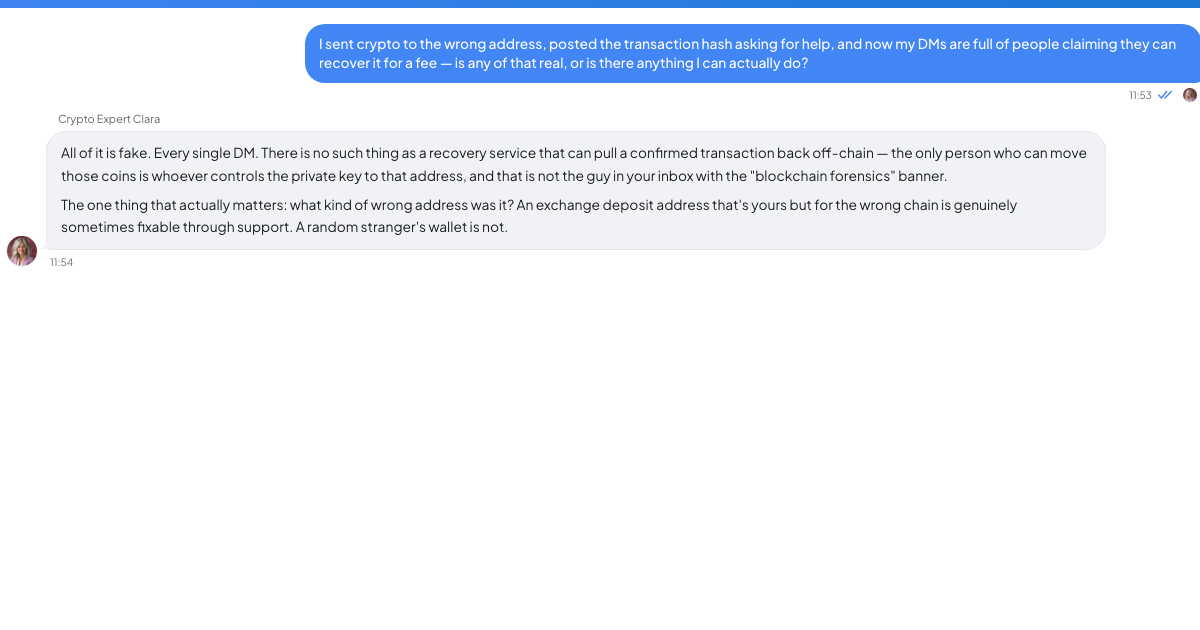
Then the messages begin from supposed recovery specialists and blockchain-forensics teams. Someone with a badge in their profile picture. Two who say they can reverse it, one who needs a small consultation fee first, one who needs to verify ownership of your wallet, one with a stock photo and a Telegram handle and testimonials you cannot check.
Delete or lock down the public post now, because it can expose you to a second loss larger than the transfer.
The one line you do not want
Treat a settled public-blockchain transfer as final. Coinbase's troubleshooting guidance tells senders to verify both the recipient address and expected network after completion and states that Coinbase cannot recover a wrong-network send (Coinbase). There is no chargeback, no reversal, no fraud department, no manager. The network did exactly what you told it to and it will not be doing anything else.
That is the true answer, and it is why honest pages on this are one paragraph long while dishonest ones run four thousand words with a contact form at the bottom. Search results here are heavily populated by the people who want your money next.
But final is not the same as gone in every case. The difference comes down to one question: who holds the keys at the other end. Work that out before you do anything else.
Which of the four things did you do
One: you left off a memo or destination tag on an exchange deposit. Some networks—XRP and Stellar among them, and certain deposit flows elsewhere—use a shared deposit address plus an identifier telling the exchange whose funds these are. Send without it and the money lands in a pooled wallet with no name on it. This is the best case on the list. The exchange has the coins and can usually credit them once you prove the deposit was yours, and many publish a recovery process, often with a fee and a wait. Open a ticket with the transaction hash, the exact amount, the timestamp, the deposit address and the account it should have landed in.
Two: wrong network, to an address you control. Ethereum-style chains share an address format, so a token sent on BNB Chain, Polygon or Arbitrum to a self-custody address of yours is sitting at that address, on that chain. Add the network in your wallet, add the token contract if it does not show up on its own, and there it is. You'll need a small amount of that chain's native gas token to move it.
People spend days grieving that one before somebody tells them it is a five-minute fix. It works only where you hold the private key for the address, and it does not carry across incompatible chains—a Bitcoin address and an Ethereum address do not share a key derivation, and coins sent to a format the receiving chain cannot produce a key for belong in category four.
Three: wrong network, to an exchange's address. The keys belong to the exchange now, and whether they can help depends on how their custody is built and whether they support that chain at all. Some run a paid recovery service for exactly this. Some refuse flatly for anything they do not list. Ask them, and do not take a forum's word for their policy.
Four: a wrong address. It's gone.
That covers a typo, a contract that is not built to receive that token and has no way to send it back, and the one that has been catching people constantly—an address you copied out of your own transaction history that an attacker put there.
How the wrong address got into your history
It's called address poisoning. The attacker generates an address whose first and last few characters match one you have legitimately used, sends you a dust or zero-value transfer so it appears in your history, and waits for you to copy from history instead of from source. Cheap to run at scale. It beats the checking habit almost everyone actually has, which is glancing at the ends.
Whoever controls that address controls the funds, and if that is an attacker, they are not sending them back. Some token contracts have a rescue function the issuing team can use, so if you sent to a contract, one message to the project is worth the two minutes—as a long shot rather than a plan.
The first hour, in order
Stop transacting. Do not try anything clever with the same wallet while you are this rattled.
Write down, in one file: the transaction hash, the block explorer link, the withdrawal ID from the sending platform, the exact amount and asset, the timestamp, the address it went to, and the address you meant. Screenshot everything, including the address book entry or the message where you got the address, because if this was poisoning or a scam rather than your own thumb, that screenshot is the evidence.
If someone deceived you into it, report it. In the US that is the FBI's Internet Crime Complaint Center at IC3.gov; in the UK it is Action Fraud (Police Scotland if you are in Scotland). Do it even if you expect nothing to come of it, because the reference number is the first thing any exchange, lawyer or later investigation will ask for. It's the entry point to every route that does not involve you paying a stranger.
What can be frozen, and by whom
Issuers of some centralized stablecoins can freeze balances at specific addresses, and have. They act on law-enforcement requests through proper channels, rather than on emails from the public. So: report, get a reference number, and if the sum justifies it, hire a lawyer who has done this before.
Be honest about the size of the loss. Below a certain amount the legal route costs more than it recovers, and there is no shame in deciding that. Blockchain analytics firms are real and effective, but they mostly serve law enforcement and institutions; large firms will not take a retail case. IC3 also states that private recovery companies cannot issue seizure orders and exchanges freeze accounts only through internal processes or legal process (FBI IC3).
The people in your DMs
One rule catches nearly all of them: no legitimate route to recovering cryptocurrency begins with a stranger contacting you and asking for money.
The rest of the tells, so you can name them as they arrive:
An upfront consultation fee, a retainer, or a payment for a report. A gas fee or a tax to be paid before your recovered funds can be released—the classic, because it lets them come back for a second and third payment. Any request for your seed phrase or private key, dressed up in any language. A request to connect your wallet to a site to verify ownership. A claim that they can reverse the transaction or work directly with the network, which nobody can do. Testimonials with no verifiable transactions behind them. No jurisdiction, no legal entity, and a Telegram handle for support.
And the one aimed at people who have already been hit: an outfit presenting itself as a law firm or an official body, offering to recover what you lost to a previous fraud. The FBI's Internet Crime Complaint Center warns that recovery fraudsters commonly charge an upfront fee, disappear or demand further fees after an incomplete tracing report, and that law enforcement does not charge victims to investigate (FBI IC3). If you were scammed once, you are on a list now, and the second approach is built to look like rescue.
If you want to talk the triage through with something other than a stranger in your DMs, TrueTalk has an advisor called Crypto Expert Clara, an AI persona built around cryptocurrency and blockchain, which is a place to describe what happened and work out which of the four you hit before you act on it.
Nothing works
For category four, nothing works. That is the whole answer, and it is unbearable on the first day, which is precisely why the first day is when people hand money to strangers.
The twenty-four hours after an irreversible send are the most expensive hours in the whole episode, and the expense has little to do with the amount you sent. The loss is already fixed. What is not fixed is how much more you are about to spend trying to undo it. Do the triage, file the report, then stop for a day. Nothing recoverable becomes unrecoverable because you slept.
And for next time, the boring habits: send a test transaction first, always. Whitelist addresses on the platforms that let you. Never copy an address out of transaction history. Check the middle of the string as well as the ends. If you use a hardware wallet, verify the address on the device screen, since that is the one thing malware on your computer cannot rewrite.
Tonight, spend four minutes recording the transaction hash, timestamp, exact amount and both addresses in one text file, then stop responding to messages.