You Think of the Perfect Answer in the Car on the Way Home
You prepare, but hesitate while the meeting moves. Use a question, restatement, build, or placeholder early, then put a late contribution on the group record.


It arrives at the roundabout
At the lights before the roundabout, twenty minutes after the meeting, your answer arrives fully ordered, with the objection already handled. It is the answer you should have given when they asked about the migration risk.
In the room you had most of it. You were weighing whether it was worth saying, whether it would sound obvious, whether the version in your head was actually right, and while you were weighing, a colleague said a thinner version of the same idea and got a good point, let's pick that up. You nodded, as you have been doing in meetings for about four years.
He didn't know more than you; his bar for opening his mouth was lower, and the minutes do not record that distinction.
Past the roundabout, the familiar advice starts up because your review said you need to contribute more in group settings. You have read all of it: prepare talking points and sit where the chair can see you.
You prepared, as you always do. You are, if anything, the best-prepared person in that room, which is part of how you got senior enough to be in it. Lack of preparation was never the problem.
The gap is between having a thought and producing it out loud, unfinished, in front of people who might push back, in real time, while the conversation keeps moving. Speaking under those conditions is different from knowing the answer. It also differs from writing the answer, which you do well; that is why your written work seems sharper than your meeting contributions, creating its own quiet frustration.
My read is that you are running a quality filter nobody else in the room is running, rather than facing a broad lack of confidence. You require a finished insight before speaking; other people voice a partial thought.
Lower the bar to four useful sentence types, none of which requires a finished insight.
Start with a question. "What are we actually optimising for here?" "Do we know what happens if we don't do this?" A question cannot be wrong, it is attributed to you the moment you ask it, and nobody can take that contribution away. Often someone else in the room is confused about the same thing and doesn't want to be the one to admit it.
You can also restate the decision. "So the proposal is that we ship in April and eat the support cost. Is that the trade?" Because you are mirroring the proposal, there is no exposure in it at all. Naming the actual decision on the table is cheap, and it often lands well.
Another option is to build on a colleague's point. "Adding to that, the same constraint applies on the billing side." Attach one sentence to somebody else's idea, so it does not have to stand alone.
The fourth sentence reserves space for a later response. "I've got a reaction to this I can't articulate yet. Give me until tomorrow morning and I'll write it up." Most people won't use this one, because it feels like admitting you're slow. Saying it publicly stakes your claim. Senior people use the move, and they say it with a flat voice, which is the trick.
Use a question or restatement early, before the discussion has enough shape to demand a firm opinion. Minute three is easier than minute twenty-five, because at minute three the bar is lower for everyone.
You're on the dual carriageway now, and there's a version of all this that the four sentences don't touch. That version includes your heart racing before you speak, dreading the meeting the night before, declining invitations, planning your week around avoiding particular rooms, or feeling physically sick. Those signs go beyond ordinary hesitation, so the meeting phrases above are not the right tool. Social anxiety is common and treatable; preparing harder is not its treatment. The National Institute of Mental Health lists fear of being judged, a rapid heart rate, nausea, avoidance, and analysing your performance afterward among its signs, and identifies CBT as a well-studied treatment. Discuss that pattern with a GP or therapist, preferably early because avoidance compounds. Nothing in this article substitutes for that, and if you read that list and thought that's me, treat the rest of this as optional.
If this is hesitation, practise saying a half-formed thought aloud to another person before it is finished. You cannot get that speaking repetition in the meetings themselves, because they are the one place where being wrong aloud has a price, which is what built the freeze. Colleagues are also the audience, so practice with them is not easy.
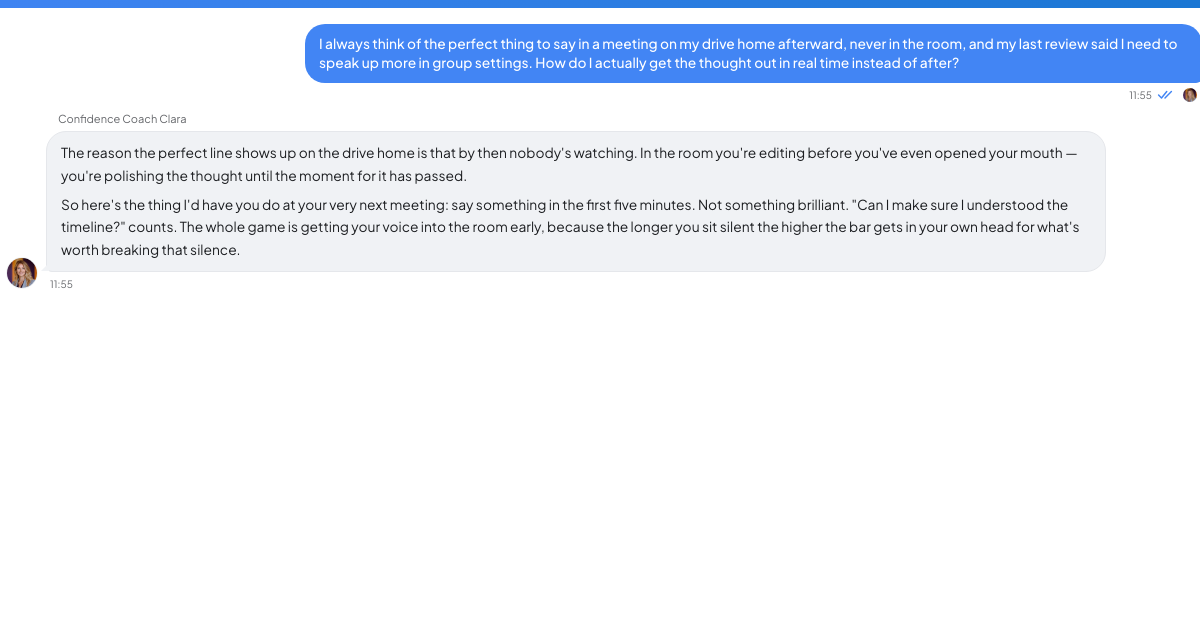
Confidence Coach Clara is TrueTalk's confidence advisor. She's an AI persona rather than a person, so at eight in the morning, before the nine o'clock, you can type the messy version of your point twice and badly and nobody's opinion of you moves either way. The free tier includes ten conversations and one hundred messages per day. She is not a therapist or a substitute for one. Be exact about the limitation: this is writing, while your deficit is oral, so the exchange is not the speaking repetition itself. It is a way of lowering the threshold before you enter the room. Draft the four sentences while the kettle boils, so that what comes out of your mouth at nine is a sentence you've already seen written down once.
Your roundabout thought is still probably the best contribution of your day, but at 6:40pm it exists only in your own head.
At 6:52, park on the drive before you go inside. Turn off the engine, take out your phone, and write four or five lines. Send it to the group rather than only to your manager, because part of what you're changing here is the record.
Repeat that process consistently and the record begins to change. Nobody needs to love email for "quiet in meetings" to become "quiet in meetings, and the useful follow-up always comes from her". You are the same person, but the sentence in your next review is different.
This remains a workaround, and I would still rather you spoke in the room. But a workaround that runs every week beats a cure you're waiting to feel ready for.
Two limits matter. A 2025 BMJ Open Quality study indexed by PubMed examined speaking up in multidisciplinary team meetings and found that the behaviour depended on systemic conditions, not merely individual courage; your room's structure can be part of the problem. Some meeting cultures reward volume and nothing else, and if the loudest person wins every time, or the meeting is really a performance for somebody senior, then no technique makes you competitive in it, and the fix may be a different room or a different manager. That's a real conclusion and it isn't defeatist to reach it. And the restatement goes stale if it's all you ever do. After a few months people notice that you summarise and never commit. Rotate among the four sentence types.
Send the group this four-line note:
One thing I didn't get to in the room: if we ship in April, the thing that breaks first is the support rota. Worth ten minutes on Thursday?