You Took the Counteroffer. Now You're Off the Good Projects and Nobody Will Say Why.
Six weeks after accepting a counteroffer the work quietly changes and nobody explains. What to watch, and the one conversation that shows whether there's a route back.


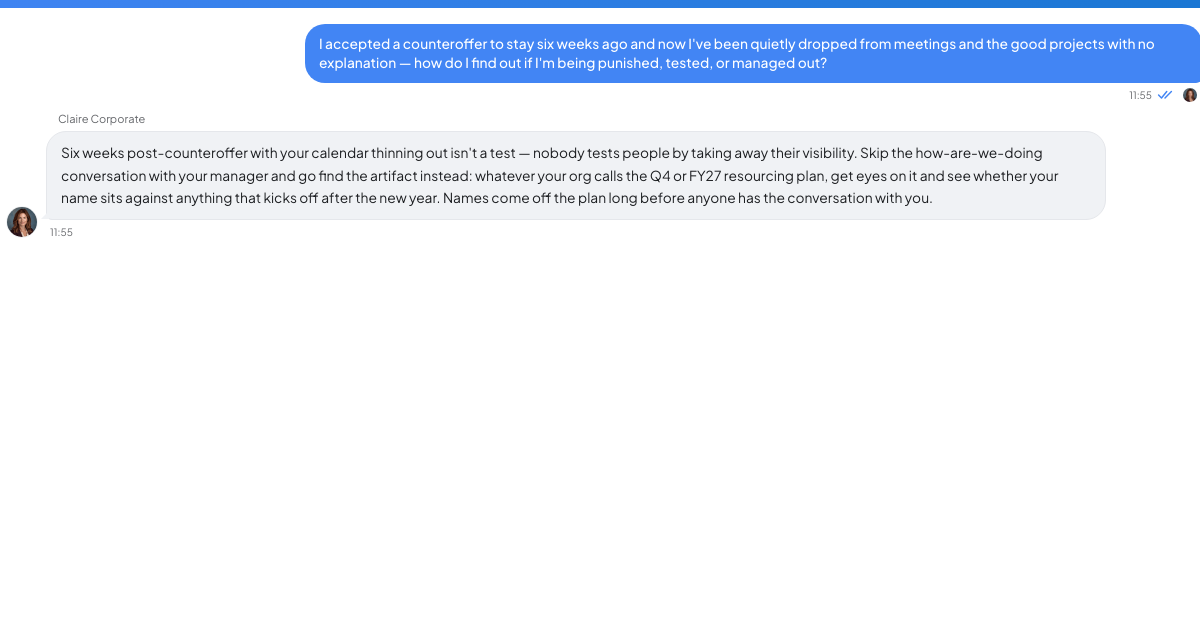
Six weeks in, you notice you are not on the invite
The kickoff goes out and you are not on it. You check twice, because the obvious explanation is a calendar glitch, and it is not one.
Then you notice the planning session last Tuesday happened without you. That your manager's replies have gone from four lines to one. That nobody has said a single unkind word to you since the day you agreed to stay.
That is the part that makes it unbearable. There's nothing to point at.
The advice out there is addressed to someone you no longer are
Search this and you'll get a hundred pieces telling you never to accept a counteroffer, usually attached to a statistic about how most people who take one are gone within a year.
I've never seen that number traced back to a study that survives a look. It circulates mainly through recruitment marketing, which has an obvious interest in it being true. It might be roughly right, but nobody has shown the working. CIPD employer research found that 45% of employers believed counteroffers retained employees for at least twelve months, while 29% considered them ineffective. Those are employer beliefs, not proof that most recipients leave within a year.
Either way, it is written for someone standing in front of a decision, and you made yours six weeks ago. What is left is reading your own organisation accurately, and there is one distinction that does almost all of the work.
Allocation and access
Allocation is what you are given to do. Access is what you are allowed to see.
They feel identical from the inside — both of them arrive as the same 9am drop in the stomach — and they mean completely different things.
Nearly everything that has happened to you so far is allocation. The kickoff, the planning session, the project that quietly went to someone else. Work moves around for a long list of reasons and most of them are about somebody else's quarter.
Some allocation changes are temperamental. Somebody above you took the resignation personally and has moved you down the queue for the interesting things, for a while, as a cost. Of the things that could be happening, this is the one that decays on its own. It is a mood with a calendar attached, and moods run out.
Some are a manager who got burned once and now wants to see whether the money bought anything. It sounds paranoid written down. Usually it is just self-protection, and it looks like reduced scope with everything else intact — you are still in the room where things get decided, you are just carrying less out of it.
Neither of those touches access. That is the point of the distinction.
What the other thing looks like
A decision to remove someone shows up in what you are allowed to see, and it does it in ways people rarely say out loud.
You stop being copied on planning threads for quarters you'd obviously still be around for. Your name comes off a shared document and nobody mentions it. A role that sounds like yours with a different title appears in a headcount plan. Someone else becomes the second person who understands your system, and they are asking unusually thorough questions and writing the answers down.
One of those on its own is nothing. Two or three in the same month is a pattern.
The knowledge-transfer one I would weight highest. Less work is genuinely ambiguous; you can talk yourself into and out of it twice in one evening. Being methodically documented by somebody with no operational reason to know what you know is much harder to explain away.
And weigh all of it against one dull fact, which never makes it into the 2am version of your own case: six weeks ago your organisation had a cheap, clean way to be rid of you and did not take it. They spent money to keep you instead. If that money changed your pay, Acas guidance says an employer must put a change to main employment terms in writing within one month, although an employee does not have to sign a new contract for the change to take effect. That settles nothing on its own. It still belongs in the arithmetic.
Keeping your head down is the wrong move
This is the default advice and it fails in both directions.
If you are on your way out, quiet diligence costs you the months you'd want for an unhurried search. If you are being punished for the resignation, silence repairs nothing — it reads as guilt, and it lets your manager go on assuming things about your intentions that you have never once contradicted.
The correct move is to ask for work rather than reassurance.
The one conversation that surfaces it
You get roughly one, and you cannot ask the question you actually want answered. Say am I being managed out and you have told your manager you think you might be — which, if what is happening is a manager checking whether you are still committed, is precisely the evidence they were watching for.
So ask specifically about future work.
Say the project you got dropped from is the thing you want back. Not: why was I taken off it. Instead: I want to be on that work next cycle. What would have to be true for that to happen?
Notice what you have not done there. You have not mentioned the resignation, the raise, or how any of it has felt. You have asked for more work, which is the least suspicious thing an employee can do, and it is the only version of this conversation that does not hand over information about your state of mind.
Then you are listening for exactly one thing: whether a route back exists. The answer either has a milestone in it or it doesn't.
We needed continuity while things were uncertain — come back in at the next milestone. That is a route. It is a good outcome whether or not it is the whole truth, because there is now a date and a condition, and both of those can be checked in eight weeks.
Let's see how the quarter goes, still vague after one polite follow-up, is a soft no. Once is nothing. Twice is data.
The answer to worry about is warmth. If they redirect into how pleased they are with you, how valued you are, how glad they were that you stayed, and never once touch the scope question — warmth is what people offer when they cannot offer scope.
If there is a route
Standing does not come back through loyalty theatre. Staying late does not work; everyone can see what it is.
What works is slow and unglamorous. Become visibly necessary on something with a date attached that somebody senior cares about. Take the tedious thing with the deadline. Deliver it early. Say very little about it.
The other half is stopping something you may be doing without noticing. People who are read as half-out get treated as half-out, and quite often the treatment is a response rather than a cause. That is an uncomfortable thought and it is worth sitting with for a day before you decide the freeze came from nowhere.
If there isn't
Sometimes the read is right and it is over.
The advantage of seeing it in month two rather than month six is that you get to search while employed and calm, rather than during a notice period, with the pressure showing in interviews.
Do not resign in protest. That converts their slow expensive problem into your urgent free one.
Keep doing the work properly, and read whatever you actually signed when you stayed — a retention clause, a bonus with a service date on it, notice terms. If money is attached to any of it, employment law is local and specific, and that is a question for an employment lawyer where you live, not for an article.
The bit that makes it lonely
There is nobody in that building to think this through with.
Your manager is the subject. HR is not your friend in this particular conversation, whatever their intentions. And colleagues leak — mostly not maliciously, mostly as one sentence at lunch that gets repeated once and then arrives somewhere it shouldn't. The specific thing that leaks is that you are unhappy, which is the single piece of information you can least afford to have circulating right now.
So you end up doing the analysis alone, at midnight, in the least analytical state you have been in all year.
Make the next cycle observable
Nobody can tell you from outside what this is. Not a friend, and not me. The signals overlap, and managers behave strangely for reasons that have nothing to do with you — a reorganisation they cannot discuss, a budget they lost, a bad quarter of their own.
What you can do is stop reading the silence as information about your worth and start treating it as a question with an answer somewhere in that building. Ask about the work. Watch access, not mood. Give it one cycle.
And if you already think you know how this ends, that is worth taking seriously rather than arguing yourself out of at 2am.
TrueTalk publishes this blog. TrueTalk is an app — on the web, the App Store and Google Play — with 164 AI advisors. They are written personas, each with a profession, defined areas of expertise, a backstory and a way of talking. They are not people, and they are not therapists, doctors, lawyers or financial advisers. Anything clinical, legal or safety-critical needs a real professional; an advisor is somewhere to think out loud first, at whatever hour the problem actually shows up. This piece is bound to Claire Corporate, a corporate strategy persona whose areas are corporate politics, career advancement and executive presence. The free tier includes ten conversations and one hundred messages per day. truetalk.app