You Want to Raise Your Rate on the Client Who Gave You Your First Job
Your oldest client pays your oldest rate, and gratitude keeps you there. How to separate the loyalty from the pricing, and send one short message.


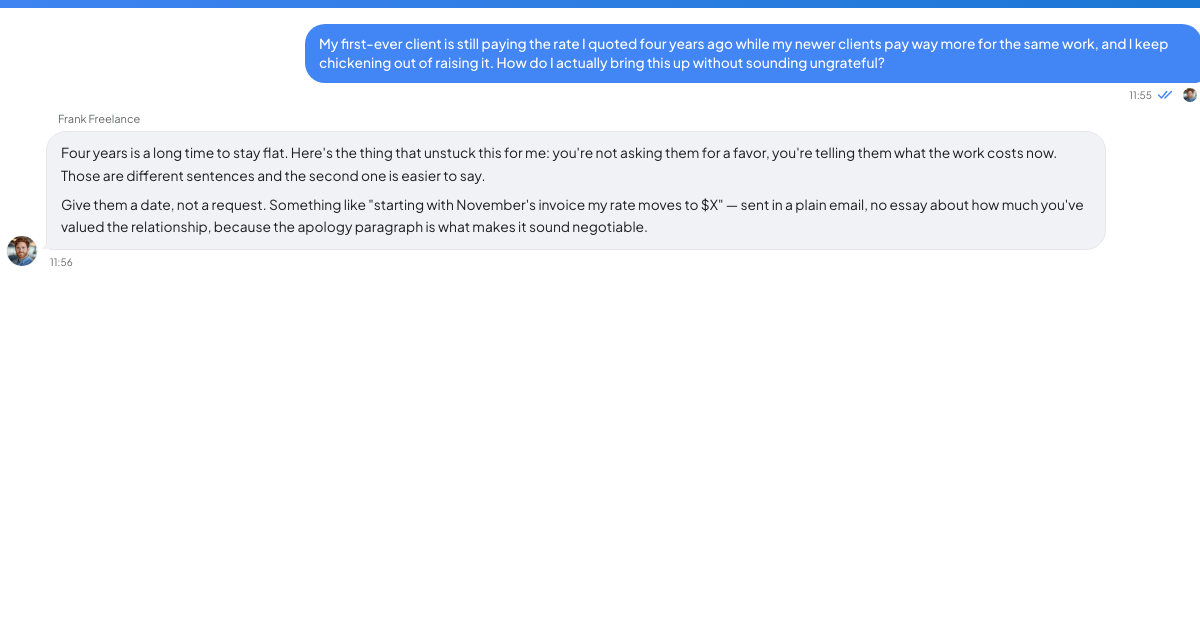
Start at the end: the reply
Imagine finally sending two sentences containing a date and a number.
Then imagine what comes back at 9:04 the next morning, before you have even opened the laptop properly.
No problem, thanks for the heads-up.
I cannot promise you that reply and nobody can. Some clients push back, a few cannot afford it, one or two will make you wait nine days for an answer. But keep 9:04 in view while you read the rest of this, because the eleven months you have spent not sending the message were built on the assumption that a reply like that is impossible.
Let's go back through the eleven months.
The number you set before you knew what you were doing
Four years ago somebody took a chance on you, and you named a figure that felt slightly cheeky as you typed it. Their immediate yes was an early indication that your figure was low.
You have got considerably better at the work since. Your newer clients pay far more for the same thing. That first client is still on the original number.
Every quarter you decide to fix it, and every quarter something makes it the wrong month — they have got a launch on, the new person is still settling in, it is nearly the holidays. The number stays where it is. The resentment goes up a notch, aimed at somebody who has done absolutely nothing wrong.
What is actually happening is that you think you owe them.
Your gratitude is genuine, but it does not belong in the rate calculation.
They took a risk on someone unproven, and that was a genuine kindness. You are right to remember it.
But look at what the debt has quietly turned into. An unlimited, permanent, indexed-to-nothing discount that you keep paying and that neither of you ever agreed to. Nobody sat down in 2022 and decided you would hand this company thousands a year in perpetuity. It happened one un-had conversation at a time.
Lay it out and a decent client would be appalled — that you have been subsidising them, and that you have started to feel used about it. The person who backed a beginner is not usually the person who wants a discount extracted from guilt.
Why are they still paying the old rate? The likeliest explanation is the dull one. Nobody has changed it. Prices do not drift upward on their own.
The fear underneath the fear
Everyone assumes the risk is losing them.
Think about what leaving would actually involve for the person reading your email. Somebody has to brief a new supplier on four years of accumulated context about their business — the internal politics, the thing you are not allowed to say in the newsletter, the reason the March campaign got pulled — and that somebody is them. Any replacement quotes current market rates, which, by your own account, are above what you are about to ask for. That is the switching cost, and it is the part people leave out of the 3am version.
The fear that actually paralyses is a different one, and nobody writes it down: they say yes, and something warm turns transactional.
I would argue that is backwards. Right now you tot up an invisible balance every time you do a job for them, and they have no idea the ledger exists. There's a word for a relationship where one side is quietly counting, and it is not warm.
Two sentences, in writing
Send it in writing because on a call you will discount into the silence — you say the number, four seconds of nothing happens, and you fill it yourself with a concession nobody asked for. Writing also lets them react privately instead of performing a reaction at you.
The two mistakes are over-justifying and apologising, which are the same mistake in different coats. Every extra reason you supply is another thing that can be argued with. Write four paragraphs about rising costs, increased demand and your new certification and you have handed over four negotiating handles. Write two sentences and there is nothing to argue with except the number.
Something like:
Hi [name] — from 1 March my day rate is going to $X (up from $Y). I've held the current rate since we started and it is now well below what I charge elsewhere, so I wanted to give you plenty of notice rather than spring it on you. Everything else stays exactly the same. Happy to talk it through if that is useful.
A date, not a request for permission. I wanted to see whether it might be possible to discuss adjusting my rate opens a negotiation you did not mean to open.
The notice period does the work the apology was trying to do, and does it better, because it has practical value: time to move budget, time to tell whoever needs telling.
Use exactly one clause acknowledging the history. I've held the current rate since we started is plenty — they'll do the rest of the arithmetic themselves, and more generously than you would.
Leave out any phrase resembling I hope that is okay.
On the number: quote what you would quote a new client of the same size for the same work. Check that number against your costs as well as your market: the U.S. Small Business Administration's break-even guidance defines break-even as total cost equalling total revenue and calculates service units as fixed costs divided by price minus variable cost per unit. Remember the costs attached to self-employment when setting the rate. The IRS self-employed individuals guidance says self-employed people generally file an annual return and pay estimated tax quarterly, and that self-employment tax is Social Security and Medicare. If you are nervous, land only slightly under the new-client rate. A legacy client a little below your market rate is fine and defensible for years; a legacy client at half of it is a slow injury you'll keep re-opening every time you invoice.
Do not ask your partner
You'll be tempted to run the message past them, and they are the worst possible reader for it. Not because they are wrong — because the household income goes up if you send it, and both of you know that, so nothing they say arrives clean.
When the loyalty feeling is pointing at something true
Sometimes the old client is a two-person business where the difference is real money rather than a rounding error in a departmental budget. That case is genuinely different and deserves a real answer.
Keep the rate and change the shape of the work.
Offer fewer retainer days, drop the part of the scope that was always marginal, or move to a smaller fixed monthly block; provide less work at the same rate.
A discounted rate stays invisible and permanent. Reduced scope remains visible and can grow when their situation improves, so you can later expand it instead of carrying the discount into 2031.
If 9:04 does not happen
Two things can come back, and a third thing that is not an answer at all.
A no with a date in it. We cannot do it this financial year, can we revisit in six months. Usually honest, and usually fine — if the date goes in writing. Accept that delay once, but not twice.
A no without one. We'll have to think about whether we can continue, or a flat refusal with nothing behind it. The first is negotiation, testing whether your number is real; fold within the hour and you have told them every number you quote is soft. The second leaves you with a decision you would rather not have, and the honest answer is that it turns on your pipeline rather than your feelings about them. Replace the income within a quarter if you can. If you can't, keep the client at the old rate and put a specific date in the calendar to come back to it. Put a real date six months out in the calendar rather than sometime.
And then the nine days of nothing, which is what a lot of people actually get. It is very hard not to read that as horror, and it is almost always somebody on annual leave or waiting for their own budget conversation. Send one short follow-up on day ten. Do not send a softening one. The message you have already sent was fine.
Stop keeping the private account
Whatever comes back, the thing that ends today is the counting.
You have been running a private ledger for four years that the other party does not know exists, adding to it every time you do a job at 2022 prices, and that ledger has done more damage to this relationship than any rate rise could. The damage does not show that they are cold; it occurs because you are the only one who can see the ledger, and you have been getting angrier at somebody who is, from where they are sitting, a perfectly happy client with a supplier they like.
After sending the two sentences, go and do something else for a day, because the reply is not the hard part and never was.
TrueTalk publishes this blog. TrueTalk is an app — on the web, the App Store and Google Play — with 164 AI advisors. They are written personas, each with a profession, defined areas of expertise, a backstory and a way of talking. They are not people, and they are not therapists, doctors, lawyers or financial advisers. Anything clinical, legal or safety-critical needs a real professional; an advisor is somewhere to think out loud first, at whatever hour the problem actually shows up. This piece is bound to Frank Freelance, a freelance business consultant persona whose areas are freelance business, client management and work-life balance. The free tier includes ten conversations and one hundred messages per day. truetalk.app