Your Cofounder Has Stopped Working and You Already Signed 50/50
Separate the work problem from the ownership problem, diagnose what changed first, then read the documents and negotiate with legal review.


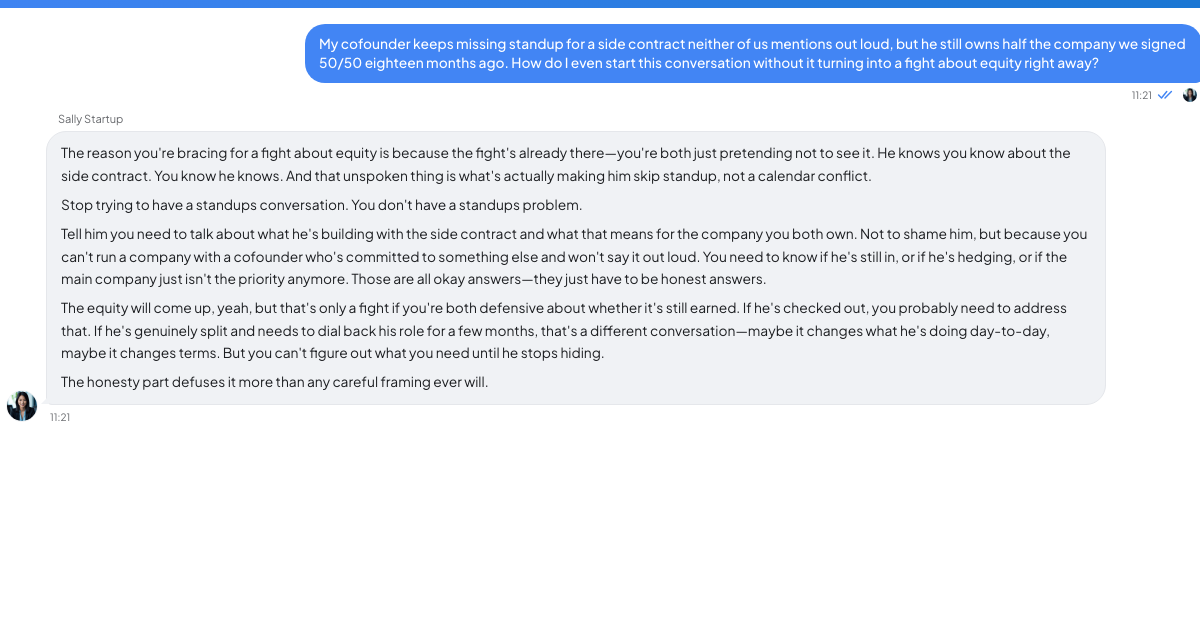
Eighteen months in, you're doing standup alone
He has missed standup again, for the third time this month. At 11:40, he messages that he was on a call; you know it was the side contract, although neither of you has said that aloud.
You finish your work and then take on his.
That evening, you draft about four paragraphs, reread them and delete the message. This cycle has continued since March, making five months of drafts.
Throughout it, he still owns half the company.
Everything written about this is addressed to you eighteen months ago
The retrospective advice says to use vesting, sign a founders' agreement and have the hard conversation early.
Every recommendation is correct, but now it functions purely as blame. You know because you were there when you did not do it, mostly because implying that your friend might stop showing up felt insulting at the time.
Set that retrospective advice aside. You now face two problems that people keep combining: the work problem and the ownership problem. They require different fixes and timelines. If you begin with ownership, you will never get a truthful answer about the work.
Find out what actually happened first
Your theory is clear: he has checked out and is riding your effort while retaining half the equity. That theory may well be right.
In practice, this commonly turns out to be at least three different things, each requiring a different response.
Burnout. The tell is which work has stopped. Burnout takes out the initiating work first — cold outreach, hard decisions, anything requiring a standing start — while the reactive work survives longest. Someone burnt out can often still answer. What they can't do is begin.
A decision already taken. He's leaving and hasn't said so, sometimes because he hasn't fully admitted it to himself. In that reading, the side contract marks the transition already underway rather than a symptom. The tell is financial: he is quietly building an income that doesn't need this company to work. Watch what he protects when something has to give.
A mismatch in what full-time meant. More common than founders like to admit. You both said full-time. You meant sixty hours and no other commitments; he meant a serious job's worth of effort plus the flexibility that comes with owning the place. Neither of you wrote it down, and you've each spent a year privately appalled at the other.
Under that third diagnosis, he believes he has done nothing wrong, so your recurring four-paragraph message will land like an ambush.
You cannot identify the diagnosis from outside his head. The first conversation exists to find out.
The diagnostic conversation
Keep equity entirely out of this first conversation. Mention equity and everything afterward becomes negotiation, leaving you with nothing truthful.
Meet in person if possible, in a place where neither of you is the host. Open with facts and no adjectives — because adjectives are the thing that turns this into a fight about whether you're being fair.
Roughly: over the last three months I've done the customer calls, the releases and the investor updates, and you've been on the other contract two or three days a week. I don't want an argument about it. I want to know what you want the next year to look like.
After the question, stay quiet for an uncomfortably long time. Let the silence run longer than feels reasonable. The first thing people say is a defence; the second thing is often the truth.
You are listening for something other than an apology. It's whether he describes a future with the company in it, in specific terms, containing things he will personally do.
Each of the three diagnoses is workable. Continuing with no answer, as you have been doing, is the unworkable outcome.
Then, on a different day, the ownership conversation
Hold the ownership conversation on another day, ideally in another week.
Beforehand, pull out and read the documents you actually signed rather than relying on memory.
Is there vesting on the founder shares, and if so, what's the cliff, what's the schedule, and is it running from incorporation or from some later date? Cooley explains that a typical founder schedule vests monthly or quarterly over four years and lets the company repurchase unvested shares at the lower of cost or then-current fair market value (Cooley GO). Are the shares subject to a buyback or repurchase right? Does anything address what happens if a founder stops working full-time? Who controls the board seats? Is there a shareholders' agreement separate from the articles, and have you read that too?
The documents usually reveal one of two positions.
Either there is vesting and they'd half-forgotten, in which case time is quietly on your side and the argument for acting now rather than after another year has accrued is obvious. Or there's nothing, and half the company is simply his.
If the second applies, face your position honestly: you have no legal lever, and this becomes a negotiation with someone who can refuse and walk. That's uncomfortable, and it's also clarifying. Your negotiating currency is the plain fact that a company with a disengaged fifty-per-cent holder is worth dramatically less to everybody, him included, and that you are the only person who can currently fix it.
What to propose
Your proposal depends on what the documents and work conversation revealed, which is why order matters.
If he is leaving, propose a negotiated reduction that preserves something real for what he built. Founders in your position usually want him to end up with zero. Zero is rarely achievable and rarely fair — he did build the first part of this, and a deal he considers insulting is a deal he'll fight, slowly, at exactly the moment you need a clean cap table.
If he is staying at lower intensity, rename the role and title honestly and adjust equity to the work he will actually do. The trap is a fudge that lets everyone avoid saying the word part-time. Fudges don't survive diligence and they don't survive a bad quarter.
For burnout, propose a defined break, a return date and a specific definition of returning. And say the second half out loud — that if the return doesn't happen, you'll be back in this conversation, and it'll be a harder one.
All of that touches share transfers, company law and tax. In the United States, the IRS says a Section 83(b) election generally must be filed no later than thirty days after property transfers, illustrating why equity tax steps cannot be improvised later (IRS). Those vary enormously by country and can go wrong in ways that are expensive and hard to reverse — a badly executed founder share transfer can produce a tax consequence for one or both of you on shares nobody has been paid for. Have a startup lawyer draft or review every document before signature. Not to have the conversation for you. To make sure the thing you agree is the thing that actually happens.
Don't leave it for investors to find
You may be tempted to continue and leave the problem for the next raise.
That is the worst available choice for two reasons. Diligence asks who does what, and it talks to your team, and your team knows. A founder problem you disclosed and handled imperfectly is survivable; one that gets discovered is read as information about your judgement rather than his.
And the arithmetic keeps running in the meantime. Every month you don't have this conversation, more of what you personally build gets owned by someone who isn't building it.
The friendship
You may lose the friendship, a possibility most advice avoids stating.
The loss is not certain, but it is possible and will probably last a year or so even when the friendship recovers.
What seems to matter most is whether he hears it from you or from a lawyer's letter, and whether you discussed the work before the money. That's the whole reason for the order.
There's also a version where the friendship survives intact and the company doesn't survive the compromise you made to protect it. Which of those you'd rather have is a question about what you want the next few years of your life to contain, not a business question, and there's no general answer to it. It's worth knowing what you'd choose before you're in the room.
Rehearsing it
Five months of drafting amounts to rehearsal without a partner rather than indecision.
TrueTalk has an AI advisor called Sally Startup, a serial entrepreneur persona whose areas are startup founding, product development and venture capital. It's an AI advisor — not a human cofounder coach, and not a lawyer — but you can say the whole thing out loud with the real history in it, at midnight, and hear how your opening lines sound coming back at you. The free tier includes ten conversations and one hundred messages per day. Anything touching the documents still goes to a lawyer.
Pick the date
Pick a date this week rather than sometime this quarter.
Send the invite with an unremarkable title and a real slot. Waiting will not make the conversation easier; it will increase the amount the two of you must argue about.