Your Down Payment Is in the Market, You Close in March, and It Just Dropped 18%
Work backward from closing, learn the lender’s sourcing rules, move risk on a fixed schedule, and leave enough time for cash to be documented.


Six months is not long enough to be right about anything
On a Tuesday morning in September, you open the brokerage app as you have on most mornings for four years, and the number looks wrong. It is not catastrophic, but it is eighteen percent below the number around which you quietly built a life.
Your down payment was thirty thousand dollars; now it is less, and closing remains in March.
Every article tells you that money needed within five years should stay out of the market. That guidance is correct but useless now, because the money is already invested after four years of choices that felt responsible. Nobody starts a savings pot planning to buy a house. It becomes a down payment somewhere around year three, and by then the money has already made its own choices.
Set the chart aside and work backward from March.
Count backwards, not forwards
Treat the closing date as fixed. Nearly every other decision hangs from that date.
Closing day. Funds must be cleared, in your name and held in a wire-ready account rather than settling or pending.
A few days before that. Wire. Escrow may need a cashier's check or a wire from an account they've already seen. Before wiring, verify the account name and number in person or through a previously agreed phone number; the CFPB warns that scammers impersonate settlement professionals with altered instructions (CFPB).
Two to four weeks before. Final underwriting review. Underwriters often re-pull bank statements shortly before closing, and a five-figure deposit that appeared last week will be asked about.
Roughly sixty days before. This is the one that changes the whole calculation. Lenders typically want two months of statements on the accounts your funds are coming from, and anything that arrived recently and looks large gets flagged for sourcing. Fannie Mae's selling guide currently defines a large deposit for a purchase as one deposit exceeding fifty percent of total monthly qualifying income; when those funds are needed for the down payment, closing costs or reserves, the lender must document an acceptable source (Fannie Mae). Check the current threshold because it moves, and remember that money you cannot source can be excluded from qualifying funds entirely.
Whenever you apply. Your loan officer will tell you which assets count and at what percentage. Ask this early and get it in writing.
Reverse the timeline. For a March closing, aim to have the money in cash in a normal bank account around December or January. Do not wait until March.
Your usable runway is therefore three or perhaps four months rather than six.
The lender rules nobody puts in the "should I sell" articles
Two lender details matter more than your market forecast.
First, cryptocurrency generally becomes eligible for a conventional loan only after conversion to dollars, placement in a regulated US financial institution and documentation of that conversion. Use that rule as a scheduling instruction. On the standard conventional path, your ETH is not down payment funds. Fannie Mae also says converted virtual currency must be documented, held in a US- or state-regulated financial institution and verified in dollars before closing; it cannot fund the earnest-money deposit (Fannie Mae). It's a thing that can become down payment funds, after a conversion and a transfer, with a paper trail at every step — and then the converted money still has to survive the large-deposit sourcing question above. If you plan to hold it until February and then convert, you've built a plan around the asset that needs the most lead time.
Second, lenders treat brokerage securities differently from bank cash. Some lenders and programs apply a discount to their value, some want proof of liquidation before they'll count them toward funds to close, and requirements vary by program and by lender. No general online answer can establish your lender's rule. Ask your loan officer today and get the answer in one email.
The recovery math, out loud
Recovering from an eighteen percent decline requires roughly a twenty-two percent gain. The arithmetic is one divided by 0.82.
"Wait for a recovery" is asking for a twenty-two percent move inside three or four months. Markets sometimes deliver such a move. Nobody knows whether this market will, and anyone claiming certainty is revealing themselves rather than the market.
Use the less popular premise that the drop's size should have almost no bearing on your decision. The loss is already behind you. The market neither knows your purchase price nor accommodates your March closing. The only live question is what you want your risk to look like on the day you need the money — and the honest answer for a purchase with a date attached is: low.
De-risking in stages, which is not the same as timing anything
Selling everything on one Tuesday makes that Tuesday's price the bet. A fixed tranche schedule set now refuses that single-date bet.
Say you decide on four sales, one every three weeks, the first one this month, aimed at being fully in cash by December. Put all four dates on the calendar now. Then execute them regardless of what the chart is doing, because the entire value of a schedule is that it removes you from the decision. Changing it when the price dips is how a schedule becomes a series of impulses wearing a plan's clothing.
One reasonable variation is to sell the amount actually needed first and let the surplus remain invested longer. Sell the riskiest holding first — if part of this is ETH, that's the piece with both the widest range of outcomes and the longest lender-side runway, so it goes first on both counts.
Check taxes before clicking sell. Selling at a gain has consequences; selling at a loss may offset gains elsewhere. The IRS currently limits excess net capital loss deductions against ordinary income to $3,000, or $1,500 if married filing separately, with additional loss carried forward (IRS). Wash sale rules don't currently apply to crypto the way they do to stocks — section 1091 is written around stock and securities, and crypto is treated as property — though proposals to change that keep surfacing. Ask a preparer about your specific holdings rather than trusting a forum.
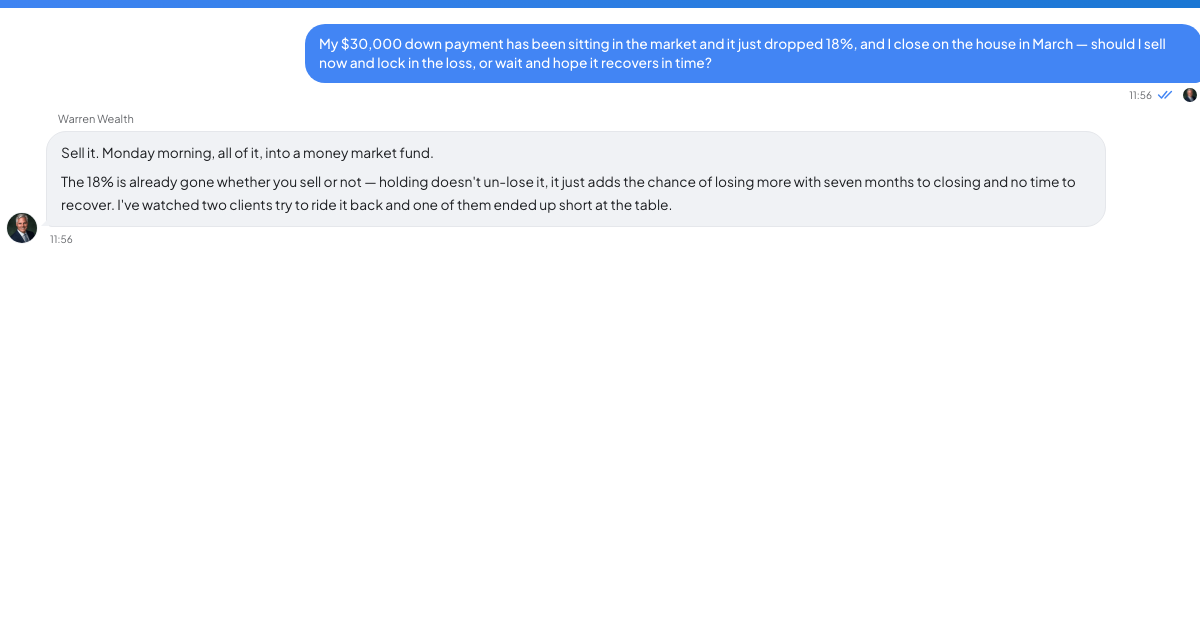
TrueTalk offers Warren Wealth, an AI persona described in the catalogue as an investment research educator with twenty-five years of market experience. It's not a human adviser and it doesn't know your lender's overlays or your tax situation. What it's decent for is the part where you're trying to think through a tranche schedule at eleven at night and don't want to explain four years of savings history to a stranger first. It's available instantly.
Where this doesn't apply
If there is no accepted offer or contract and the date is only "sometime next spring," your closing date is not real, so stop treating a wish as a deadline.
When selling realizes a large gain with an unpleasant tax effect, the arithmetic can change enough to justify an hour with a professional before acting.
If buying genuinely requires a recovery, say plainly that you have a budget problem rather than a down payment problem and are asking the market to solve it. It might. It's under no obligation to.
Today, put the December or January cash deadline on your calendar and ask your loan officer where the funds must sit. The fatal outcome is arriving in February with the right amount in the wrong place, unseasoned and unsourced, because that can move the closing for a reason unrelated to the market; the exact timing of an earlier sale is secondary.