Your Mother Is Buying Gift Cards for a Man Who Doesn't Exist, and She Won't Hear It
You showed her the evidence and she stopped taking your calls. Stop arguing about the man, name the scam's moves, protect the accounts, and keep contact open.


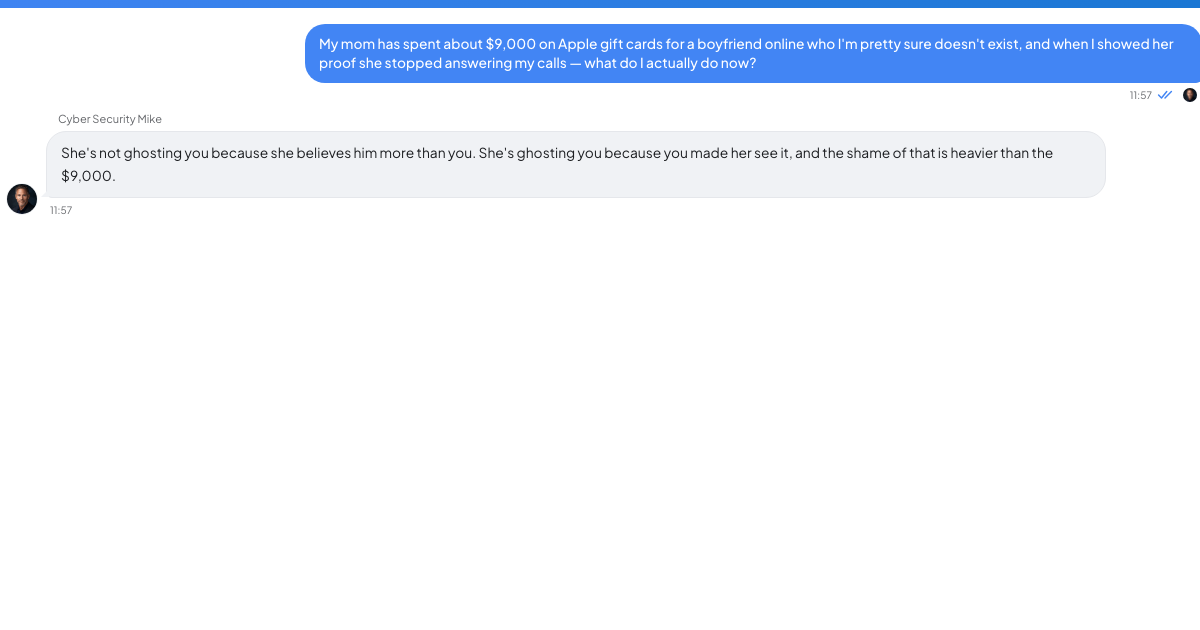
After the kitchen argument
There are nine thousand dollars in Apple gift cards beside the fruit bowl. You counted twice, said scam, and watched your mother shut down. By the end you were jealous, controlling or after her money. She has not answered since Tuesday.
Proof can make this worse because accepting it carries a brutal price. She would have to concede that the man who texted her good morning every day for months never existed, that the relationship which got her through a bad winter was a script, that a stranger played her at her age while her children watched, and that the money is gone. Defending him costs less today. Every fresh piece of proof raises the emotional price of admitting the truth. Another reverse-image printout makes the door heavier, so stop building the prosecution.
Describe the pattern instead. Apple says its gift cards buy only Apple products and services, never hospital bills, utilities or government fees. Its current guidance says scammers commonly build trust or romantic interest, create urgency, guide the purchase step by step and demand the redemption code (Apple Support). The US Federal Trade Commission is categorical: no real business or government agency insists on gift-card payment — not the IRS, a bank, a hospital or a shipping company. Those are facts she can compare with her own messages without first agreeing that he is imaginary.
Ask what happened, in order
Romance fraud often follows a repeatable sequence. The FBI's IC3 has warned that these operations use scripts, and handwritten versions of the scripts have been found in seizures. The people running them do this professionally rather than improvising one relationship at a time:
- Fast intimacy: constant contact within a fortnight and plans for a future within a month. Faster intimacy brings the first financial request sooner, before questions arrive.
- Separation: he warns that her family will be jealous or think he wants money. Your objection was discredited before you made it.
- No live camera: offshore work, deployment, a broken phone or hospital rules always prevent video.
- A timed crisis: customs, surgery or shipping must be paid before morning, leaving no time to tell anyone.
- A small first ask: perhaps a hundred dollars, repaid promptly to establish that he pays people back, before the larger demand. Earlier payments then make walking away harder.
Ask her to recall which of these happened and when. Name professional manipulation rather than gullibility. Prediction is the strongest tool available. Calmly forecast an emergency when she says money is tight, offence when she requests video, or a claim that her family wants to split them. If it occurs, she has observed the pattern herself.
Do not promise that recognition will land immediately. Some people need the scheme to fail on its own schedule. Staying reachable may be the useful work for now.
Act on the money today
Call the gift-card issuer with the cards and receipts. Apple warns that once a stranger has the numbers, the funds might be spent before Apple or law enforcement can be contacted; in the United States it directs victims to Apple Support or 800-275-2273 and to say "gift cards" (Apple Support). In practice, the funds will probably be spent before you reach either Apple or law enforcement. Gift-card redemption codes travel instantly and then vanish. Other gift-card issuers maintain their own fraud lines. Same-day calls occasionally catch an unspent balance, so make that call before finishing a complete evidence file.
Call the bank's fraud department rather than the branch counter. Ask about wire and transfer limits and account alerts. The Consumer Financial Protection Bureau advises contacting the relevant bank, credit union, card company or other provider as soon as possible; it also notes that some states let financial institutions place a temporary hold when elder financial abuse is suspected (CFPB). The bank decides what it can lawfully do.
Report the case at reportfraud.ftc.gov and, because it happened online, the FBI's IC3. File with local police and retain the report number because some banks and insurers will not discuss the case without one. Nobody is likely to recover the money; the purpose is to create a usable record.
Freeze her credit with Equifax, Experian and TransUnion. Federal law makes freezes free, and they block the common second act of opening accounts in her name. Preserve chats, photographs, card numbers, receipts and payment confirmations. The messages, photos and payment confirmations are the only evidence anyone will ever have, and your mother will delete them when she decides to protect the scammer, so screenshot everything.
Know when family persuasion has ended
Know this threshold now rather than discovering it eighteen months later. Escalate if money continues to leave, a new person appears on an account, or she receives strangers' transfers and forwards them. That last pattern can turn a victim into a money mule with criminal exposure.
The CFPB classifies financial exploitation as elder abuse and recommends reporting suspected abuse to local adult protective services and police; it also points families toward legal advice about available remedies (CFPB). Adult protective services has a route in every state. In the United States, the Eldercare Locator at 1-800-677-1116 can identify the local agency. Call an elder-law attorney as well. Powers of attorney, capacity and guardianship carry legal and medical consequences on both sides, including consequences for your relationship with her, and belong with professionals rather than adult children working from internet research. Ask before the crisis forces the question.
Cyber Security Mike on TrueTalk is an AI, not adult protective services or a lawyer. At three in the morning, you can use it to list what information may already be circulating before you make those calls. The free tier includes ten conversations and one hundred messages per day. If money is moving, call the bank and professionals.
Keep ordinary contact going: the dog, weather, a photograph of the kids. Do not attach another argument about him. The scheme usually does collapse. The person still on speaking terms with her that day is the person able to help, so she needs somewhere to land that is not waiting to say it was right. Text her tomorrow about the dog.