Your Mum Comments on Your Body Every Single Visit
A boundary is more than its opening sentence. Plan the Christmas exits, make one precise request, choose a consequence you will keep, and prepare for her tears.


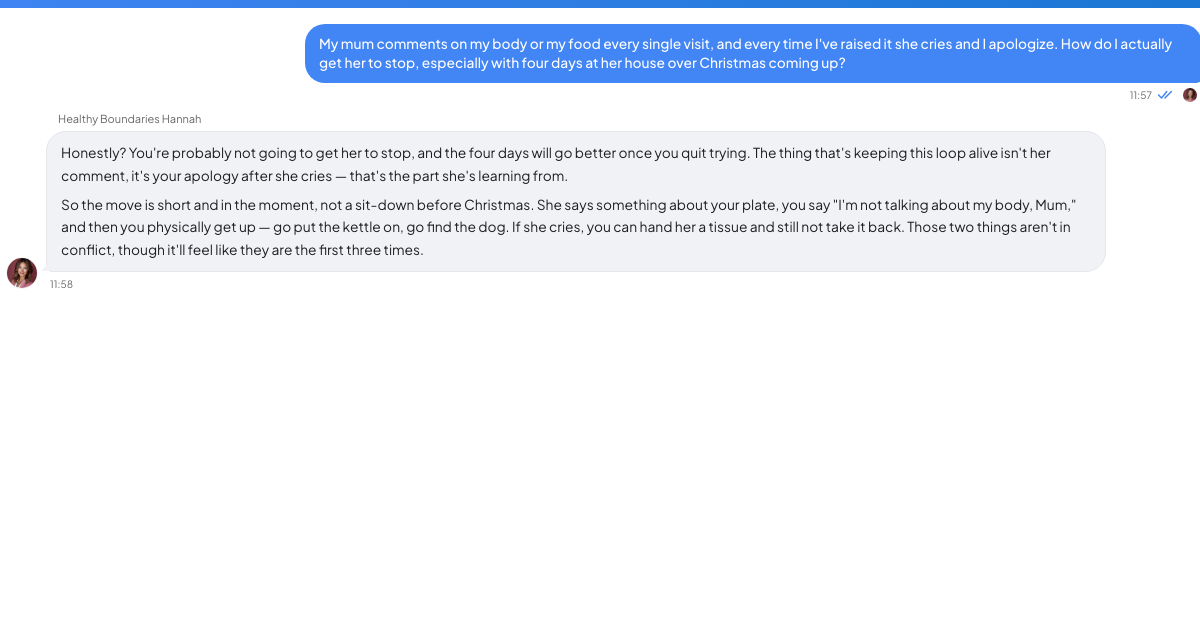
Plan December before making the call
Christmas is four months away, and you arrive at her house on the 23rd for four days. She opens the door, looks you up and down and says either "you've filled out a bit" or "you're not eating enough, are you?" Either version takes the same three seconds, every visit. The drive home is manageable. Tuesday, the following weekend and the next fortnight are where the old voice returns after two years of work quieting it.
You remember raising this twice and think there may have been a third attempt. Every attempt you remember ended at stage two: she cried, you apologised and someone put the kettle on. Stage three never began because you had not decided on a consequence beforehand. Trying to invent that consequence in your mother's kitchen, after stage two has already collapsed, will produce the same result. This time, work backwards from Christmas.
Book a hotel for two nights, a friend's room or a cousin's spare room now if you can. Separate accommodation turns a four-day stay into visits you can leave; that single change does more work than any script on this page. Do not wait until November or the 20th. If staying elsewhere is impossible, arrange exits: announce on day one that a walk after lunch is your new routine, plan a drive on the 24th, have your own car if there is any way, and choose a routine reason to leave the room such as the kettle, loo or checking the car. You will use that room-exit move frequently; while you are staying in a house you cannot leave, it is the only consequence available.
Brief one sibling or your partner before arrival. Their job is to change the subject, not prosecute your case; that small manoeuvre works remarkably well. A week before Christmas, pre-empt the comment with a reminder; it is easier for both of you than correcting her afterwards. Send: "Looking forward to it. Just a reminder of the thing I asked about — no comments on how I look or what's on my plate. Means a lot."
That request needs to exist before the reminder. Make the phone call soon, on an ordinary Tuesday.
Decide all four stages before dialling
1. The request. Give no history or justification, do not phrase it as a question, and make it by phone — not in the hallway, at a family event or within thirty seconds after another comment. Keep it behavioural, short and non-negotiable: "Mum, I need you to stop commenting on my body and what I eat. Not smaller comments. None. It's important to me." Do not lead with how it makes you feel; that opens a conversation about feelings, especially hers, and the request can disappear into a trial about whether she is a bad mother. There is no perfect wording that guarantees she will hear it, and her crying would not prove the wording defective. Explaining invites a debate about whether your reason is adequate, and you will lose that debate because she has known you since birth and believes she means well. She may mean well; intention is not the behaviour you are asking her to stop.
2. The repeat. Assume the old habit will appear again. Say, "That's the thing I asked you not to do," then change the subject yourself. The first repeat is not proof that she does not care, and it does not require an escalation you cannot sustain.
3. A consequence you will carry out. End the conversation or visit briefly: "I'm going to head off now. I'll call you Wednesday." Leave, then call on Wednesday. That follow-through attaches the consequence to the comment without threatening an estrangement you do not want. A consequence you do not enforce teaches her that the boundary is decorative. A small repeatable response is more useful than a dramatic one you abandon.
4. Your aftermath. Choose now whom you will message on the drive home. The two weeks afterwards are part of the injury, and telling a trusted person what happened makes that aftermath substantially shorter.
The NHS advises families supporting someone with an eating disorder to avoid comments about appearance, even complimentary ones, and to avoid discussion of diets or weight (NHS). That gives you an external, specific standard if you need one; it does not turn the boundary into a debate she must approve.
When she cries, remain kind and keep the request
She will cry. Her distress is not evidence that you did something wrong; those feel identical when it is your mother, but they are distinct facts. Decide your response before hearing it: stay, be kind, and say, "I know that's hard to hear. I'm not angry with you. I'm not taking it back." Then allow the silence. It will last longer than feels tolerable, and then it will pass. Filling it with explanations is how the request becomes a retraction.
If crying turns into "so I can't say anything right" or "you've changed," leave warmly: "Let's talk when it's calmer." Do not add a parting shot.
If your sister, aunt or another relative calls to report that Mum is in bits, use one line: "I've asked her not to comment on my body. That's all it is." Repeating the same boring sentence produces no new argument, which makes it difficult for relatives to keep pressing.
Healthy Boundaries Hannah on TrueTalk is an AI persona, not a therapist. You can practise that sentence twenty times before saying it once to your mother, or use it at whatever hour the visit ends, when you have begun convincing yourself that you overreacted. The free tier includes ten conversations and one hundred messages per day.
Watch for relapse, not just boundary failure
If the fortnight after a visit includes counting, checking, skipping food, mirror scrutiny or old rules returning, seek clinical help rather than relying on scripts. Tell your GP plainly that you have an eating-disorder history and are noticing old behaviours. Ask for referral to an eating-disorder service.
NICE says people with suspected eating disorders should be assessed and treated at the earliest opportunity; its quality standard links early intervention with better recovery rates and a lower risk of relapse (NICE). The same standard expects children and young people to begin assessment and treatment within four weeks, while adult timing follows locally agreed pathways. Do not wait for your appearance or weight to prove severity.
Eating disorders are illnesses with established treatments, and relapse can be part of recovery rather than a personal failure. An AI conversation or article can help you organise a thought, but it is not treatment and must not replace it.
Your mother may never stop completely. If she changes only partway, the practical gain is that you no longer lose a fortnight to every visit because transport, a separate room, an enforceable consequence and personal support are already arranged.