An IRS Letter About Crypto Arrived and You Have Four Years of Trades and No Records
IRS letters 6174, 6174-A, 6173 and a CP2000 ask for completely different things. How to tell them apart, then rebuild a defensible transaction history when the exchange is gone.


Identify the notice before you start reconstructing trades
The envelope has sat on the kitchen table for two days and you have read it four times. It says "virtual currency" somewhere in paragraph two; the upper-right corner says 6174, 6174-A, 6173, or CP2000. Start with that code. These letters are different, and treating them as one category can mean either needless dread over a courtesy notice or a missed deadline.
6174 is educational. It states reporting rules, accuses you of nothing, and requires no response. Amend a return you know was wrong, but the notice itself is not asking. 6174-A says the IRS has information suggesting you may not have properly reported virtual-currency transactions. It still requires no response, which is not the same as nobody looking at you.
6173 has a response date. By it, provide amended or delinquent returns, or a statement signed under penalties of perjury explaining why you believe you already complied. The letter says that nonresponse may refer your account for examination. CP2000 is a proposed change to one return where third-party reporting differs from your filing. It has its own printed response window. It is a proposal rather than a bill, and crypto versions are often wrong for a reason worth documenting.
Gross proceeds are not necessarily your gain
The IRS separates digital-asset guidance before January 1, 2025 from guidance generally applying on or after that date: IRS digital assets guidance.
Imagine buying on an exchange, moving coins to a hardware wallet, then a second wallet, sending them to a DeFi protocol, pulling them back, and selling part through another exchange three years later. You moved your own property between wallets you controlled. Virtual currency is property under IRS treatment; those internal wallet transfers are not dispositions and do not trigger gain.
Reporting systems historically captured gross proceeds, what left and at what price, without your acquisition cost or proof that incoming coins were your own transfer. They can add outflows into apparent income. Six wallets and two exchanges may leave a paper trail of huge sales even when you are roughly flat. That is not a phone-call defense. You must show the work.
Reconstruct the history in this order
Revenue Procedure 2024-28 says specific-identification records should state acquisition date and time, basis and fair-market value, disposal date and time, and what was received: Rev. Proc. 2024-28. Do not begin with software that expects clean CSV exports from exchanges that survived.
Begin with bank and card statements: every dollar wired in and every dollar that came back out. These are contemporaneous third-party records. If fiat in was $52,000 over four years and fiat out was $61,000, you have strong evidence of net cash position. It is context, not a ceiling on taxable gain; crypto-to-crypto trades, spent coins, and coins received as income can be taxable without a bank movement.
Next, list every controlled address, even an address you think is empty. An HD wallet's extended public key can give you the tree instead of only the four addresses you remember. Use Etherscan and equivalent explorers for transaction histories. Etherscan CSV exports top out at 5,000 rows, and some explorers now require an account. Export in chunks, keep the raw download exactly as received, and rename nothing. Its on-chain timestamps were written when transactions happened. You are reading evidence rather than relying on memory.
Label internal transfers before touching anything else in the sheet. That step turns apparent sales back into the transfers they were.
Dead exchanges are slower. A failed platform often leaves a claims administrator whose portal produced creditor statements. Search your email for deposits, trades, monthly statements, and password resets. The last item proves only that an account existed on a particular date, but that can still be useful.
Select a basis method and hold it. Specific ID needs records linking the exact unit to acquisition date, basis, sale date, and proceeds; without records, there is no specific ID. Basis tracking across wallets changed for years beginning in 2025: Revenue Procedure 2024-28 moved to a per-wallet footing. Your preparer must know which years fall on either side.
Write a dated memo last, while the work is fresh: source material, assumptions, and reasons. Courts have accepted reasonable estimation when records were destroyed through no fault of the taxpayer under the Cohan rule, but that doctrine has limits and is not permission to invent numbers.
Documentation changes the result
Unestablished cost means zero basis, so every dollar of proceeds is gain. If explorers show $180,000 of gross proceeds over four years, zero basis produces $180,000 of taxable gain. A reconstruction showing $164,000 spent acquiring coins produces $16,000 instead. The trades and wallets are identical; documentation is the difference. Spend a weekend on spreadsheets before paying an hourly professional.
Know where DIY stops
A 6173 response is signed under penalties of perjury. Use a CPA or enrolled agent for reconstruction and returns. If deliberate omission is realistically possible rather than disorganization, talk to a tax attorney first: IRC 7525's federal accountant privilege does not extend to criminal matters, and an attorney who engages the accountant is the standard way to keep work inside privilege. The order cannot be undone.
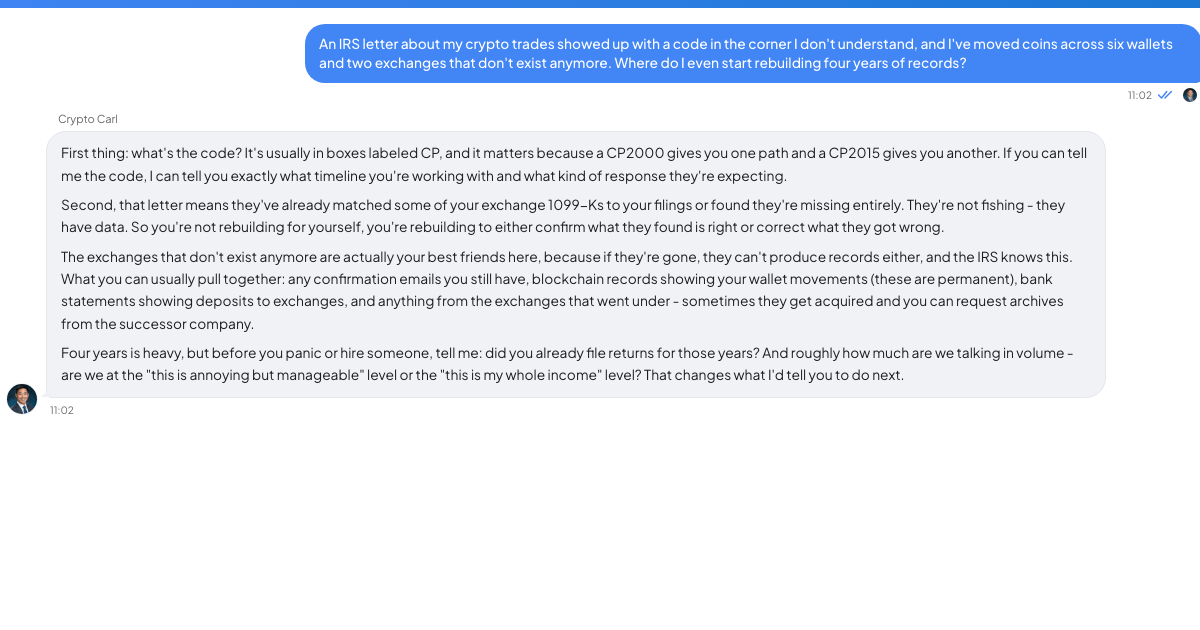
At one in the morning, TrueTalk's Crypto Carl can help you identify the notice, list needed wallets and chains, and distinguish a real issue from something that only looks awful in the dark. Crypto Carl is an AI persona with a blockchain background working on crypto investment and digital assets. It cannot sign anything, is not your CPA, and cannot respond to the IRS for you.
Privacy tooling, platforms with no records, and bridges that do not reconcile cleanly can make reconstruction genuinely partial. Say so in the memo where nobody can know; do not invent a tidy figure. If the code is 6173 or CP2000, its printed date is real. Reconstruction takes weeks, and finding a professional during filing season takes longer than expected. Pull bank statements tonight if you can.