Can They Lay Me Off While I'm on Maternity Leave?
In the US, yes, a genuine layoff can include someone on leave, but the employer has to prove you would have been cut anyway. Here is how to test that and what to do this week.


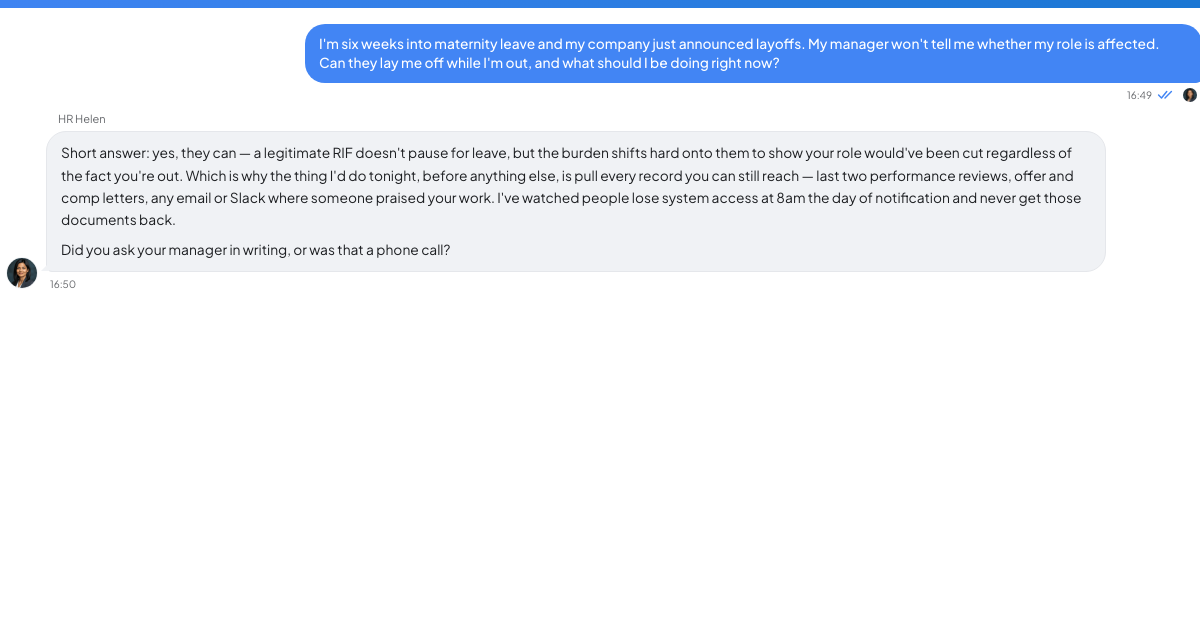
In the United States, an employer can lay you off while you are on maternity leave if the layoff is genuine and you would have been included even if you had not been on leave. What they cannot do is pick you because you are on leave or because you are pregnant. This post covers US federal rules; other countries, and some states, protect parents more strongly.
What does the law say about layoffs during FMLA leave?
The federal Family and Medical Leave Act (FMLA) gives eligible employees up to 12 workweeks of job-protected leave in a 12-month period. You are eligible if you have worked for the employer at least 12 months, put in at least 1,250 hours in the 12 months before leave starts, and work at a site with 50 or more employees within 75 miles. The Department of Labor's FMLA fact sheet lists all three conditions and says employees must be restored to the same or a virtually identical position on return.
That restoration right has a limit. Under 29 CFR 825.216, if you are laid off during leave and your employment ends, the employer's duties to continue leave, maintain group health coverage and restore your job stop at that point. The same rule puts the burden of proof on the employer: it must show that you would have been laid off during the leave period regardless. Leave protects you from being singled out. It does not make you uncuttable when the whole team is being cut.
Is it pregnancy discrimination?
The EEOC states that Title VII, as amended by the Pregnancy Discrimination Act, prohibits pregnancy discrimination, and its pregnancy discrimination page lists firing, layoff and termination among the covered employment actions. So a layoff is unlawful if pregnancy, childbirth or a related condition is what put you on the list.
Here is how that plays out. Suppose a company eliminates a whole product team of eleven people and you are one of them. That looks like a business decision. Suppose instead a team of twelve loses one person, and she is the one who left in March for leave. That deserves a harder look. The test is not whether the timing hurts. The test is whether the selection would have been the same had you been at your desk.
How do I tell a real layoff from a convenient one?
Ask for specifics in writing, politely. A real reduction in force usually leaves a trail you can check:
- A defined scope. Which teams or roles were affected, and how many people.
- Selection criteria. Seniority, role elimination, location, performance ratings. Ask which applied to you.
- A decision date. If the decision was made before you announced the pregnancy or requested leave, that helps the employer. If it was made after, ask why.
- Who else was affected. If every other person in your role was kept and you were the only one cut, note it.
- Whether your duties still exist. If your job is posted again within weeks under a new title, that is worth recording.
You can say it plainly in an email: "Thank you for letting me know. Could you share the criteria used to select roles for this reduction, the date the decision was made, and the number of people in my role who were affected?" You are not accusing anyone. You are gathering facts.
What should I do in the first week?
- Do not sign the separation agreement on the day. Ask how long you have to review it, and ask for it as a document you can take home.
- Ask about health coverage. Your group plan may stop at termination, and that matters during a postpartum period. Ask the exact end date and the COBRA election window. Start this conversation early, because a gap in insurance is expensive right after a birth.
- Save records. Your leave approval, performance reviews, emails about the pregnancy or leave, and any messages from your manager since you announced. Keep them in a personal account, not on a company laptop.
- Write down what happened. Date, time, who was in the room, exact words. Do it the same day.
- Check the deadline. The DOL's FMLA protections fact sheet says allegations generally must be raised within two years of the violation, and discrimination charges carry their own deadlines, so ask a lawyer or the EEOC which applies to you. Treat the clock as running.
When should I talk to an employment lawyer?
More often than people expect. Many employment lawyers offer a first consultation free or cheap, and you do not have to decide anything in it. Go if any of these are true: you were cut and others in your role were not; your manager's tone changed after you announced the pregnancy; the layoff came days after you asked for leave or extended it; or the severance offer comes with a release you are being asked to sign. A release often gives up your right to sue, so a lawyer should read it first. If the agreement is a fair price for a fair layoff, a lawyer will tell you that too, and it costs you an hour.
If company-wide layoffs are involved, also read do laid-off employees get severance for what a federal notice rule can and cannot get you.
How do I handle the money and the job search with a newborn?
Separate the two questions. The legal question has a deadline and a paper trail. The practical question is income. Check unemployment eligibility with your state labor department early, because rules on who counts as available for work vary by state. Then give yourself a realistic job-search schedule: two or three focused hours on days when childcare exists is a plan, whereas trying to apply at 3 a.m. between feeds is not.
When you do interview, a gap that includes leave and a layoff is easy to explain in two sentences: "I was laid off in a reduction while on parental leave. I am ready to start now." You do not owe anyone the details. If it helps to rehearse that answer or sort out what to ask HR, HR Helen, one of TrueTalk's AI advisors with a background in human resources strategy, can walk through the wording with you. She is not a lawyer, and the question of whether your layoff was lawful belongs with one.