Do Laid-Off Employees Get Severance? What the Law Requires and What You Can Ask For
In the US no federal law requires severance. WARN notice covers larger layoffs, and everything else is contract, policy or negotiation. Here is how to ask for more.


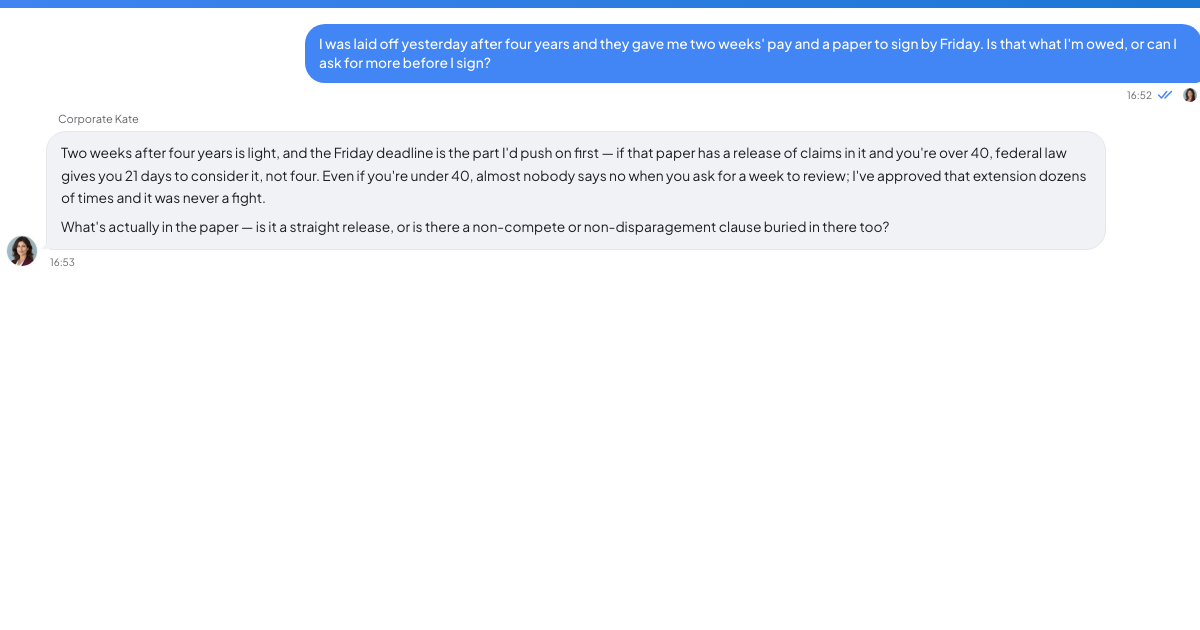
In the United States, no federal law requires an employer to pay severance to laid-off employees. Severance is owed only if your contract, a company plan or policy, or a union agreement says so, or if the company offers it in exchange for you signing a release. Larger layoffs trigger a separate federal rule, the WARN Act, which requires advance notice but not a cash payout. These are US rules; other countries, such as the UK, have statutory redundancy pay.
Is severance pay required by law?
The Department of Labor's FLSA advisor is blunt: "There is no requirement in the FLSA for severance pay," and severance "is a matter of agreement between an employer and an employee (or the employee's representative)." The same page notes that the Employee Benefits Security Administration may be able to help an employee who did not receive severance required by an employment contract.
So your first job is to find out whether an agreement exists. Look in these places:
- Your offer letter or employment contract. Search for "severance," "termination without cause" and "notice."
- The employee handbook or a severance plan document. Some companies have a formula, often a number of weeks per year of service.
- A union or collective bargaining agreement.
- Past practice. If everyone cut last spring got two weeks per year served, that is a useful benchmark when you ask, even if it is not binding on its own.
Some states add their own rules, so check with your state labor department. I have not verified individual state requirements for this post.
What does the WARN Act actually require?
The Worker Adjustment and Retraining Notification Act is often mistaken for a severance law. It is a notice law. Under 29 U.S.C. 2102, a covered employer may not order a plant closing or mass layoff until the end of a 60-day period after it gives written notice to affected employees (or their representative), the state, and local government.
Who is covered is narrower than people assume. Under 29 U.S.C. 2101, a covered employer generally has 100 or more employees, not counting part-timers. A mass layoff means an employment loss in a 30-day period for at least 33 percent of employees and at least 50 employees, or at least 500 employees. A plant closing means a shutdown of a single site that causes employment loss for 50 or more employees.
If an employer skips the notice, 29 U.S.C. 2104 makes it liable to each aggrieved employee for back pay and benefits for each day of the violation, up to a maximum of 60 days. If your layoff is large and you got less than 60 days of notice or pay, that is worth raising with an employment lawyer or the state rapid-response office.
Smaller layoffs, say 8 out of 90 people, are usually outside WARN entirely, which is why so many people hear "effective today" with no notice period.
Why do some employers offer severance when no law says they must?
Because a signed release is valuable to them. Typical severance agreements ask you to give up the right to sue over your employment, agree not to disparage the company, and sometimes accept a non-compete or a confidentiality clause. The money is the price of that paper. That logic has a practical consequence: if you are offered severance, they want something from you, so you have room to ask for something back.
How do I negotiate a severance package?
You usually have more room than you think, particularly if you have long service, if you are in a smaller group of people being cut, or if you hold information about the business. Here is a workable order of operations:
- Do not sign in the meeting. Say: "Thank you for the information. I would like to review the full agreement and come back to you by Friday." Ask for the written terms and the deadline.
- List what you want beyond weeks of pay. Common asks: more weeks, company-paid health coverage for a set number of months, accelerated vesting of stock or a retirement match, accrued PTO paid out, a neutral reference and an agreed explanation of why you left, outplacement services, and an extension of your laptop or phone for a few days to transfer personal files.
- Anchor on a number and give a reason. "Given nine years of service and the timing, I am asking for 26 weeks rather than the 16 offered, plus six months of coverage."
- Ask for the change by email. HR can say yes without a meeting, and you have it in writing.
- Have a lawyer read the release before signing, especially if you have any discrimination or wage concerns. An hour of review is cheap next to giving up a claim.
If you are on leave when you are cut, the picture changes; see can I be laid off while on maternity leave.
What happens to my other money?
Severance is usually taxable wages. Unemployment is separate, and in many states severance can affect timing or eligibility; ask your state agency before assuming either way. Also ask whether unused vacation is paid out, and check your state labor department's rule on it, since I have not verified the state rules. And if you hold stock options with a short exercise window, read what to do when you cannot afford to exercise before the deadline passes.
What if there is no severance at all?
Then you ask for the smaller things, which cost the company little: a reference, a start-date delay on benefits ending, a clear statement that your departure was a layoff, and a written explanation you can use later. Corporate Kate, the AI advisor on TrueTalk with a background as a Chief People Officer, can help you draft a counter-request in a calm tone if the wording is the hard part. Check the contract question with a lawyer if there is any doubt, because the answer turns on your documents rather than on general rules.