You Were Laid Off Before Your 401(k) Vested. What Do You Keep?
Your own contributions are always yours. The employer match depends on your plan's vesting schedule, and a few days of service can change the number. Here is how to check before you sign anything.


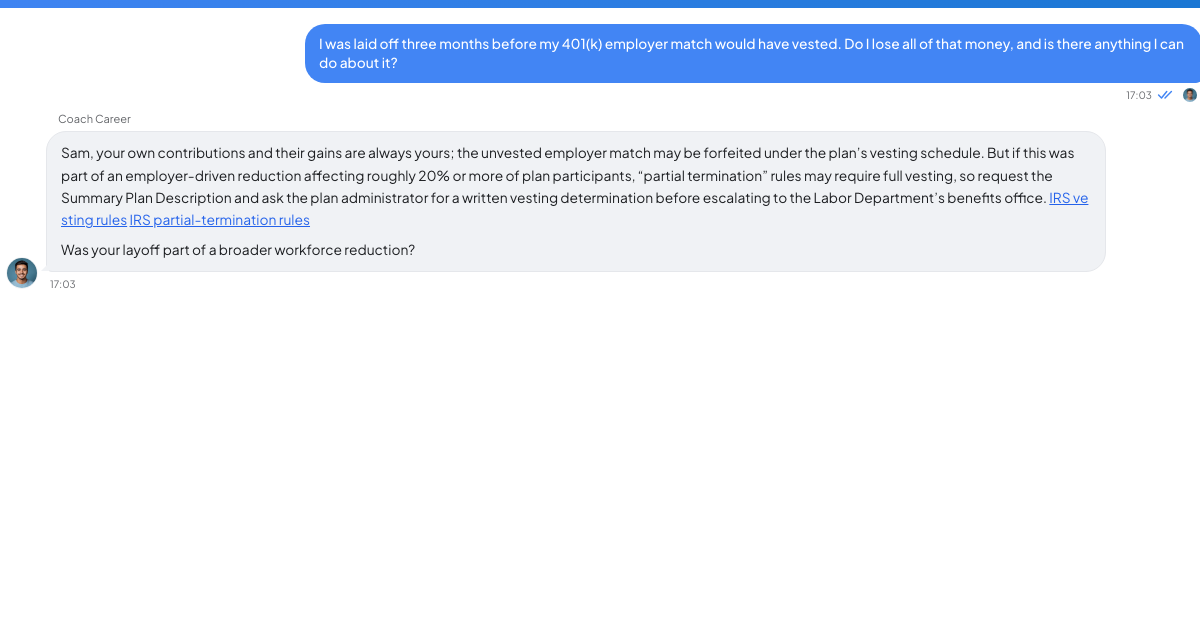
If you are laid off before your 401(k) is fully vested, you keep 100 percent of your own contributions and any earnings on them, and you keep the portion of the employer match your plan has already vested. The unvested part of the match is generally forfeited. How much that is depends on your plan's vesting schedule and your years of service, so find your exact vested percentage in the plan portal before you do anything else. This post covers US 401(k) plans.
What is always mine when I leave?
The IRS page on vesting says elective deferrals and other employee contributions are always 100 percent vested, meaning they belong to you at once. That covers your paycheck deferrals, plus the gains on them. Employer contributions in SEP and SIMPLE IRA plans are also always fully vested. The money that can be lost is the employer match or profit-sharing in a standard 401(k) plan.
How does vesting work for the employer match?
The IRS describes two common patterns. Under cliff vesting, a plan can wait until you reach 3 years of service and then vest you at 100 percent all at once. Under graded vesting, the IRS gives a 6-year example: 20 percent after year two, rising 20 points a year to 100 percent in year six. Your plan may be more generous than these, never stricter than what the law allows.
Here is a worked example. You have 2 years and 10 months of service under a 3-year cliff plan, and your employer has put in $9,000. If your layoff date is before your third anniversary, you may leave with $0 of that $9,000. If your plan's rule is the 6-year graded one and you have 2 years of service, you would be 20 percent vested, or $1,800. Neither number is a guess you should rely on: your plan document is the authority.
What counts as a year of service?
The IRS notes the plan defines it, and that it generally means 1,000 hours worked over 12 months, although employers may count service differently. So how your plan counts matters when you are close to a threshold. Some plans count from your hire date, others count by plan year. Ask HR or the plan administrator to confirm in writing the vesting service you have credited as of the termination date.
How do I find out my vested balance?
- Log in to the plan website before your access ends, and download your latest statement. Most statements list "vested balance" separately from total balance.
- Request the summary plan description (SPD). It contains the vesting schedule and the service rules. Ask the plan administrator for it in writing.
- Email the plan administrator. Ask: "What is my vested percentage and vested dollar amount as of my termination date, and how many years of service am I credited with?"
- Keep a copy of the answer.
Can I negotiate a later last day to get vested?
Sometimes, and this is the most valuable thing to try if you are close. If you are a few weeks from a vesting anniversary, ask whether your termination date can be moved to after it, for example by treating the intervening period as paid notice or garden leave. Put it in a calm, specific request: "My three-year anniversary is on 14 November. Could my separation date be set to 15 November, so that my match vests? I am happy to stay on leave until then." The company may say no, but it costs them little compared with the value of what you could lose, and severance negotiations are where such asks fit. For how those negotiations work, see do laid-off employees get severance.
I have not seen verified data on how often employers agree, so treat it as an ask rather than a right. Do not sign a separation agreement that has a release until you know your vested balance and have decided whether to ask. If you suspect you were cut right before a vesting date on purpose, write down the timeline and talk to an employment or benefits lawyer, because that pattern can raise legal issues in some cases.
What if the company laid off a lot of people?
Federal rules can sometimes require full vesting when a plan is terminated. The IRS vesting page says employees must be 100 percent vested when a plan terminates. I could not verify the separate rules on partial plan terminations in this post, because the IRS page I tried to open on it was unavailable, so if your employer laid off a large share of its workforce at once, ask the plan administrator in writing whether the layoff triggered a partial termination and whether that affects your vesting.
What do I do with the money I do keep?
You usually have a few choices: leave it in the old plan if the balance allows it, roll it into an IRA or a new employer's plan, or cash it out. Cashing out early can bring income tax and penalties, so avoid it if you can, and speak to a tax professional before you decide. A rollover moved directly between accounts keeps the tax treatment intact. The decision is not urgent on day one; the vesting question is, because the facts get harder to change after your last day.
If you also hold stock awards with short windows, see what to do when you have 90 days to buy stock you cannot afford.
Coach Career, an AI career advisor on TrueTalk with a background in career counseling and transitions, can help you write the email to HR asking for a later separation date or help you plan the first month of your job search while you sort out the money.