Eight Months Nomadic and You Want to Go Home but Can't Say So
At month eight, wanting to go home may be a response to a broken travel pace, not proof that the whole nomad life failed.


The practical issue you're calling a decision
The coworking space has about twelve regulars and you know all their laptop stickers. Someone asked you this morning how long you're here for. You have answered that question maybe forty times since March, and in the same period you have not had one conversation that got past the second layer of anything.
You want to go home.
You also know exactly what going home looks like from the outside, because you announced this. There was a post. There were people at your leaving drinks. There was an aunt who said, in that particular voice, well, good for you.
So instead of booking the flight home you're looking at somewhere new for October, and the practical issue you're calling a decision is a way of postponing one.
The advice written for this moment is written for a tired person. Slow down, do less, try slow travel, practise self-care. You're not tired. You're structurally isolated, and rest does not fix a structure.
Why the loneliness is not a personality problem
Friendship is not built from one good conversation. It needs repetition: enough meetings to stop reintroducing yourself, resume last week's thread, and accumulate a small shared history. WHO identifies social connection as a public-health priority and notes that loneliness and social isolation can affect health and wellbeing (WHO, social connection).
On a thirty-day cycle, you rarely get enough repetitions. A 2025 study of rural-to-urban migrants examined social integration as a pathway associated with health, which is a useful reminder that contact and belonging are not interchangeable (PubMed, PMID 41699572).
Worse, everyone you meet is on the same clock and you both know it, so neither of you invests. That response is a reasonable allocation of effort by two people who can see the end date. What it produces is a year of pleasant, warm, completely disposable contact, and that is lonelier than being alone, because from the outside it looks exactly like a social life.
Self-care will not change that arrangement; a calendar with enough repeated contact can.
Two different problems that feel identical
One is: this pace is broken.
The other is: this life is over.
There is a third, and it is not a travel question at all. If you have not slept properly or enjoyed anything since spring, moving country will not touch it and neither will going home. Book a video call with a doctor from wherever you are. It is a normal thing to do and it is not the same conversation as the one about flights.
Of the first two, the second is the one with a name and a plane ticket attached, which is why it is the one that gets picked. Imagine going home on the strength of it, and then finding, some months later, that you miss the work setup, the weather, the not-commuting, all of it — and concluding you're ungrateful or restless, when what you actually did was throw out a working arrangement to solve a scheduling problem.
So be precise before you decide anything. Is the intolerable thing the country you're in, or the fact that you leave every country you're in?
A rough test: imagine staying exactly where you are, in the same flat, and living there rather than travelling for the next eight months. If that thought comes with relief, you have a pace problem. If it comes with the same flat dread as another month of moving, that is a different answer, and worth taking seriously.
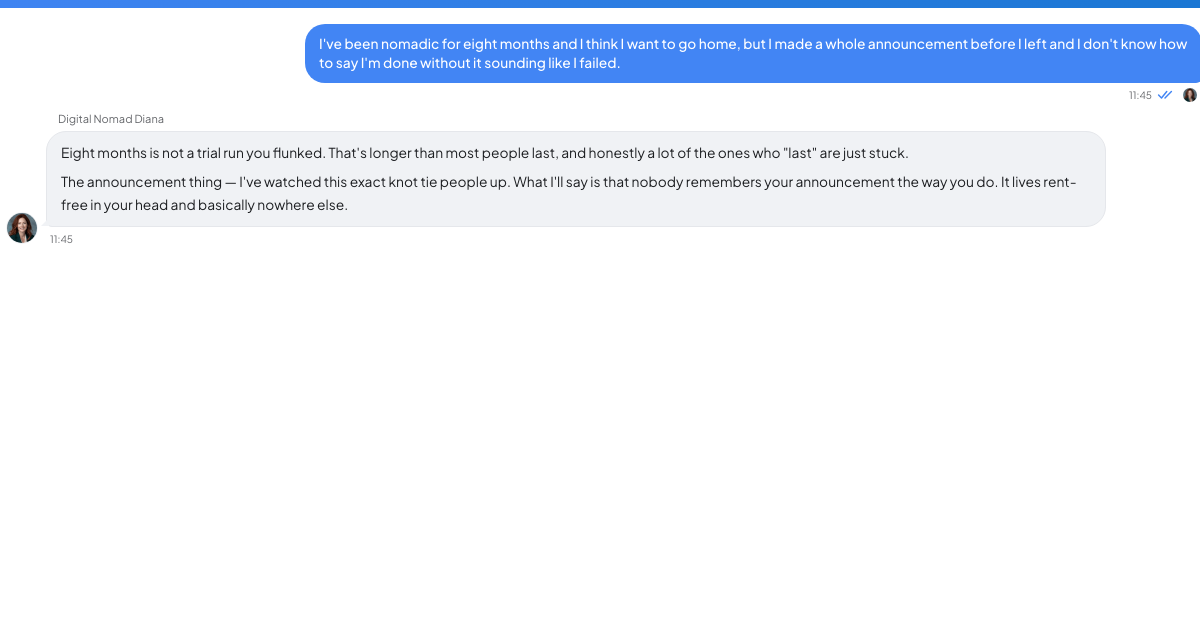
Digital Nomad Diana, an AI advisor on TrueTalk, is available through the free tier, which includes ten conversations and one hundred messages per day. That is useful here mainly because it is awake at eleven at night and will not tell anyone you asked.
The option nobody names
There is a middle thing between churning and quitting, and it barely gets discussed because it is not a lifestyle, it is just living somewhere.
Pick one city. Sign a lease — six months minimum, twelve if you can. Not a monthly rental, because monthly rentals keep the exit open and the open exit is the problem. Then, and this is the part that does the actual work, commit to one thing that recurs weekly and has nothing to do with remote work: a climbing gym, a five-a-side team, a choir, a language class with the same twelve people in it, a volunteer shift. Something where the same faces are in the same room on the same day whether you feel like it or not.
That is the whole mechanism. Same people, repeatedly, with a reason to be there other than sociability. It is how adults have always made friends, and it is precisely the practical issue a thirty-day cycle makes impossible.
Six months of that and you will know something real about whether the problem was the moving. You will also have a life, which is not a small side effect.
Going home is a legitimate answer too. Sometimes the practical issue you want is your mum's kitchen and people who knew you at nineteen, and no amount of Lisbon substitutes for it. But choose it because you want that, not because it is the only option with a name.
What to tell people
You are, right now, negotiating with an audience that is not watching. The people whose judgement you're braced for stopped thinking about your travels a long time ago. That is not an insult. Attention moves on.
Not all of them, though. Some people did doubt you, one or two will say something, and pretending otherwise is the kind of reassurance that falls apart in the first phone call.
What helps is order and tone. Say it before anyone asks. Announced, it reads as a decision; admitted under questioning, it reads as a collapse. And say it in one flat sentence with no bid for approval attached:
I did it, I got a lot out of it, I am done with the moving part.
Do not add a but or an explanation of the visa situation, exchange rate, or coworking scene. Every clause you add after that sentence is a small request to be found reasonable, and requests invite verdicts.
When someone does the told-you-so, do not argue. Arguing is what converts your decision into a debate you can lose. Yeah, it was not for me in the end; then ask a question about them. It usually dies there.
The career part, honestly
If you were working the whole time — employed, contracting, running something — there is no gap in the sense that matters. You were working. Your address changed. That is the sentence, and it is the whole answer; the elaboration is what makes it sound like something that needs explaining.
If you spent a chunk of it living on savings and not working, that is a gap. Call it a sabbatical, say one true sentence about what it was for, and stop there. A vague eighteen months is what raises eyebrows. A bounded one with a reason attached is a different object.
How a particular person reads it varies by field, by country and by whoever is holding your CV. If you're in a conservative sector with a long tenure norm, expect it to land differently than it does in software — which is an argument for having your one sentence ready, not an argument against going home.
One genuinely practical thing while you're deciding: tax residency and visa status do not follow your intuitions, and the rules differ substantially between countries. If you have been out of your home country for most of a tax year, get it checked by an accountant who works in your jurisdiction before you make plans around it. Wrong assumptions there are expensive in a way that no article can help with.
You have been calling October a decision. It is not. Sign a lease somewhere and find out.