Every System Works for Four Days. The Fifth Day Is Where You Actually Live.
Habit systems assume tomorrow matches today. Build a floor version and recovery rule for the fifth day.


Monday through Thursday
You start Spanish, running, or the file with the novel in it. Monday feels good, and the app draws a small flame. Tuesday, same. Wednesday, same. Thursday you nearly skip it, then do it at half nine and feel briefly heroic.
Those four days are easy to turn into evidence that Friday proves you lazy. A systematic review of 20 studies involving 2,601 participants found substantial variation in habit-formation time; four studies reported central estimates, while individual participants' formation times ranged from 4 to 335 days (Singh et al., 2024). Four good days cannot settle the question.
At 23:15 the toddler is up for the second time. Your shift may have moved late, or a friend rang in a state at ten and you were still talking at midnight. The day changed shape. Almost every published habit method assumes it will retain its shape: cue-routine-reward needs a reliable cue; habit stacking — after X, do Y — needs X at roughly the same point; morning routines need a morning you own; streaks assume every day contains a slot. For rotating shifts, on-call weeks, a two-year-old, and unpredictable sleep, those preconditions do not merely hold less reliably; they do not hold. Advice designed for somebody whose Tuesday resembles Thursday is sold as universal, so a system mismatch gets misclassified as personal failure.
Friday, 22:40
You are behind on everything, on the sofa, with the app open. The task costs ninety seconds, and you do not do it. This tired moment matters more than Saturday's extinguished flame or the notebook you buy three weeks later.
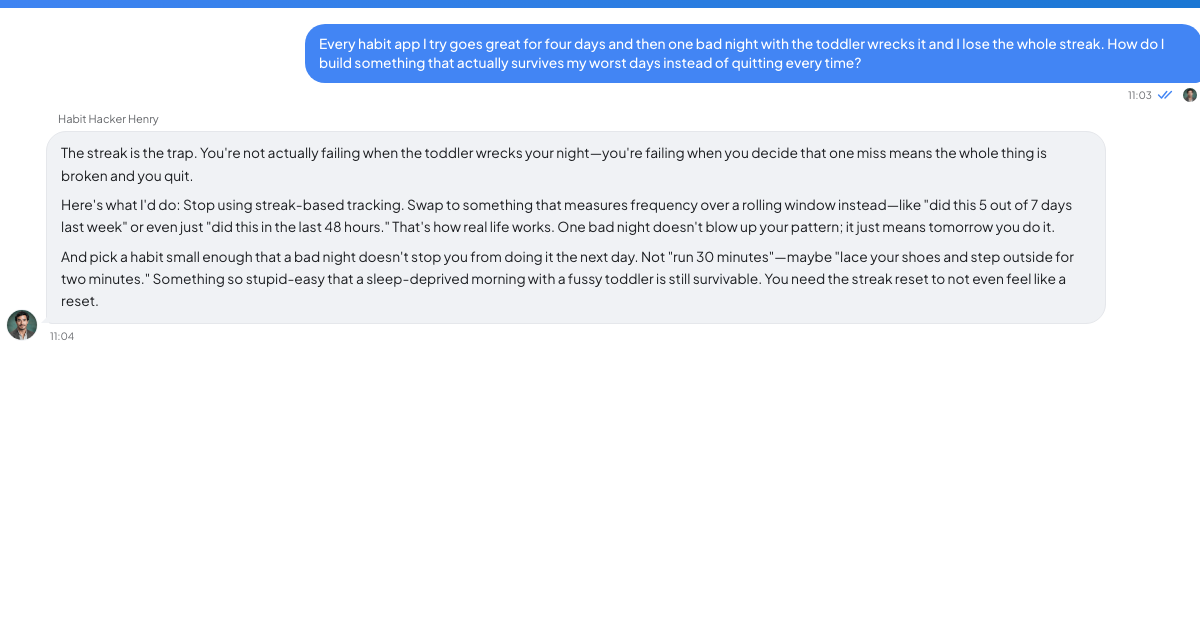
Say the counter is 47. One bad Thursday appears to destroy everything in it when you have least capacity for loss. A miss may become quitting. For an irregular week, streak counting is actively destructive, and I would delete it before changing anything else. It can motivate at the start, right until it turns and eats the habit it was counting.
A better calendar is not the fix. Twenty minutes of Spanish suits Wednesday and may be impossible tonight. The whole skip, rather than the oversized target itself, is what costs you continuity. In clinical and analogue samples of people with mental-health problems, a meta-analysis of 29 experiments from 18 records, including 1,636 participants after an outlier was excluded, found specific if-then plans had a large effect on goal attainment (Toli, Webb, and Hardy, 2016). That evidence does not establish the same effect for every habit or population, but the planning method is concrete. Depleted people decide poorly about whether they have already failed, so decide while calm what you will do on the foreseeable bad day.
Describe the ordinary bad day: shift at six, home at seven, dinner, bath, one child down at eight, the other not until twenty to ten, nothing left. Make its surviving version the permanent floor. Spanish becomes one sentence aloud. Gym becomes shoes on, out the door, and straight back if needed. “Write 500 words” becomes open the file and change one line. Fifteen minutes of meditation becomes sixty seconds with a timer.
It may feel pathetic. The floor does not produce a full session's results; it preserves continuity and makes returning easier. Its purpose is to preserve the identity claim “I am someone who returns” through a bad week, although a token action does not prove a fixed identity.
The two-minute rule in Atomic Habits comes close, though Clear presents it as an on-ramp. Here the small version remains the habit and extra work is a bonus. Do not let a good Tuesday raise Friday's bar.
Write the recovery rule early
On a Sunday when you are fine, write:
One miss is not a break. On the next available occasion I resume at the floor version, and I make no attempt to catch up.
Use this as a recovery rule, not a guarantee: one miss can precede a longer lapse. No catching up matters because “do double tomorrow” makes tomorrow unappealing, and one missed day can become two. Schedule misses too. If it is a five-day habit, schedule the other two days off; a planned absence is not failure and removes about half the days on which a daily streak might have broken.
Habit Hacker Henry is TrueTalk's AI habit advisor, available at 22:40 when a human coach with a Tuesday slot is not. The free tier includes ten conversations and one hundred messages per day. He cannot make you act. He can hear “I missed today” before it becomes three weeks.
Marathons and dialysis do not have a floor version
Thirty seconds of running is not a small long run; this floor does not replace marathon training. Medication schedules, dialysis, and clinical thresholds are not habits in this sense. Do not use these tricks for them.
If you cannot start anything, tiredness does not lift with sleep, or you have suspected ADHD for years, habit design is not treatment. Tell a GP. An assessment can answer what a twelfth notebook cannot. Design the fifth day, but not instead of the appointment. Doing the floor most days for a year may not transform your life as promised; it means that after a year you are still doing it, which is more than the previous eleven systems managed.
Saturday's count
Directly replace the streak with the only count worth keeping: total days ever. Suppose Saturday shows 206 days over the last year, including gaps for the toddler's wake-ups, late shifts, and calls with a distressed friend. The total only rises. It cannot break, so it cannot be quit; it preserves those named gaps and answers the self-accusation that you are lazy. Many systems are sold on a clean morning, finished template, or counter at 47 rather than on their performance during ordinary disruption. A streak will never show that record.