You Used to Read a Book a Week and Now You Can't Finish a Chapter
Reading-slump advice is written for a fortnight, not two years. The eleven half-read books by your bed are part of the problem, and abandoning them formally is the first move.


There are eleven books by the bed and you know where the bookmark is in every one
The bookmarks sit at pages 40 and 62, with one at page nine, which barely counts as started. Two are library books that have been renewed until the system will not renew them again.
Tonight you picked up the newest one, read a page and a half, realised none of it had gone in, read it again, and then your hand went to the phone without any decision being involved. Forty minutes later you turned the light off.
You used to read a book a week for twenty years. It was a thing you were, the way some people are runners.
And you are grieving it, and you feel faintly ridiculous for grieving it, because people have real problems and yours is that you cannot concentrate on a novel.
That grief is reasonable because losing a capacity you had built part of your identity on is a genuine loss, and the fact that it is small next to other people's losses does not make it not one. But the conclusion you have reached — that your attention span is broken and the damage is permanent — is probably wrong, and wrong in a specific way that can be worked on.
The advice you have found was written for a fortnight
Every reading-slump piece assumes a temporary dip and recommends a novella, a five-minute timer, rereading an old favourite, or reading in a café.
That advice can suit someone who's had a rough month and will be reading normally again by spring, but after two years it is useless because all of it targets motivation, and motivation is not your problem. Your repeated attempts show that you want to read so much you keep buying books you do not open. A person who has bought eleven books they cannot start is not short of desire.
The eleven books are doing something to you
Here's the mechanism I think is actually running, and I've never seen a slump article mention it.
Each abandoned book is a small unsettled debt. The feeling is only a half-second flicker when your eye crosses the stack. Those eleven flickers mean the twelfth book arrives into a room where eleven things you started are visibly unfinished, so opening it costs more than it should. The question stops being shall I read and quietly becomes shall I add to the pile.
In a two-week slump the pile is two books deep and weighs nothing. At two years, the pile has become a permanent part of the room.
So deal with the pile before choosing another book.
Formally abandon all eleven. Out loud, if you can stand it — which sounds absurd and works better than it has any right to. Move every book off the bedside table: shelve it, box it, or give it away, and I would give at least four of them away, because keeping a book you have twice failed to read is not neutral. Say the sentence: I am not reading this. Not now, not later, and I'm not sorry.
If you want permission from an authority, the librarian Nancy Pearl's Rule of 50 is the one to borrow: give a book fifty pages, and if you are over fifty, subtract your age from a hundred and give it that many instead. Past that, the book failed you.
The stack going to zero is the whole point. You want the next book to walk into an empty room.
Then stop choosing books the way you have been choosing them
You have been picking aspirational books: the prize winner, the one three people you respect wouldn't shut up about, and the one you feel you should have read by now.
That is how you choose when reading is easy and you can afford to be improved by it. Your current attention does not support that selection method.
Choose instead for the attention you actually have at half past ten on a Tuesday, in a house with a phone in it, at the end of a working day — not for the attention you had at twenty-six on a two-hour train with nothing else to do.
This changes the axis rather than lowering your standards. Plenty of excellent prose is built to hold a fractured attention, and plenty of much-recommended prose is built to reward the opposite: attention accumulated over hours and repaid late.
What tends to hold, judged on reading-hours rather than merit:
- Short chapters. Ideally short enough that you finish one before the phone gets you. Three pages is a unit you can win.
- Strong forward causality — this happened, so that happened. Plot provides a handrail rather than lowering the book's literary value.
- Concrete sentences. Prose that names objects and actions rather than moods and states.
- Self-contained forms. Short stories and essays hand you a completed thing in twenty minutes, and a completed thing is exactly what you have been starved of. A collection you read four pieces from and set down is not an abandoned book.
- Voice that pulls from the first line. Muriel Spark's short novels do this, and Penelope Fitzgerald's do, and the short ones run well under two hundred pages, so the far end of the book is within sight from the beginning.
What will not work right now, however much you want it to, includes the big ensemble novel with twelve names in the first thirty pages and the block-paragraph modernist. Books whose pleasure is cumulative and deferred also will not work right now. Wolf Hall is a magnificent book and its dense, close-third narration demands precisely the sustained attention you have not got at the moment. Middlemarch takes a hundred pages to sink its hooks in and repays that entirely, and you are not reaching page one hundred this month.
Those books remain available later, but they are not the ones to test yourself against while you are rebuilding.
Buy one book at a time; read it, or abandon it inside fifty pages and buy the next.
About the phone, honestly
Yes, the phone is involved. Be careful with the story you have built around it, though, which is that something has been physically broken and the breakage is permanent.
Whether heavy phone use durably degrades sustained attention in adults is genuinely contested. In Skowronek, Seifert, and Lindberg's experiment, participants aged 20 to 34 completed an attention test with a smartphone present or absent, and the phone-present group showed lower cognitive performance. You'll find confident claims in both directions, and the honest answer is that it is not settled. What is not contested is much duller: reading competes with a device that is better at being interesting per second than any novel, and it is within arm's reach.
Treat that competition as an environment problem with a boring fix: put the phone in a different room and keep the book beside you for twenty minutes rather than attempting a virtuous hour.
Audiobooks also count, although some readers will object. I will say plainly that the objection is snobbery — if the sentences are going in, you are reading the book. If listening is what gets a whole book finished after two years of finishing none, take the finished book.
Where none of this applies
If the concentration has gone everywhere — not just books, but films, conversations, work you used to do without effort — then this is not a book-choice problem, and no amount of short chapters will touch it.
Persistent trouble concentrating travels with a lot of different things: poor sleep, depression, thyroid problems, grief, medication, undiagnosed ADHD, the perimenopause. The NHS menopause guidance specifically lists memory or concentration problems and says they may feel worse alongside sleep problems and severe tiredness. Which one, if any, is not something an article can tell you and not something worth guessing at. That is a GP conversation, and a perfectly reasonable one to book. "I have not been able to concentrate on anything for two years" is a legitimate opening sentence in a doctor's room.
Everything above is for the other case: where you can still lose an hour to a long article or a boxset, and it is specifically books that have gone.
The part that is hard to do alone
The hard part is choosing because you have lost confidence in your own picks, which is why the eleven exist, and the recommendation lists aren't built around the eleven books you abandoned and the page you stopped on.
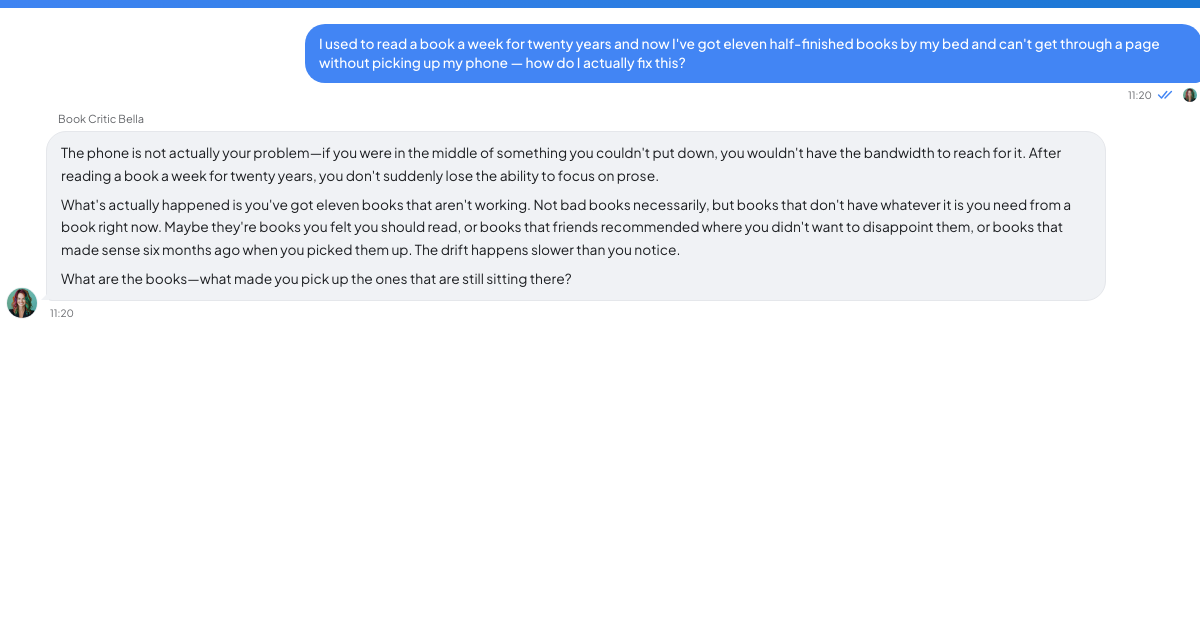
TrueTalk has an AI persona for this — Book Critic Bella, written as a book critic and publishing consultant, with specialisms in literary criticism, English literature and the publishing industry. She's a persona rather than a person, which is worth saying plainly. What she's useful for is the brief you cannot give a bookshop: here are the eleven I abandoned and the exact page I stopped at in each, here's what my evenings look like now, what should I try. That is a more specific brief than a bestseller list can act on, and it is available at eleven at night when the thought actually occurs to you. The free tier includes ten conversations and one hundred messages per day.
Test one completed piece
Your ability to read remains; the lost part is a particular relationship with it, where you had two uninterrupted hours, no competing device, and could be trusted to finish whatever you were handed.
What usually returns first is one completed short story on a Tuesday night with the stack by the bed at zero, rather than a book-a-week pace. Use that deliberately low result as your operational test.