Everyone Says Get a Referral. You Genuinely Do Not Know Anyone.
Skip live events, write to a recent switcher, and ask for information before asking anyone for a referral.


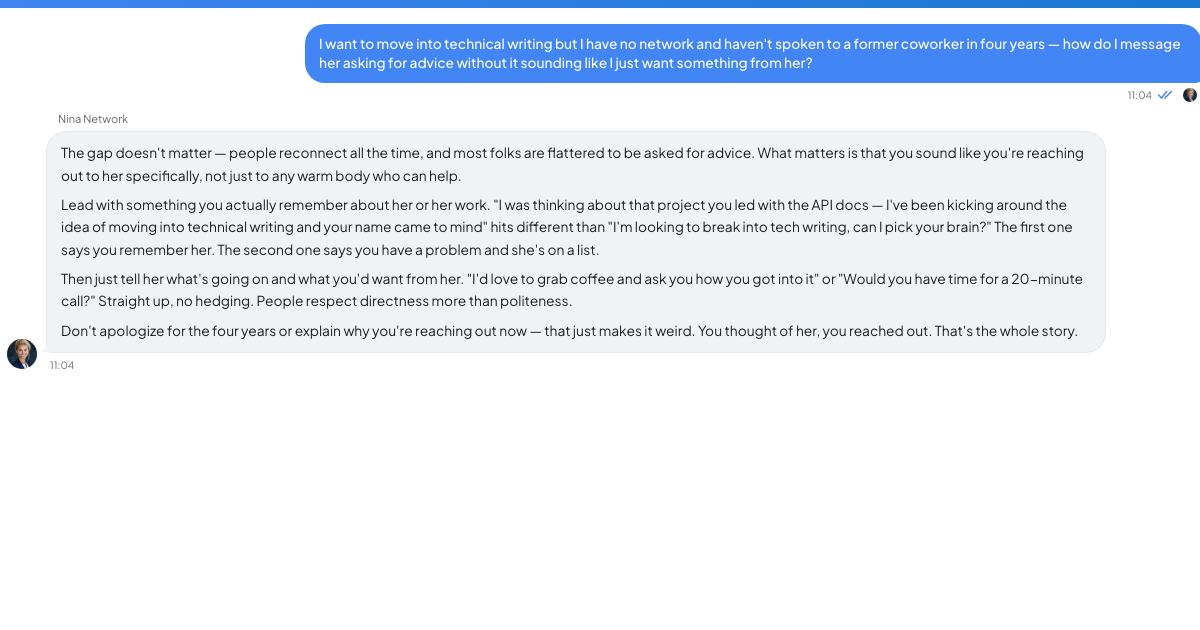
Advice for somebody with a circle
“Reach out to your circle.” There is not one. “Go to industry events.” You went, stood near the coffee for forty minutes, and left. Networking advice often assumes contacts and a temperament that enjoys using them. Without either, it sounds like an order to become somebody else by Friday.
The obstacle is the physical embarrassment of asking a near-stranger for help with nothing to trade. On your screen may be a half-written message to somebody last seen in 2022, at a company that no longer exists: four opening lines and no Send. Route around the feeling.
Writing only
For this plan, reject events completely. They require real-time performance without editing, in front of an audience, while useful people may already be surrounded. Written outreach lets you revise privately and recipients read when they choose. The desired conversation can arrive asynchronously, so events add pressure without being required.
CareerOneStop defines an informational interview as a meeting to learn somebody's real-life experience in a relevant field or company, not a job interview, and recommends 15 to 30 minutes (CareerOneStop).
Choosing the wrong target category is why people conclude cold outreach fails. Start with people whose work includes strangers: recruiters, in-house talent teams, community managers, founders currently hiring, meetup organisers, and newsletter writers. Your message sits beside their work rather than interrupting it.
A recent switcher is especially useful. Someone who moved from teaching into instructional design two years ago has a live memory of the difficulty and a willingness to explain it that may not yet be worn down by strangers. They remember which of two certifications wasted money because they bought both, what sentence passed the first screening, and how many months lay between deciding and getting paid. They may not consider themselves senior enough to resent your email. Nobody wrote the definitive guide to your exact switch; unlike a guide, they answer follow-ups. If you send one message this week, send it here.
A concrete tie that is not friendship — the same former employer, course, professional body, or small town — is thin and enough. Also contact people who publicly explained the work in a blog post, conference talk, or long careful comment; they already spend unpaid time explaining it, and you are the audience. Senior people at large companies, with no connection and no role they own, mostly will not reply.
Information before referral
A referral is a loan of credibility. If you interview disastrously, the referrer risks reputational credit with colleagues. Asking a near-stranger to stake it is a large request dressed small, so silence is reasonable. Information costs them nothing: what the team is like, whether the advert matches the job, which certification matters, or whom else to ask. An answer takes minutes and makes somebody feel useful.
Harvard's career service says informational conversations are for learning and advises against asking for a job or referral before rapport. It recommends a short message, shared ground, a clear request, preparation, and 20 to 30 minutes (Harvard Griffin GSAS guide). A referral may later be offered after a conversation supplies a basis for it. Reversing that information-first, referral-later sequence is why the first message fails.
Four years of silence
You did not stay in touch and now want something. You carried that silence; the other person had four years of life in which your absence was small. Do not fake a three-week warm-up by liking posts. Name the gap once.
Write to Priya, the former colleague who ran QA on your old team. The company folded; she moved into technical writing, where you want to go. Use about five sentences:
“We worked together at [company] until it went under in 2022; I was on the platform team. Out of nowhere, sorry. I am trying to move into technical writing and saw you made that switch. I am not asking you to put me forward — I would like to know how you got the first role, and whether the portfolio mattered or it was the domain knowledge. Fifteen minutes on a call, or a reply here if easier; no reply is fine too.”
Removing the big ask saves a refusal. The clean exit lowers pressure and makes replying easy. Never flatter her, mention an inspiring journey, or open with a generic post compliment; those read as templates because they are.
Nina Network is TrueTalk's AI persona for professional networking and relationship building. Paste the version rewritten eleven times, say who receives it and what did or did not happen between you, and work at midnight when dread is worst. No booking is needed. The free tier includes ten conversations and one hundred messages per day. Nina helps wording, not introductions; she cannot open a door.
Expect silence
Plenty will not answer, and that nonresponse is the format rather than a verdict on you. Assume a low hit rate, send more than feels dignified over time, then follow up exactly once after a week or so with one line and no guilt. This is slower than having an existing network: someone with fifteen years of relationships may make one call; you may send many messages for a few replies. It is unfair, but doable alone tonight without becoming an extrovert. Send one message, not twenty, to a recent switcher who remembers your position.