Five Years of Streaks and You Still Can't Follow Two Natives Talking
Years of streaks can leave real-time speech untouched. Train familiar reductions in stages, then work toward accents, overlap, and noisy conversation.


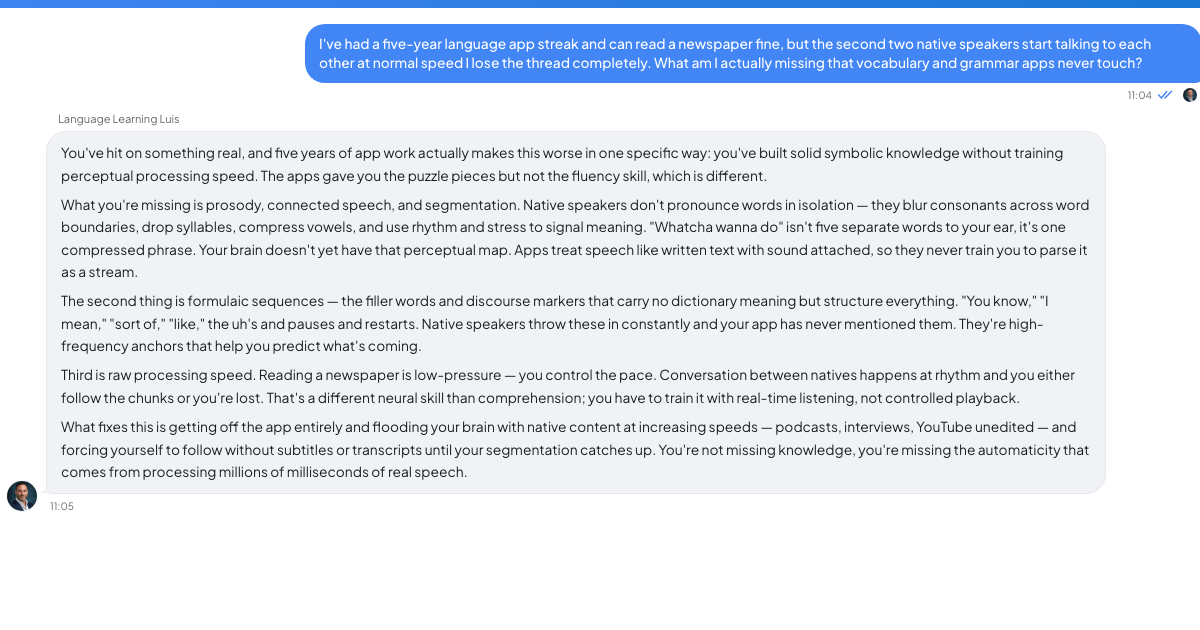
The words reached you in a different shape
loh amigoh. tá. ch'ai pas. jeet yet. These are ordinary phrases as your ear may receive them. Across Caribbean and Andalusian Spanish and much of the coast, syllable-final s can be aspirated or dropped, so los amigos sounds nearer loh amigoh. Está becomes tá; para is often pa and nada can be na, turning todo para nada into to pa na.
In everyday French, je ne sais pas may arrive as something close to ch'ai pas, il y a as y a, and whole pronouns can disappear. English did you eat yet can become jeet yet. This is systematic connected speech rather than slang or sloppiness. Research with 64 learners of English found native connected speech harder to recognise in adverse listening conditions than in quiet (Wong et al.).
You stored a careful sound-shape for está. Your ear gets tá, your brain searches for a match, and three more words pass before it gives up. Much of the apparent wall of noise consists of sentences you would understand immediately on paper, arriving in their spoken form.
At dinner, someone asks you a question slowly and kindly, opening the vowels for you, and you answer it. Then they turn back to the person beside them. Four seconds later you have caught a preposition, a familiar name, and something that may have been a verb. The same shock happens at work: a colleague explains a task directly and you follow; two colleagues start resolving it with each other, interrupt, shorten familiar phrases, and laugh while you are still locating the subject. That morning you read a newspaper article and understood most of it. You have a streak in four figures. You begin wondering whether you simply cannot do languages.
Your classroom trained a different event: one clear voice, orderly turns, words in citation form, and silence around each item. Conversation brings reductions, overlap, shared references, accent variation, and no pause while you resolve one word. Native listeners predict from context and check the incoming sound; you are still decoding serially, which becomes too slow once you fall two words behind.
Keep the possible causes separate. Unknown vocabulary creates a knowledge gap. An unfamiliar accent changes expected sound patterns. Slow serial processing loses the next phrase while you solve the last one. Anxiety can consume attention and make all three feel worse. None of those is proof that your own accent, intelligence, effort, or capacity for languages is defective.
Stop restarting the beginner unit
You have restarted that material three times looking for the missing piece, and it is not there. Beginner recordings are engineered to be intelligible: slow, clear, over-articulated, and one voice at a time. More of that input repeats the condition that created the gap. You need familiar words changed by speed before asking yourself to handle two speakers, overlapping turns, shared references, no accommodation, and background noise.
Restarting is comfortable because understanding everything feels like progress. Material you understand about two-thirds of, and have to fight for, feels like failure while it is doing useful work. Your streak has the same limitation: an app can count reviewed words and elapsed days, but it cannot count a day when listening confused you productively. Five years of optimising that proxy can leave real-time parsing almost untouched.
Do not replace the beginner unit with films playing in the background and call it immersion. Krashen's claim that useful input is mostly comprehensible and slightly beyond you is influential rather than settled; critics have long noted that slightly beyond is not precise enough to test. My view, not a study, is that hours of audio you cannot parse mostly teach you to tune it out.
Train the sound in real time
Narrow the domain hard: use one podcast, one host, one subject, and one accent for weeks. Variety may hold your interest, but familiarity with a voice and recurring vocabulary gives parsing capacity back. When that speaker's pero no longer needs decoding, you have room for the next word.
Work with thirty- to sixty-second clips. Listen four or five times without text, consult the transcript, and then listen twice more without it. You are waiting for the moment the mush resolves into words and cannot sound like mush again. The change does not generalise instantly, but every resolved clip enlarges the set of sound-shapes you can catch.
Transcribe ten to twenty seconds at a time and check what you wrote. It is slow and unpleasant, which is why it exposes gaps that passive listening hides. You may discover that one reduction has escaped you for years because reading never made it visible. Learn reductions explicitly for the language and dialect you need by asking what disappears in fast speech. They are usually a short, well-documented list, and almost no course teaches them because courses teach the written form and then hope.
Reduced playback speed is useful for a first pass through a hard clip, but do not live there. The skill you need is time-bound: you must identify the phrase before the next phrase replaces it. End every session at full speed, even when the last listen feels worse than the first. I would choose twenty focused minutes daily over two hours of half-listening; that comes from people I have watched rather than a study.
Use a familiar single-speaker podcast before treating two native speakers as your benchmark. Once familiar connected speech begins to resolve, work toward less familiar voices and the overlapping conversations you actually want to follow.
Use a fair benchmark and check the right problem
Nobody can honestly tell you how long this takes. Distance from languages you know, previous sound exposure, and weekly practice all matter. The Foreign Service Institute's familiar estimates—roughly 600 to 750 classroom hours for its easiest category and about 2,200 for its hardest—describe overall professional proficiency, not the moment fast speech stops blurring. Anyone giving you a timetable for that particular transition is guessing.
Two native speakers talking to each other are the difficult benchmark: they overlap, rely on shared context, make no accommodation, and may compete with room noise. A subtitled film is another exercise again. Subtitles in your own language train comprehension of the content; target-language subtitles combine reading with audio; no subtitles test listening. Be clear which one you are practising.
If fast speech is also hard in your native language—at noisy restaurants, on phone calls, or when three people talk—mention it to a doctor. A PubMed study assessed 58 adults referred for listening difficulty despite normal audiograms, including people later classified with auditory processing disorder (Bamiou et al.). Hearing loss and auditory-processing differences can go unnoticed even after a standard hearing test, and no transcription routine treats either. Anxiety may worsen real-time focus, but it does not by itself establish a hearing or processing diagnosis.
Production adds a social cost. Stumbling in front of a person spends their patience and your nerve; with your partner's family, you may get about two attempts before someone switches to English to be kind. Language Learning Luis is TrueTalk's language advisor, an AI rather than your partner's mother. You can get the same sentence wrong six times without watching anyone's face change and ask which reductions apply to the dialect you care about at one in the morning. The free tier includes ten conversations and one hundred messages per day. He cannot train your ears. Only transcription does that.
Return to the four seconds at the table or in the meeting. Listen for an aspirated s, the missing syllable in para, or a familiar verb contracted onto a familiar pronoun. Those are words you already own. Your job is to recognise them before the conversation moves on.