It's April, Every School Said No, and You Have Nine Days to Decide
Rejected or waitlisted everywhere with a deposit deadline days away. What a waitlist number actually means, when an appeal has grounds, and why transferring is the underrated route.


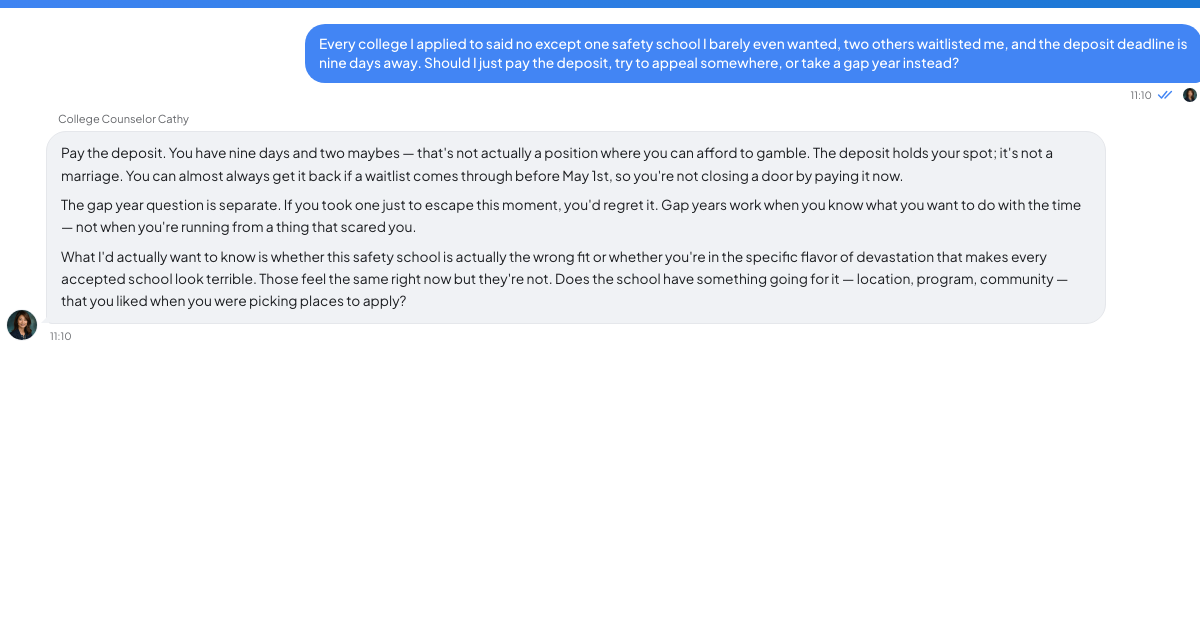
Nine portals, and the one that said yes is the one you do not want
There were nine. Six came back no. Two came back waitlist, which is a no wearing a coat. And the one that said yes is the school you added in October because your counselor kept asking whether you had a safety, and you typed it in without reading much, and now it is the only door in the building.
It is April 22. The deposit is due on the first.
Downstairs there are fourteen tabs open about gap years and somebody has said the word “appeal” four times since Tuesday, and neither of them knows what either thing is, because why would they. Nobody in your house has done this before. You are deciding the next four years during the worst week you have ever had for thinking about yourself.
So make it smaller. Nine days, four routes, and three of the routes can be researched to the bottom in about six hours. By the second week of May, you will be enrolled somewhere, deferred, or holding a gap year with a concrete plan. Do not spend all nine days on an appeal without grounds and reach 11:40pm having never investigated what a strong first year at the safety could buy you.
The thing your parents are doing wrong
They are using “appeal” and “gap year” as though the two belong in the same sentence. An appeal is a narrow procedural request: it either has grounds or it does not, and you can find out which by lunchtime. A gap year consumes twelve months of your actual life and needs its own evidence. Putting them on one list is how a family burns the whole week on the option that was never going to work.
Same with the waitlist. At some schools in some years it is a live queue that moves in June. At others it is the same no with a chair left outside the door.
The number that tells you which
Search the school's name plus “common data set.” Many US colleges publish one — check the school's institutional research page. Go to the section labeled C2, the wait list section. For a past year it tells you how many students were offered a place on the waitlist, how many accepted a place, and how many were then admitted from it.
At schools that publish it, the Common Data Set makes the number checkable. The initiative is a collaboration among higher-education data providers, the College Board, Peterson's, and U.S. News; section C2 records the number offered a waitlist place, the number accepting it, and the number later admitted (Common Data Set Initiative).
Pull both of them tonight. It takes twenty minutes.
Sometimes the admitted-from-waitlist figure is a healthy slice of the queue. In some years, the published number is zero. A zero two years running is information, and it beats anything a stranger on a forum will tell you about their cousin who got the call in July. Look at several years, because waitlist behavior swings hard on how many admitted students said yes, which nobody knows in advance.
While you are in there, read your own offer letter properly. What's the deposit, is it refundable, and what does it say about depositing elsewhere.
The two letters, if either applies
The letter of continued interest. This is the one thing that occasionally moves a waitlist, and it works by being short, specific and sent once. Some schools tell waitlisted students outright not to send anything. If yours does, do not. They mean it.
If they do accept one: say plainly that you'll enroll if admitted, and say it to exactly one school, because it is only true once. Give new information — a final semester grade, a finished project, an award that landed after you applied. Give one concrete reason it is that school, one that could not be copy-pasted to another campus. Then stop. It is a note, not an essay.
Nobody outside an admissions office can tell you how much weight it carries.
The appeal. Appeals have grounds or they do not. Grounds look like a factual error in your file, materially new academic information, a substantial change in your circumstances since you applied. Wanting it very badly is not grounds. Neither is disagreeing.
Whether a school accepts appeals at all varies, and the school will tell you. Some publics run a formal process with its own deadline. One phone call settles it. If the answer is no, close the tab and put those hours somewhere they will do some good.
The safety, run honestly
The most underrated route in this mess is the one that looks like surrender: go to the safety, do a serious first year, and transfer.
It looks like surrender because it feels like accepting the bad outcome. Of the four routes here, enrolling and transferring is the only one that can add college grades to your record before another admissions review. A gap year leaves your transcript where it is. Two semesters of college coursework does not.
What makes it work is boring and specific.
Your first-year grades, which have to be good rather than fine. The particular courses, because target schools want particular ones, and picking them in August instead of discovering them in March is the whole ballgame. Deadlines, which for transfer often land earlier than people expect and sometimes come in the fall. And in some state systems there are published agreements between community colleges or state schools and the universities above them; search the system's site for “articulation agreement” or “transfer admission guarantee,” then read the current terms yourself, because they change and they are conditional.
The part that hurts people is credit. Credits that land as electives instead of requirements cost you a semester. Email the target school's transfer office before you register for anything, and get the answer in writing.
The honest cost is arriving in your second or third year, into friendships that formed without you. Some people find that fine. Some find it lonely for a term and then it passes. Weigh it properly.
The gap year, and what separates the two kinds
The mere existence of a gap year does not improve an application; its contents may.
The version that reads well has a shape someone else can describe — a job you held for eight months with a supervisor who knows your name, a thing you built or ran, a course you finished. The version that reads as a lost year is the one where the honest summary is “I was at home and I was going to sort it out.” Nobody's judging you morally for the second one. It just does not answer the question the next application asks.
Two practical notes. Ask the school that admitted you whether they allow a deferral, because deferring an offer you hold is a different transaction from giving it up and reapplying from scratch, and plenty of colleges have a policy for it. And if you do plan to reapply, be clear about what October looks like: you writing essays alone while everyone you know is somewhere else, with a transcript that has not changed since the last time these offices saw it.
Two things about money, because nobody mentions them
If you come off a waitlist after the first of May, the deposit you already paid somewhere else is usually gone. Budget for it instead of being surprised by it.
Ask, in writing, whether need-based aid is still available to students admitted from the waitlist at that school. At some it is. At some the budget is committed by then. Do not let anyone answer it generally — ask that school.
Do not double-deposit. NACAC's enrollment materials state that a student affirms sending an enrollment deposit to only one institution and that multiple deposits may lead to withdrawal of admission (NACAC). The terms are also printed on what you sign. Holding one deposit while remaining on a waitlist is normal. NACAC's ethical guide says member colleges should give students admitted from a waitlist after May 1 at least 48 hours to commit, so ask for the deadline in writing rather than paying two schools (NACAC Guide to Ethical Practice).
The question you are not asking out loud
It is the one at two in the morning. Am I just not smart enough.
I'm not going to tell you the decisions say nothing about your application, because that would be a lie and you'd know it. What I will say is they do not say what you are currently reading them to say. An admissions office is assembling a class against constraints — how many seats a program has, how many people they need in a dorm, how last year's yield came in. Those constraints do not care about your worth and they do not measure it. Nine rejections and one admission reflect that constrained selection process; they do not provide a measurement of your worth.
If the feeling is bigger than the decision — if it has been sitting on you for weeks, or it is reaching into things that have nothing to do with college — a school counselor, a doctor, or another professional is the right route, and using one is not an overreaction.
For the college-shaped part of it, TrueTalk has an advisor called College Planning Cathy, an AI persona built around college admissions and student affairs. Not a real counselor, and no stake in what you pick. It is a place to think out loud about your specific list first, rather than instead. The free tier includes ten conversations and one hundred messages per day.