Four Months Sober and Your Boss Just Ordered a Bottle for the Table
A work dinner, a bottle for the table, and four seconds to answer. Use one repeatable line, plan your exit, and put real recovery support behind it.


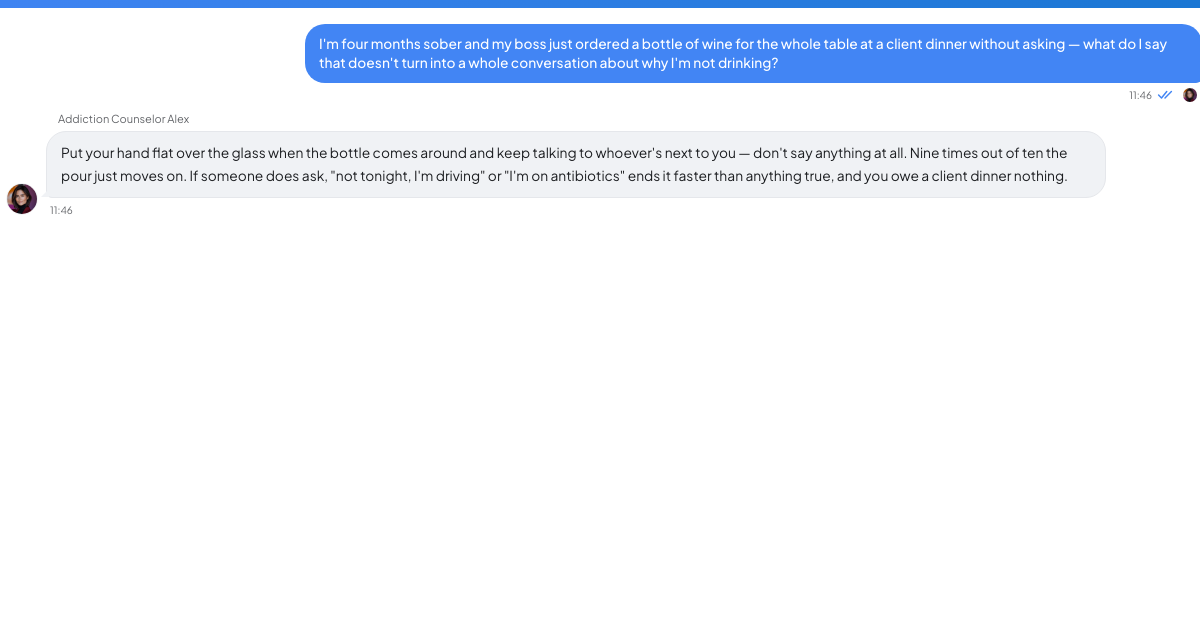
Four seconds over the bread
You stopped drinking in April. Nobody at this work dinner knows, because until tonight nobody needed to know. Then the waiter arrives with a bottle your boss ordered for the table and fills every glass without asking. Yours is now sitting at your right hand for the next two hours, starters are coming, and the colleague opposite who always notices has noticed. By the second bottle, you can already hear the pregnancy joke or the remark about you being no fun since the promotion.
You have about four seconds to answer. Saying you are driving may get you through one evening. Soda water with lime may let everybody assume what they like. Neither is bad emergency cover, but across a year you cannot be driving every Thursday, and each different excuse becomes another detail to remember while your attention is already busy. Give yourself a position you can use for two years without maintaining a story.
Use the same dull, true words each time: I'm not drinking. I've stopped for now. Do not add a reason or a timeline. Move directly to a normal question—how the Hamburg account landed, perhaps, or whether they are driving up on Sunday—so your delivery treats the answer as an ordinary fact rather than an opening for a table discussion. A brisk voice helps; an apologetic pause invites somebody to fill it. Once you have answered, people usually return to whatever they were saying.
The practical setup matters too. Go to the bar yourself and return with a full non-alcoholic drink in a glass with ice. You do not have to disguise it as alcohol. A full glass simply removes the visual prompt that makes the habitual topper-up reach for the bottle. If the same colleague asks every fortnight, repeat your sentence word for word. After a few rounds, speak privately on the way back from the bar: I'm not drinking. You've asked me a few times now; can you leave it? Most people will. If this person refuses, you have learned something useful about how they handle a clear boundary.
Decide at six, not at nine
The riskiest version of the evening may begin before the restaurant: a six-o'clock arrival after a bad day, on an empty stomach, with no way home except waiting for colleagues. Eat properly beforehand. Book a taxi for a specific time before you leave home, or make another transport plan that does not depend on anyone drinking at the table. A booked car forces an active cancellation if you decide to stay; vague intentions are much easier to abandon three courses in.
For the first year, try attending the dinner and skipping its third act. Arrive on time and be genuinely present during the first ninety minutes, while the conversation is still about work and people can hear one another. Leave after coffee. Rehearse the exit sentence before you walk in: I'm going to head off, early start. It is boring on purpose and rarely needs a second explanation.
Some industries really do build relationships at an eleven-o'clock whisky bar. If yours is one of them, leaving early may carry a professional cost, and you should not pretend otherwise. Name the cost and make the trade deliberately. In your first sober year, protecting recovery is still very likely worth more than the late-bar access, but that judgment depends on your role and circumstances. You are choosing which events and portions of events to attend; you are not required to turn every invitation into a test of endurance.
Arrange one person you can text from outside if the decision starts to wobble. Four minutes on the pavement with your phone looks entirely ordinary, including for a man in a suit, and gives you space to use the support plan you made while clear-headed. At nine o'clock, three courses in, follow that plan: take the booked car, send the text if you need it, and go.
Disclosure can stay narrow
There is no universal safe answer about telling colleagues. Your industry, seniority, job security, country, and the people in the room all matter. A decent workplace may respond well, but an article cannot promise that yours will. You never owe your employer the word recovery. I don't drink is a complete response to a colleague, and declining to explain a personal or medical matter is ordinary adult behaviour.
The middle route is usually better than either extreme: tell one person rather than the room. A discreet ally can redirect the conversation, order alternatives for the table, or leave when you leave. Choose the colleague who has never repeated somebody else's private information to you, not automatically the colleague you enjoy most.
Employment protections also vary by location. Some legal systems treat a history of dependence differently from current drinking, so high stakes call for local employment advice from someone who knows the law where you work. If you are uncertain, begin with fewer details and seek advice before disclosing more.
The support behind the script
A dinner technique is only the visible edge of your recovery plan. At four months, the counsellor, programme, fellowship, doctor, or combination already working for you is doing the heavy lifting. Continue using it. The NIAAA describes behavioural treatment as developing skills, building social support, setting reachable goals, and handling triggers, all of which reach further than a clever refusal at one table. Your outside contact at nine and whatever you do after you get home belong inside that real support, not in place of it.
If you are reading this while still drinking heavily and considering stopping, speak to a doctor before you do. Alcohol withdrawal can be medically dangerous and is not something to attempt alone on a Sunday. UK clinical guidance warns that severe withdrawal can include seizures, delirium tremens, and Wernicke's encephalopathy. Your individual risk and the right level of medical care require a clinician; this article cannot assess either.
The two hours around the dinner can feel harder than the meal. Six o'clock is when you may want to say the refusal out loud twice. Eleven is when the dinner is over, you are home and wired, and sitting alone with it sounds worse than talking. TrueTalk has an AI persona available across that stretch: Recovery Mentor Alex, whose catalogue description is an experienced recovery educator who offers peer-support perspectives. He is available at both hours, when much of the rest of your support may not be. He is not a counsellor and does not substitute for your doctor, programme, fellowship, or other real support. The free tier includes ten conversations and one hundred messages per day.
The year ahead contains several firsts: the first Christmas party, the first conference bar, and the first leaving do for somebody you actually like. Those can be hard precisely because you have not done them sober before. On the second pass, you arrive with evidence that you have already managed this kind of evening. After a year of using the same sentence, colleagues are less likely to hear it as a line awaiting explanation; for most of them, it will simply be a fact they know about you.