How to Explain Two Years of Caring for a Dying Parent in a 30-Second Interview Answer
A caregiving gap does not need positive spin or private details. Use three brief sentences to state the facts, confirm your availability and return to the job.


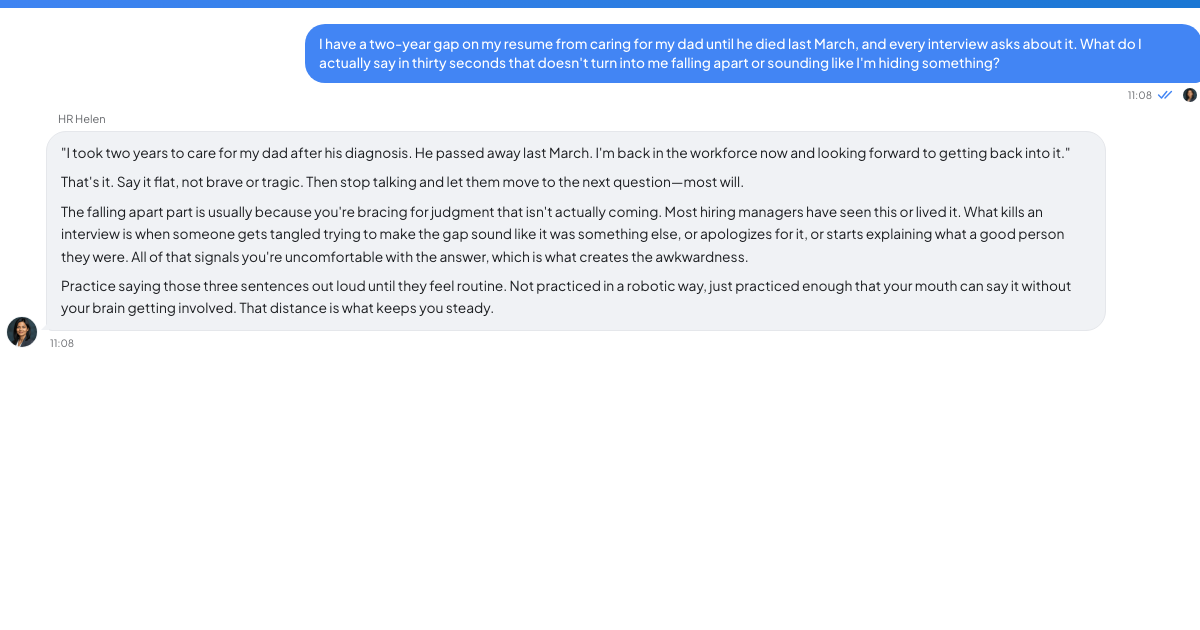
Minute six of the fourth interview
This is your fourth interview this month. The pleasantries finish, the interviewer scrolls, and her eyes stop moving.
"Help me understand the gap here. It looks like 2023 through to last spring?"
Your true answer begins with a diagnosis and ends with a funeral, so your mind has already left the call. Nothing honest seems to fit the box the question arrived in.
You have tested three versions. In the apologetic answer, you say sorry twice before explaining anything. The complete account ended last month with you crying on a video call with a stranger from a company you did not even want. "Family reasons" was so evasive that it sounded as though you were hiding something.
The two questions behind the question
First, the interviewer wants to know whether the interruption is over. They are hiring for the next couple of years and need to understand whether the demand that removed you from work is finished, continuing, or likely to return in March. They would ask a comparable question about a house move, visa or unfinished contract.
Second, they are discovering whether the subject can be discussed without turning the interview into a conversation they must manage. Most interviewers are unprepared for grief. Their discomfort may unfairly attach itself to the person who introduced it, but you can plan for that risk by keeping the answer short rather than trying to make it moving.
This is not permission for an employer to assess stereotypes instead of competence. US Equal Employment Opportunity Commission best practices tell employers to focus on an applicant's qualifications and not ask about children or other caregiving-related issues. Its worked example says that an applicant who worked three days a week for five years while caring for a father with Parkinson's should be assessed on qualifications and experience, not schedule (EEOC). Laws differ by location, so get local advice if questioning becomes discriminatory.
Do not turn your father's death into professional development
Standard gap advice suits sabbaticals, redundancies, travel years and master's degrees: frame the interval positively, list transferable skills, show what you gained. Applied here, it asks you to market your father's death as project management and stakeholder coordination.
Avoid that spin for two practical reasons as well as taste. You did not provide two years of care to build competencies, and everyone knows it, so the claim sounds performed. It also invites a follow-up about what you learned. You want the topic closed within half a minute so the interview returns to the job. The actual concern is whether the interruption is over, not whether you can justify two years.
Build the answer in three sentences
Suppose the diagnosis was dementia and the death happened in spring. Replace those facts with yours; preserve the order and length.
Sentence one gives the fact in plain past tense without medical history: "I left work in 2023 to care for my father full time. He had advanced dementia, and he died last March."
Do not apologise, build up or add a softening phrase. Past tense immediately signals that you can discuss a completed period.
Sentence two states the current position: "That's finished now, and I've been looking properly since May." This is the information they requested.
Sentence three returns the interview to evidence: "Happy to talk through how I've been getting back up to speed on the reporting side, if that's helpful." Substitute the relevant part of your own work for reporting. Then stop and let the interviewer fill any pause.
Specificity should mean the diagnosis, the two years and the date, not the hospice, the siblings who did not help, or the night he died. Those details move you from candidate to person being consoled, and nobody on the call is entitled to them.
Adjust the script when the facts differ
If you are still providing care, be honest and explain the stable arrangement because availability is the unasked question. "My mother's in residential care now and that's stable" answers it. So does "my sister and I split it, and my half is two evenings a week." Concealing an ongoing commitment only lets it surface later in a way that looks worse.
If the death is very recent, the first sentence may not come out flatly and the status line may not yet be true. Six weeks after a death, your voice may still break; there is nothing defective about that. You may decide you are not ready to interview yet, which is a legitimate decision rather than failure. If grief itself is stuck, take it to a bereavement counsellor or doctor on its own terms, not as interview preparation. The script is a twenty-second problem and grief is not.
A multicentre qualitative study interviewed palliative-care nurses who had experienced a significant bereavement within the previous 24 months. Participants described conflict between personal and professional roles and grief as a continuum; their advice included taking time off, recognising that grief does not stop at the return to work, and doing what feels right for the individual (Reed et al., International Journal of Palliative Nursing, 2019). That evidence is from nurses, not every bereaved applicant, but it supports treating readiness as individual rather than imposing a timetable.
If the gap is long and your skills have moved on, keep currency separate from the caregiving explanation. Give a second answer with concrete evidence such as a course or a small freelance project.
If your voice breaks
Rehearsal does not guarantee composure. Say "Give me a second," take the second and continue. A five-second pause followed by a steady sentence asks less of an interviewer than twenty minutes of visible effort. Apologise no more than once, and preferably not at all, because repeated apologies turn a moment into the atmosphere of the interview.
Some interviewers will still handle it badly. One may ask what he died of; another may change the subject so abruptly that the swerve dominates the room. Record the reaction without overinterpreting it. Nervous people say clumsy things, and a fumble does not automatically identify a bad manager. If the person would supervise you and the fumble feels more like a flinch, though, it is data about where you might spend your days.
Rehearse without watching somebody react
Practice audiences have faces. Your friend will become upset, and your sister definitely will; their reactions can undo the sentence you are trying to stabilise.
HR Helen is one of the 164 advisors on TrueTalk and specialises in human-resources strategy, the side of the desk from which this question comes. She is an AI advisor rather than a person, available on the web and in the app. The free tier includes ten conversations and one hundred messages per day. Ask her to pose the interview question, deliver your answer, and then ask what you left open or gave away.
You are not rehearsing until you feel nothing about your father. Say the three sentences in enough empty rooms that, on a Tuesday morning, you can finish them, pause, and move to the reporting example you prepared.