It's 6am, the Brisket Is Stuck at 160, and People Arrive at Two
The stall could break in forty minutes or in four hours and nobody can tell you which. Your off-pit time is eleven o'clock, though, and that is a number you can work to. The morning, hour by hour.

06:00
Say it went on the pit at ten last night. It climbed the way it is supposed to, hit 160°F somewhere around two in the morning, and has sat there since. You have checked the probe placement twice. You have swapped thermometers. It is 160.
Twenty people are coming at two this afternoon. You have been awake twenty-two hours and the sum you keep doing in your head goes: zero degrees an hour, forty degrees to go, therefore never, therefore turn the pit up.
Put the dial down. Both numbers in that sum are wrong, and the second one is wrong in your favour.
Take the rate first. A stall is a temporary plateau. Moisture evaporating from the surface removes heat about as quickly as the fire supplies it. Modernist Cuisine's tested brisket was left dry; the source explains the stall through evaporation and hypothesizes that periodically adding sauce could prolong it by keeping the surface wet (Modernist Cuisine). When the surface dries enough the temperature climbs again, sometimes quickly. Nobody can tell you from a thermometer reading whether that is forty minutes away or four hours. It is genuinely unknowable, which is why every article tells you to be patient, and why patience is no use to you at six in the morning.
One check before you accept the diagnosis at all. If your pit is running cold you do not have a stall, you have a fire problem, and the dome gauge on a cheap smoker can read wildly differently from the grate. Put a probe at grate level next to the meat and look at that number instead. If it is windy, or cold, everything takes longer than the recipe promised, because the recipe was written by someone in a different climate.
06:05 — work backwards from eleven o'clock
A brisket needs to rest. Cut it straight off the pit and you'll watch the juice run onto the board. It also holds heat extremely well once it is wrapped and insulated, which makes finishing early the safest outcome available to you today.
So the number you care about is when it comes off the pit, and you want that at least an hour before you serve. Two or three hours is better.
Serving at two means taking it off the pit by eleven, with noon as the absolute outside.
That leaves five hours until the off-pit target, which is the deadline your next decision can affect.
06:15 — wrap
Measure the decision against eleven o'clock.
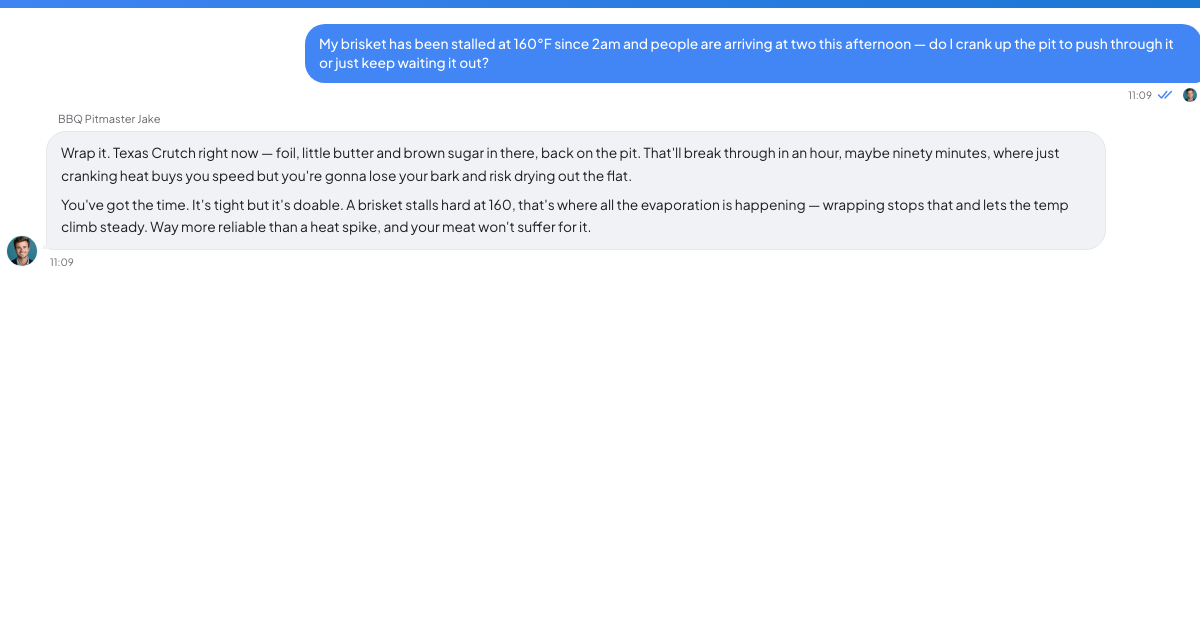
With more than eight hours of margin you could ride it out bare and chase maximum bark. That is the one situation where "be patient" is real advice, and it is not your situation. With four to eight hours in hand, which is where you are, you wrap — now, rather than after one more look at the probe. With under four hours you wrap in foil, raise the pit once to a number you say out loud, 275°F being a reasonable one, and stay outside with it.
Wrapping exists for this deadline. Sealing the meat stops the evaporation that is holding the temperature down, and the climb resumes.
Foil or butcher paper matters, and at six in the morning the answer is foil. Paper breathes, which is why it protects bark, and breathing is precisely what you are trying to stop. Foil traps the steam and gets you through fastest, and you pay for that with a softer bark. Put it back on the pit unwrapped for the last twenty minutes if you want some crust back. If you have not got twenty minutes, nobody at a birthday party is grading bark.
Wrap it tightly in two sheets with the seam on top. Some people add a splash of beef tallow or broth; it is optional and it is not the thing saving you. Put the probe back into the thickest part of the flat. USDA says a thermometer belongs in the thickest portion, away from bone, fat, or gristle, and that large irregular roasts should be checked in several places (USDA FSIS).
While the lid is open anyway — do not spritz. Spritzing during a stall works against you, because more surface moisture means more evaporation, which is the mechanism pinning the temperature down. Spritz is for colour and bark, earlier in the cook.
Close the lid and leave it alone, because every look costs recovery time without giving you useful information.
And on turning the pit up: the rule that says never do it is folklore. Plenty of good brisket is cooked start to finish at 275–300°F by people who aren't cutting corners. What hurts you is an unattended jump in heat while a cook who's been up all night goes for a lie-down. Raise it deliberately, to a stated number, and stay with it.
Somewhere between nine and twelve — is it done?
Around 200–205°F is the usual answer and a reasonable place to start looking, but briskets do not all finish in the same place. You are waiting for the probe to slide into the flat with almost no resistance, like softened butter. Check three or four spots. The point will feel done before the flat does, which is normal and not a reason to pull it.
If it probes tender at 197°F, pull it. If it reaches 205°F and still fights the probe, keep cooking.
One variation worth knowing: if you are cooking a flat on its own rather than a whole packer, it is thinner and leaner, it moves faster once wrapped, and it dries out sooner. Wrap earlier and watch it.
11:00 — the cooler hold
At eleven, set up a monitored hot hold.
Fill a cooler with hot tap water, leave it ten minutes, tip it out, dry it, line it with towels. Leave the brisket wrapped, put it in, pack towels around it, shut the lid.
A big wrapped brisket in a well-packed cooler stays hot for a long time, often several hours. But a cooler is not a warming appliance. It does not add heat, it only slows the loss, and "several hours" describes what usually happens rather than what your cooler will do in your kitchen today. USDA guidance says hot food that will not be served immediately should stay at 140°F or above; it also warns that bacteria grow fastest between 40°F and 140°F (USDA FSIS). Leave a probe in the brisket so you know the number. If it is drifting toward 140 before you serve, move it to an oven on its lowest setting.
An oven that will genuinely hold 150–170°F beats any cooler, and if you own one, use that instead.
A monitored three-hour hold expands your usable finish window from eleven until one; the cooler absorbs that timing difference while the probe confirms the brisket stays at or above 140°F. If the brisket comes off at eleven, it can sit wrapped in a picnic cooler under four towels for those three hours before twenty people eat, provided the probe confirms the safe holding temperature.
If eleven comes and it is still tough
Sometimes the brisket is simply tough because grade, thickness, and luck vary.
Chop it. Mix it with the rendered fat and a little sauce, serve it on rolls with pickles and onion. Chopped brisket forgives everything a slice reveals, and the person most upset about it will be you.
If you want to talk it through while it cooks
TrueTalk has an advisor called BBQ Pitmaster Jake — a pitmaster and smokehouse owner persona whose areas are smoking, meat prep and regional barbecue styles. He is most useful for the specific version involving your cut, pit, and clock rather than the general case. Jake is an AI, so he cannot smell your fire or put a thumb on the flat, but he can take a question at ten past six on the web or in the app, which is more than your neighbour can. The free tier includes ten conversations and one hundred messages per day.