One Table, One Celiac, One Vegan, and a Kid Who Eats Beige
Plan the kitchen protocol before the menu: protect a gluten-free base, keep nuts out, separate toppings and label every bowl for nine guests.


Audit the kitchen before choosing dinner
Begin with the colander rather than the menu.
Rinsing after wheat pasta does not clean the colander. Wash it thoroughly in hot soapy water, use an inexpensive second colander stored in another cupboard, or avoid boiling wheat pasta that day.
Check the toaster next. Keep gluten-free bread out of any toaster used for wheat bread. Coeliac UK recommends either a dedicated toaster or toaster bag; you can also grill the bread on foil.
Cross-contact makes this primarily an equipment problem, before it becomes a recipe problem. Because coeliac disease is autoimmune, gluten triggers an immune response that damages the gut lining, making traces relevant. The threshold behind a "gluten-free" label is 20 parts per million: the EU rule, Commission Implementing Regulation (EU) No 828/2014, says the statement "may only be made where the food as sold to the final consumer contains no more than 20 mg/kg of gluten", and the FDA's gluten-free labelling rule, 21 CFR 101.91, sets its ceiling at the same figure. The FDA says a gluten-free label cannot be used on food intentionally made with wheat, rye, barley or their crossbred hybrids unless the relevant derived ingredient was processed to remove gluten; unavoidable cross-contact must remain below 20 ppm (FDA gluten-free rule Q&A). The threshold is a regulated standard you cannot see.
Before choosing a dish, inspect the objects around your kitchen.
Boards. A board previously used for bread can retain crumbs in its grooves. Choose metal, glass or a board reserved away from bread.
Flour. Flour used earlier in the week may have settled as fine dust on the worktop, overhead shelf and extractor hood. Clean those surfaces with a fresh wet cloth rather than Tuesday's crumb-catching tea towel.
Shared jars. The butter, the jam, the mayonnaise. Once a toast-covered knife returns to a shared tub, treat that tub as cross-contacted. Either open new jars or decant safe portions into small bowls with dedicated spoons.
Oil. Never use oil from breaded frying for gluten-free food.
One sequencing rule removes many risks: cook gluten-free food first on cleaned surfaces, cover it and move it away. Only then begin the remaining cooking.
See what four dinners demand
Imagine a table of nine. Your sister-in-law received her coeliac diagnosis years ago. A colleague of your partner eats vegan. Another guest carries an adrenaline pen because of nuts. Your six-year-old nephew accepts rice, plain pasta, chicken and toast, but leaves when a vegetable appears.
Your search returned twenty-seven gluten-free vegan dinner ideas. That result supplies dishes, not a safe service plan. The dish-by-dish approach has left you planning four separate dinners.
Picture repeating the safe protocol four times in a home kitchen on Saturday while guests arrive. That means cleaning surfaces on four separate passes. You would also track every spoon through four workflows. Keep the covered gluten-free thing out of the way while three other pans are going and someone's asking where the corkscrew is. No individual step is especially difficult. Failure becomes likely during the fourth repetition, around half past six when the doorbell rings.
The failure begins in meal design rather than cooking technique. It began when you treated each dish as the unit of planning.
Build one safe base and five bowls
You can't take the cheese out of a lasagne. You can't make a stew gluten-free after you've thickened it with flour. Every adapt-this-recipe plan fails the same way, because the restriction is built into the structure.
Cook one base everyone can eat, then serve the optional components in separate bowls for self-assembly.
Shapes that work: steamed rice, with bowls of roasted vegetables, a bean or lentil thing, grilled chicken or pork, a herb salad, pickles, sauces in small jugs. Baked potatoes done properly with six toppings in six bowls. Corn tortillas and a spread of fillings. A big pot of something naturally vegan — chickpeas and tomato, a coconut dal — with meat, yoghurt and bread served alongside rather than stirred in.
Look at what that does to the kitchen protocol. There's one gluten-free stage, at the start, on clean surfaces. After that, the risky items — the soy sauce, the bread, the wheat pasta — are either absent or sitting in their own bowl with their own spoon, where they're visible and static. The coeliac guest skips two bowls. The vegan skips two others. The six-year-old has plain rice already on the table, because it's the base of the meal rather than a special request, and nobody has to announce that he's being catered for.
Planning takes more effort than making one lasagne. Front-loaded into the planning, lighter at the stove if you get the structure right. If you're already dreading it, shrink the meal instead of heroically expanding it: one base, five toppings, and a pudding you bought. Sorbet and fruit clears every restriction on that list without you touching it.
Verify every packet you will use
Soy sauce usually contains wheat. Malt vinegar is barley. Stock cubes, some mustards and plenty of ready-made sauces contain gluten. "Wheat-free" is a different claim from "gluten-free", because barley, rye and malt are all still in play. Because formulations vary by brand and country, read the packet in your hand instead of a photograph online. Coeliac UK and its equivalents in other countries publish current guidance and are a better source than a recipe site.
Vegan traps run the same way: fish sauce, Worcestershire sauce (anchovies), honey, gelatine, and parmesan, which is traditionally made with animal rennet.
Keep nuts out of the building
For this meal, separation is insufficient. Don't put nuts in anything, don't set a bowl of them out, don't use nut oils or a satay sauce. One shared serving spoon is enough to move traces around a table.
Ask your guest directly about her requirements. Severity varies enormously, and what she tells you outranks anything you read, including this. If you want something more authoritative than a host improvising, Anaphylaxis UK and, in the US, FARE both publish guidance on cross-contact for people cooking at home.
Complete the uncomfortable safety check before guests arrive. Before the meal, ask her where her adrenaline pen is and how to use it. If a reaction starts, the pen goes in first and you call the emergency number straight away — adrenaline, then the ambulance, in that order, and never wait to see whether it settles down on its own. FARE states that antihistamines may ease some skin or mouth symptoms but do not stop anaphylaxis; epinephrine is the only approved medicine to stop it and should be given first and fast (FARE emergency guidance). Antihistamines and a lie-down are not treatment for anaphylaxis.
Managing the allergy itself is a matter for her and her allergist, not for a host, a recipe site or an app. Your job is the menu. Knowing where the pen is takes ten seconds and it's the only part of the evening that could matter more than the food.
Put a card beside every dish
Use small folded cards. Dish name, then whatever applies — gluten-free, vegan, contains dairy. Out on the table before anyone arrives.
Give every bowl a label. Including the boring bowl of rice, including the roast potatoes nobody has a question about. If only the special dishes get a card, you've built a little display around the people with restrictions, and one of them will spend the evening being asked about her intestines by your uncle.
Do the conversation in advance and privately. One message to the coeliac guest a few days before: here's the plan, here's how I'm handling the kitchen, is there anything you'd want done differently. If she offers to bring something, say yes and mean it. It's how some people with coeliac disease manage eating at other people's tables.
And you might still get it wrong. Someone moves a spoon between bowls. The six-year-old dips a piece of bread into something. If that happens, say so immediately and plainly to the person affected rather than hoping it was fine — being told is what lets her make her own decision about the rest of the evening, and about tomorrow.
The evening will be judged on whether four people who usually eat around the edges of a meal got to eat the same dinner as everyone else, sitting down, without a fuss being made.
Get help structuring the menu
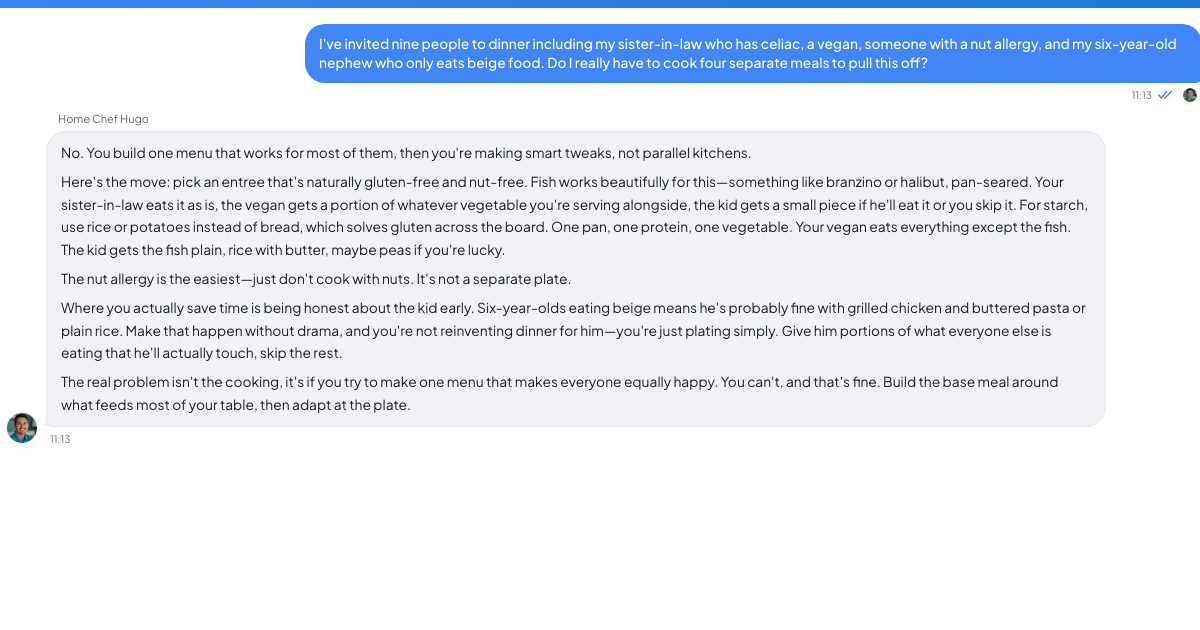
TrueTalk has an advisor called Home Chef Hugo — a private chef and cooking instructor persona with a culinary arts background, whose areas are culinary technique and teaching people to cook. It's software: an AI persona, not a person, which is mostly relevant in that you can open it at eleven at night with nine names and a list of restrictions and work out what the base is, what goes in the bowls, and what you can buy instead of make. Web or app. The free tier includes ten conversations and one hundred messages per day.
The allergy stays outside that conversation. That one goes to the guest, and past her, to her allergist.
Finish the shopping list with separate equipment
Add a cheap second colander, label it for gluten-free use, and store it in a different cupboard. It will probably cost less than anything else on the shopping list while removing repeated washing and cross-contact decisions during service.