Posting About Yourself on LinkedIn Feels Humiliating, but Silence Isn't Getting You Hired
You do not need to perform the usual LinkedIn voice. Make your profile searchable in private, then publish one useful technical note only when it serves you.


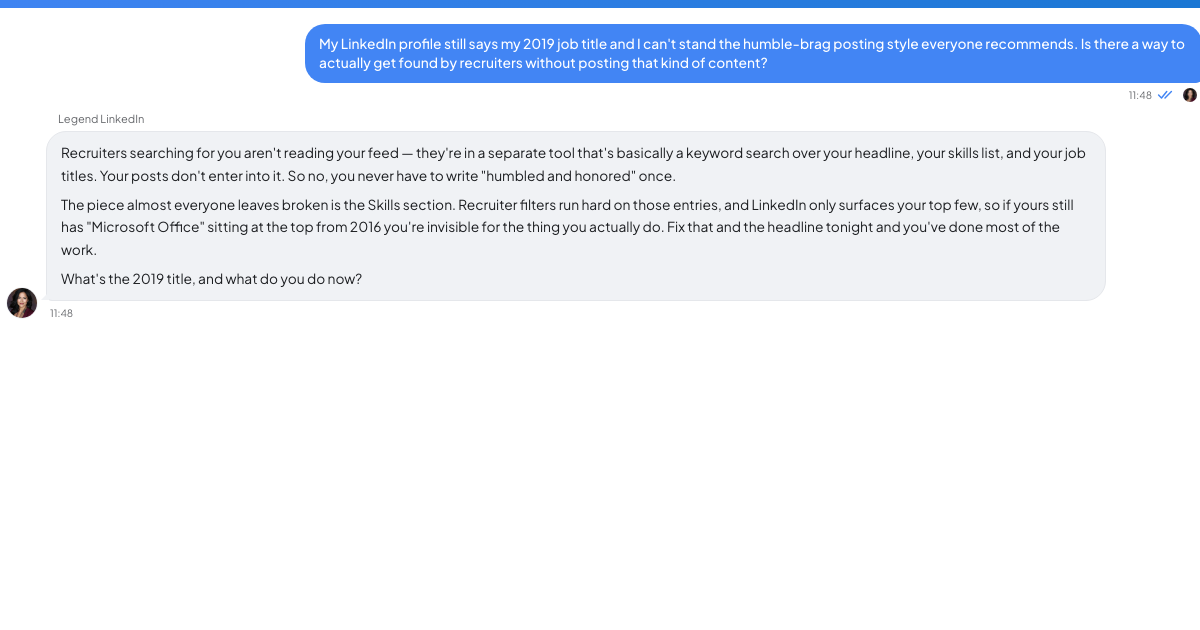
Make the profile searchable before you perform
Public performance needs an audience; making yourself findable takes one private afternoon of writing, and that is the job more likely to help you get hired.
Begin with the reason you avoid both tasks. You know the genre: someone's flight is cancelled, a stranger helps with the bags, and by the fourth line it has become a lesson about resilience in enterprise sales. Then, on its own line, Agree? You've read a hundred of those and every one made your skin crawl, so you post nothing. Your profile still carries the job title you had in 2019 and a summary you wrote on a train in a bad mood. The recruiters who do find you write about a role three grades below yours, in a city you've never lived in.
Telling yourself to get over it and post anyway rarely works. The reason is practical rather than moral. If you write in a voice you find contemptible, it shows — not anywhere you can point at, but in the small hedges, the slightly-too-careful phrasing, the general sense that the person typing doesn't believe a word of it. A senior engineer performing thought leadership badly comes off worse than a senior engineer who says nothing at all.
Your instinct about the voice is sound, but the underlying problem remains: in many fields, inbound approaches arrive through this website and your useful information is absent.
What Recruiter can actually filter
LinkedIn's own Recruiter documentation lists filters including current and past job titles, location, companies, skills, schools, industries, spoken languages, years in the current company and years in the current position. Its Keywords filter accepts Boolean strings and draws from the member's profile page (LinkedIn Recruiter Help).
Nobody outside LinkedIn can give you the ranking formula: result order, the weight of recent activity and last quarter's changes are not public. Discount anyone who presents a precise formula as fact.
The actionable part is simpler. Search uses profile text you control. LinkedIn also says its Skills filter uses explicitly listed skills and implicit skills extracted from sections including the summary, position description, title and headline (LinkedIn Skills filter). If the relevant evidence and language are missing, your ability alone cannot make the profile legible to that search.
That makes the highest-value LinkedIn task a private document you write once with nobody watching.
Draft the profile like a specification
The headline box invites a slogan, which is why people misuse it. Recruiters search for roles and capabilities.
Say you're a consultant anaesthetist whose real specialism is difficult-airway management, and you teach it to trainees. Consultant | Passionate about patient care | Lifelong learner is invisible. Consultant Anaesthetist — difficult airway management, simulation teaching, ICU is a string of terms somebody would actually type into a box.
Apply the same logic throughout the profile. The About section says what you do, at what scale, with what, in plain sentences — not a narrative about your journey. If you're an engineer, name the tools, including the unfashionable ones, because the person hiring for a twelve-year-old system is searching for exactly those.
And give every past role the title the market uses rather than the one your employer invented. A grade label that exists only inside your own HR system — Band 4 Delivery Professional, or whatever the equivalent is where you work — means nothing outside the building it was coined in. Be careful in the other direction, though: some odd-looking titles are used across a whole industry and searched on heavily. If other companies use it too, keep it.
Treat this as accurate form-filling rather than self-promotion. Precision matters; personality is optional.
If the drafting is the bit that stalls — and it usually is, because every available model is a style you find embarrassing — TrueTalk has an AI persona called Legend LinkedIn, specialised in personal branding and profile writing: hand over the ugly first draft at whatever hour, say plainly that you don't want it to sound like the platform, and work it until it sounds like you. The free tier includes ten conversations and one hundred messages per day. As an AI, it can't tell you what any particular hiring manager wants.
If you post, make it roughly monthly
Hooks, isolated one-line paragraphs and Agree? chase reach among strangers. Your narrower aim is for about six relevant people to recognise your name when someone asks for a recommendation.
Post something short, specific and genuinely technical about once a month. A thing that broke and what it actually turned out to be. Or the two-hundred-word answer to the question you've now been asked six times and are tired of retyping. Detail is the point, and detail is the one thing the engagement-bait crowd can't manufacture, because they'd have to have done the work.
Skip the story arc and the closing lesson about leadership. Aim for the tone of a note to a competent colleague.
Expect few likes. Three relevant readers can matter more than four hundred irrelevant ones; comment counts mainly serve people whose business is attention.
Two caveats that belong here rather than in a footnote. If part of you wanted the recognition as well as the job, this route doesn't deliver it, and it's better to know that now than to be quietly disappointed in March. And if you're job hunting right now, the profile rewrite is the urgent half — posting is a slow instrument, and it won't rescue a search that has to conclude in six weeks.
There's also a decent chance none of this matters much in your field. Plenty of work still gets filled through agencies, professional bodies, direct approaches, or word of mouth inside a community where everyone already knows who's any good. Look at how the last three people you know actually got their jobs. That's better evidence about your industry than any general advice, this piece included.
Use one hour this week
Reserve one hour this week. Put searchable role language in the headline, translate internal role labels into market terms where accurate, and list the real tools, including boring ones. Close the tab when the hour ends.
Even if you never publish a post, that hour leaves recruiters with an accurate profile they can search.