On Monday You Become the Boss of the Two People You Complain to About the Boss
A promotion over former peers creates four immediate conversations. Speak privately to your friend and the colleague who applied before you address the team.


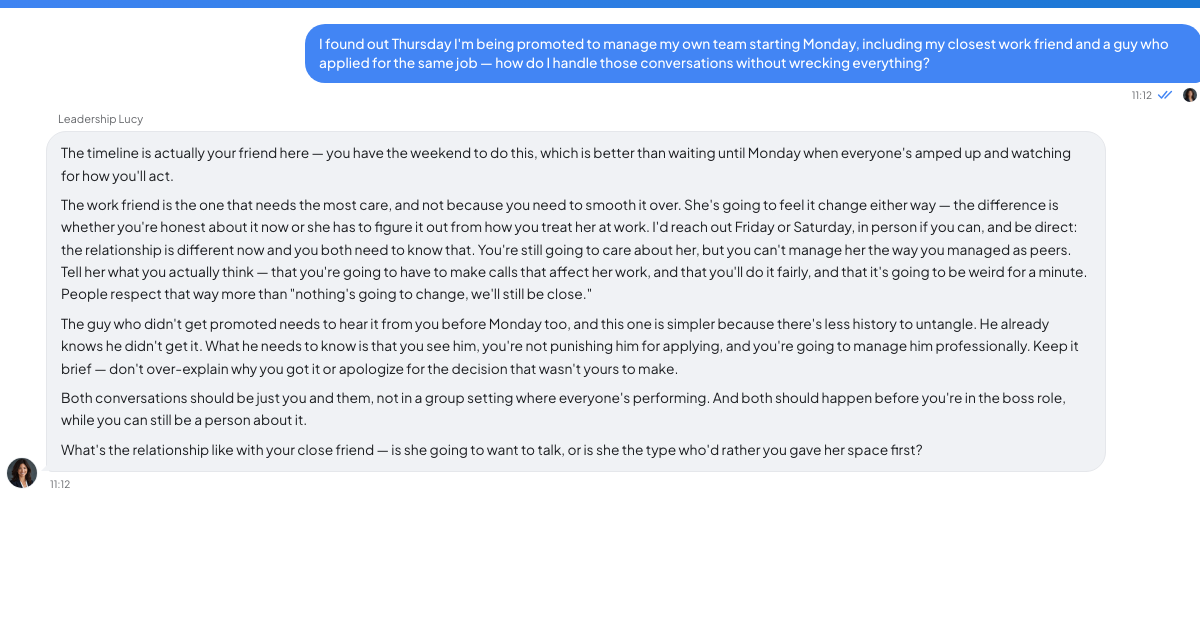
By Friday, the two-year group chat has changed
You hear about the promotion on Thursday. By Friday lunch, the floor knows. The chat where you and three colleagues agreed for two years that the quarterly deck was unreadable begins to slow.
Nobody removes you, because removal would be a decision people could discuss. The chat simply becomes quiet, then a second one appears without you. You will learn about it late and accidentally, which is how much of your new information will arrive.
That is week one. Weeks two through eight become harder because decisions acquire names.
Your closest work friend requests the final week of August. A colleague with nine years on the team wants the same dates. Only one can take leave, you must decide, and your handover says not to play favorites. A principle cannot divide one August week between two people who both know you.
The Center for Creative Leadership describes moving from peer to boss as a relationship shift. Its guidance is concrete: set clear expectations with friends and former coworkers, treat people fairly but not necessarily identically, base rewards on merit rather than favoritism, and build good relationships even with people you do not naturally click with. Those principles matter. Your immediate problem is still four familiar people whose reactions you can predict almost word for word. Handle them individually, hardest first.
Speak to your friend before an incident exists
Have the conversation during the first few days, before a rota, review, or rejected request makes every sentence sound like damage control. Meet off site if you can. Tell her both that you want the friendship and that one boundary has changed.
Do not say, “Nothing changes between us.” She already knows that is false, and a comfortable untruth teaches her something damaging about your new voice. Say: I want to keep this. One thing has to change: I can't be the person you vent to about work anymore. I'm now part of what you'd be venting about, and I'd have to do something with it.
Stop there. Do not fill the silence with reassurance. Let her give you the unflattering version of what she thinks, even though you will want to argue. If the conversation survives, ask her to tell you when you are being weird about the transition. You will be, and she is the only team member who can tell you.
Do not overcorrect to prove impartiality. You may give your friend the worse assignment, tighter deadline, or harsher judgment on average work to defend yourself before an audience that is mostly not watching. If the nine-year colleague receives August solely because choosing your friend looks bad, you have made staffing serve your reputation. Nobody complains, so the tactic feels successful; that silence rewards the overcorrection and makes you repeat it. Eventually your friend notices a pattern she cannot quite name and will not raise. The friendship is damaged by the pattern, not by one holiday decision.
Use the rule you would apply if neither person were your friend: who asked first, or whatever the team already regards as fair. State the rule. People cannot inspect your intentions; a visible process can defend the decision.
The CIPD sets out five behavioral areas for people managers. Within the area called “being open, fair and consistent,” it includes respect and openness alongside fairness, impartiality, kindness, integrity, and consistency. The other areas cover conflict and people issues; knowledge, clarity, and guidance; relationships; and development. Its guidance also recommends dealing with conflict early and impartially, clarifying roles and expectations, following up on commitments, and offering one-to-one access. Your August explanation is where those abstractions become observable.
Go to the colleague who applied during week one
They will not approach you. Do not wait for them to look upset; they may become exceptionally polite, punctual, technically flawless, and about eleven degrees colder than last month. That coldness is dignity, not passive aggression. Treat it as a behavior problem and you will receive a resignation by October.
Avoid four familiar lines:
- “I know this is awkward” makes them manage your discomfort.
- Saying you did not expect or request the role sounds like an apology for existing and implies an arbitrary choice.
- A promise about next time claims control you do not have.
- “I hope we can be normal” asks them to reassure you during their worst workweek in years.
Try: You applied, you didn't get it, and I did. I'd rather say that than pretend last month didn't happen. I won't tell you how to feel. I want to know what you want from the next year, because I'd rather build it with you than lose you.
Mean the final clause. Put them on work that visibly develops them within one quarter, or do not make the promise. Unsupported warmth is worse than silence. CIPD's same framework treats exploring career development and arranging development opportunities as manager behaviors, not comforting language.
If they ask why they were not selected, share the reason plainly when you know it and are permitted to disclose it. If you do not know, say so and offer to ask the decision-maker. Never invent a kinder explanation. A soft fiction destroys the relationship quietly and may surface months later in an exit interview you never read.
Address the room after both private conversations
Your friend and the unsuccessful applicant will sit through any group announcement calculating whether you spoke to them first. If you address the team before them, you make them an audience.
Keep the team version short. Name what will remain unchanged during the first month, then honor it exactly. Explain how you want bad news delivered. Answer what happens to complaints now that telling you creates consequences.
You can say: You can still tell me the deck is unreadable. The difference is that I have to do something about it now. Tell me if you want that, and tell me if you don't.
This is why the old venting boundary matters. Your friend can still report a work problem, but neither of you can pretend it is consequence-free gossip between equals. Also say how you want ordinary bad news to reach you, because employees who once complained beside you now need to know whether telling you about a broken process creates blame or action. Then demonstrate the answer on the next unreadable deck.
Admit what the promotion costs
Part of the friendship will disappear, though perhaps not its best part. You bonded through shared powerlessness: the same boss, the same constraints, and no authority to change either. That fuel is gone while you hold this role.
Insisting that nothing changed forces your friend to call you dishonest or retreat each time the difference becomes visible. Retreat is easier. Name the loss once, early, to the person who owns it with you, then perform the job.
An article cannot know which person has the longest tenure, who owes whom a favor, which colleague already has an offer elsewhere, or what somebody said in the pub in March. You carry the context that determines the tone of all four conversations.
Draft each conversation badly before speaking. Read it back and remove sentences designed to soothe you rather than inform them. In most drafts that is about one third, and it is always the warmest third.
Complete all four conversations inside a fortnight
Talk to your friend on Monday. Finish the four conversations within two weeks. Your team will decide what kind of manager you are from evidence gathered before you have had time to become good at the role. It is unfair and predictable. Still drafting in week six is itself an answer.
You will not regain access to the second group chat. In October, someone may forward a screenshot containing a joke you cannot understand from a conversation you never saw. Your job has changed you into the person people handle carefully. The two people with whom you were most careless therefore need your most careful words now.
TrueTalk publishes this blog. TrueTalk is an app — on the web, the App Store and Google Play — with 164 AI advisors. They are written personas, each with a profession, defined areas of expertise, a backstory and a way of talking. They are not people, and they are not therapists, doctors, lawyers or financial advisers. Anything clinical, legal or safety-critical needs a real professional; an advisor is somewhere to think out loud first, at whatever hour the problem actually shows up. This piece is bound to Leadership Lucy, a team leadership persona. The free tier includes ten conversations and one hundred messages per day. truetalk.app