One Free Evening in a City You'll Probably Never Return To
With three tired hours in an unfamiliar city, choose one neighborhood-scale experience, ask locals answerable questions, verify hours, and keep the return route safe.


A three-day itinerary cannot be divided into Tuesday night
You have one evening, no companion, and no second chance. Taking one sixth of a three-day guide produces a rushed list, because those itineraries assume daylight and company. They also favor places visited by the largest number of people, which is different from choosing what deserves your only free evening.
You landed yesterday, have meetings tomorrow, and fly out Thursday morning. Right now you are on the hotel bed with feet still aching from the airport, comparing the restaurant downstairs with the first nearby doorway displaying an English menu and food photographs.
This is your ninth city of the year. Asked tomorrow what the other eight were like, you would describe airports, meeting rooms, and breakfast buffets. You need a repeatable method rather than another city guide.
Spend the real two hours, not the imagined three
Suppose it is Wednesday in Porto. Work ends at six, and your hotel sits a twenty-minute taxi ride from anything. You have about three hours of genuine appetite. Walking, waiting, and returning will consume one, leaving two.
Two hours can hold one bar counter and one dish you would never order at home. It cannot hold a viewpoint, landmark, and drink attempted at a jog; that version produces another evening you will not remember. Choose one thing, and choose by neighborhood rather than attraction. An attraction performs for visitors; a neighborhood carries on regardless, and that carrying on is what sticks in your memory.
Check current hours before building the evening around a market or museum. Porto's official listing says Bolhão Market has more than 70 traders, 38 exterior shops, and 10 first-floor restaurants, but the produce market closes at 20:00 Monday through Friday, 18:00 Saturday, and all day Sunday. That is exactly the kind of local detail a generic three-day list can hide. At 18:00 on Wednesday it may work; after a late meeting it does not.
Ask two people questions that require lived answers
A concierge is not dishonest, but the role rewards a recommendation that will definitely not go wrong. That incentive often produces the laminated menu. Try, in order, a receptionist who mentions growing up locally, the night porter, a bartender away from your hotel, or the airport driver if you developed enough conversation.
“What is a good restaurant?” invites a safe answer. Ask instead:
- Where do you eat when you pay for it yourself?
- Where do you go after finishing work at seven on Wednesday when you do not want to go home?
- What do you order there?
A recommendation based on experience usually arrives with a dish and an opinion about it. If the person names a place but cannot tell you what to order, they have named somewhere they have heard of. Ask two people separately and follow the overlap.
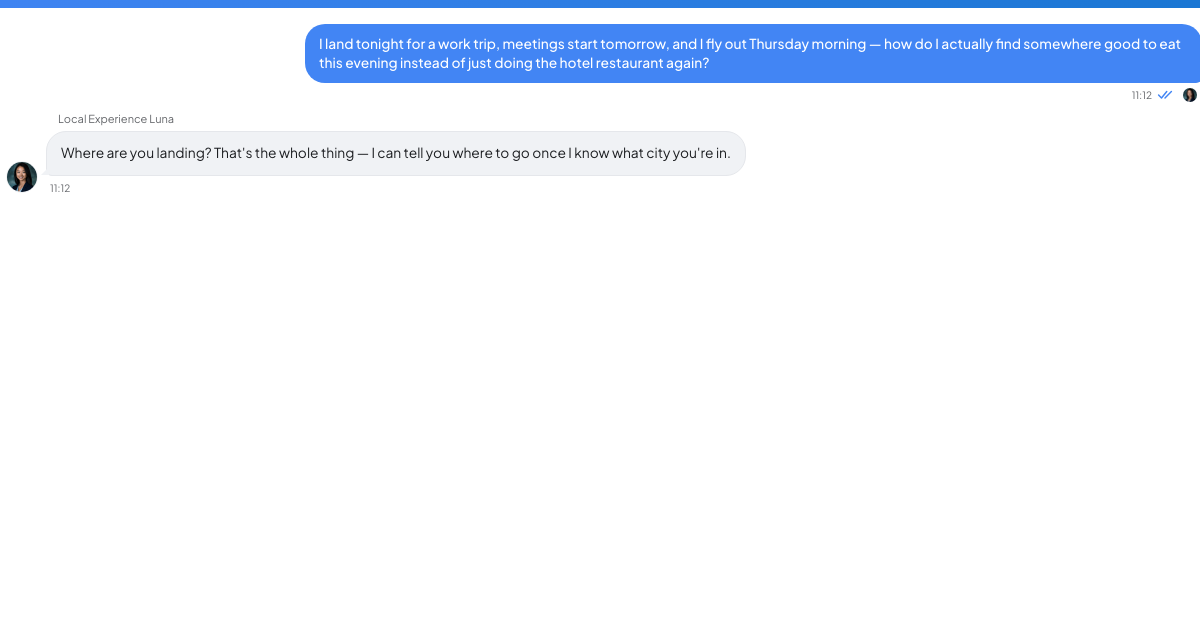
Local Experience Luna is a TrueTalk AI advisor available on the free tier, which includes ten conversations and one hundred messages per day. She can help generate precise questions. The night porter still has to supply the local answer.
Porto's official Tourist's Manifest gives similarly specific prompts: ask locals for advice, use official tourist offices for formal information, explore districts beyond the Historic Centre, support traditional shops and street markets, and walk or use public transport. It also identifies the Tourism Police at Praça Pedro Nunes 16 and lists (+351) 222 092 006. Save official help details rather than assuming a citywide safety label answers every street-level question.
Use ninety seconds on the pavement
When your patience is almost gone, inspect four things before walking in.
The hour. Local dinner time is the most consequential pavement signal. If people eat at half nine, a restaurant that is full at seven is full of visitors. Go at seven and accept that company, wait until half nine for the neighborhood rhythm, or choose a bar counter. Move the afternoon when you can.
The people entering. A room with people eating alone on a weekday is usually a room with regulars, although your work trip proves the rule is imperfect. Watch the door for two minutes instead. People who enter without pausing to read the outside menu have been before.
The menu. Short usually beats long. A kitchen offering eight dishes is cooking. A kitchen offering one hundred and forty items across five cuisines is reheating. Photographs of the food and translations into four languages mean the place was built for visitors, not the person who lives upstairs. A handwritten or clearly recently changed menu is a good sign for the same reason.
The direction from the landmark. Two streets behind the main square, station, or cathedral, prices often drop and the clientele changes. You do not need a long walk; turn perpendicular to the obvious route.
Let the evening take a shape other than dinner
For one free evening, a restaurant is usually the wrong choice. A two-hour restaurant meal alone is rarely memorable and most reliably ends with you scrolling. Look for a public activity that residents would repeat even if you were absent: a night market; cheap seats at a second-division football match; a public bath or sauna where that culture exists; a free concert in a church or hall; cards, dominoes, darts, or an incomprehensible pub quiz; or a hill, bridge, or promenade used after work.
The people would be there anyway, so you encounter a place rather than a product.
Museums are usually the wrong tool for this slot: most are closed or closing when your meetings end, and they require concentration you no longer possess. Spend thirty seconds checking official hours because a weekly late opening is one useful fact a search engine can answer.
In Porto specifically, verify whether the official market example fits your clock rather than assuming “market” means night market. Bolhão's published average visit is thirty minutes and it connects directly to the Metro, useful facts for a short slot, but its closing time may rule it out. The method survives because you choose from what is actually open.
Keep fatigue and safety inside the decision
Some purpose-built business districts near a ring road are genuinely dead after six, with only a retail park in walking range. Choose between a taxi to a real neighborhood—twenty minutes each way—and sleep. An early night is legitimate. Work travel becomes more exhausting when every free hour must produce value.
Safety differs by traveler, street, and hour. Ask hotel staff about the exact route and specify when you will return. A hesitant answer means taxi both ways or select another place. No memorable dish justifies an unlit walk where you cannot read your surroundings. Use official sources for transport and emergency details, and do not treat a general statement that a city is safe as a guarantee about your route.
If you share no spoken language with anyone nearby, choose a market stall or bar counter over full table service. You can point at what you want.
The previous nine cities blurred because no specific event distinguishes them. Create one concrete anchor: an unfamiliar dish, a porter-recommended street, a patch of rain, or a public ritual you would not see from the hotel restaurant. Ask two people the three specific questions, check the return route with reception, and leave the hotel with one destination.