The Theme Park Trip Your Sensory-Sensitive Kid Might Not Survive
Describe exactly how a conventional queue fails, verify the park's current access process, and plan every virtual wait, quiet point and exit before arrival.


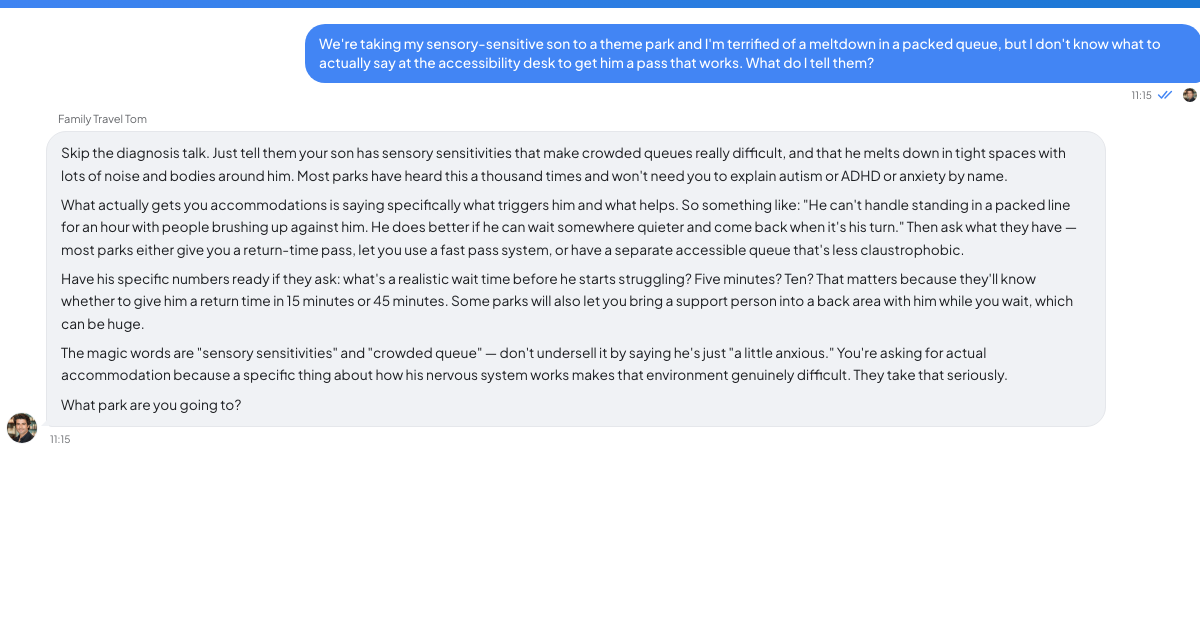
Describe function in four accurate parts
Between booking and departure, a stranger will ask you to explain your son's most difficult ordinary presentation. Some parks conduct that conversation at guest services on arrival morning. Other operators require an online conversation before the flight. Although brief, the exchange may shape all four park days more than any itinerary detail.
Few guides cover this uncomfortable description directly.
"My child is autistic" supplies the diagnosis. The staff member is assessing how a conventional queue functions for him. They're working out whether a conventional queue is workable for your child, so the sentence that lands is the one describing function and failure.
Cover four parts: the task he cannot sustain, the duration, the failure behaviour and your required response.
Suppose your son is seven. The version that gets understood sounds like this — and this is an example, not a script to read out, because yours has to be true:
"He can't stay in an enclosed queue for more than about ten minutes. Once he can't see a way out he starts to panic. When he panics he drops to the floor, screams, and hits out at whoever's nearest, and the only thing that stops it is me physically carrying him somewhere quiet — which in a packed switchback with no exit I can't do without pushing back through a hundred people."
Use three constraints when adapting the example.
Describe a typical bad day rather than an outlier. A typical bad day is both credible and relevant to the visit. His single worst lifetime incident supplies weaker evidence for ordinary accommodation needs. Attach one dated example, such as last month's dentist visit or April's airport-security queue. Give a concrete incident instead of stronger adjectives.
When asked what would help, name the mechanism: a non-confined waiting place and a reliable exit. Allow staff to match those functional needs to the arrangements they actually offer.
Rehearse the description aloud once. Describing your child this way can feel strange and humiliating; a second delivery is usually clearer. When both parents join the call, choose the speaker beforehand.
Check the park's current process at booking
Because access processes change and many guides age silently, use this section only to identify schemes to verify on official pages.
Disney runs a Disability Access Service at its US parks. Disney currently describes DAS as intended for guests who, because of a developmental disability such as autism, cannot wait in a conventional queue for an extended period. Registered guests can select same-day return times in the app, hold only one DAS return time at once, and use it until the park or attraction closes (Walt Disney World DAS). Eligibility and registration have changed in recent years, so read Disney's official accessibility page rather than any secondary guide, including this article.
Several large operators route eligibility through an outside body instead: the IBCCES Accessibility Card, described on its own site as a free resource for people needing to request accommodations at participating parks. You register online before travel; the official site asks for registration at least 48 hours before the visit, requires a healthcare-provider statement, describes the card as free and valid for one year, and warns that it neither guarantees entry nor guarantees accommodations (IBCCES Accessibility Card). Its participating list includes Universal Orlando, Universal Studios Hollywood, Cedar Point, Knott's Berry Farm and the Six Flags parks. Which means the received advice that parks won't want to see anything from you doesn't hold everywhere — at those parks there's a registration to complete in advance, and turning up without it is the mistake. Find out which kind your park is the week you book, not the week you fly.
Some parks also publish sensory information for individual attractions — noise, darkness, drops, strobe — and mark quiet areas on their official app. Check your park's accessibility page and its app rather than assuming it exists.
Plan the virtual wait as carefully as the queue
Large parks often use a return-time model, but confirm the actual park's current rules instead of relying on this summary. It gives you a return time, often roughly as long as the current standby wait, and you go and do something else, and come back.
So the thing you keep picturing — forty minutes into a queue that folds back on itself six times, the crush at the merge point, thirty-one degrees, somebody's phone playing a video at full volume two feet behind you, and your son going from fine to gone in ninety seconds with three hundred people watching — the arrangement doesn't delete that. It relocates it. The waiting time remains. The accommodation changes where that waiting happens.
That relocation creates a planning task. Forty minutes, somewhere else, with a child already close to the edge. If you haven't decided in advance where "somewhere else" is, you'll be deciding it at 11am holding an ice cream and a screaming seven-year-old.
Mark an exit and quiet point in every area
Approach the map as an exit plan.
Before travel, print the map and mark exits plus quiet locations.
Choose a decompression point in each area before you walk into it, and say it out loud to your partner. If it starts here, we go there. Deciding that in advance is most of the difference between a bad twenty minutes and a ruined day.
Do half-days, and get out for the middle of the day — usually the hottest and busiest stretch, and the one where everyone's tolerance is at its lowest, yours included. Four paid days used as six-hour halves is a perfectly good use of them; nobody charges extra for leaving at one o'clock. Return to the hotel on day one while regulation is still recoverable; that preserves more capacity for day three.
Pick one ride for the morning and treat everything after it as extra. If day one is one ride, an ice cream and an early exit, day two starts from a good memory. A nine-attraction target encourages you to override the first wobble, so use that first wobble as the planned signal to leave or decompress.
Look up whether your park runs a rider switch — one adult waits with the child while the other rides, then they swap without queueing again. If you've got a second child who came for the coasters, that's the thing that saves the trip for them.
Take the safe food in. Check the park's rules, they vary, but a familiar packet at one o'clock beats any restaurant reservation. Ear defenders go on before the loud bit. Sunglasses, hat, spare clothes, water, and whatever object already works at home.
Practise both the wait and the exit
Use the fortnight before travel to practise the required waiting skill.
Wait in real queues at home — the supermarket, the post office — using exactly the same tablet, timer, toy or routine you're planning to use in the park. You're building an association. Practise the tablet, timer, toy or routine beforehand instead of introducing it during an 11am overload.
Practise leaving as deliberately as waiting. Agree a word or a card that means we leave now, no discussion, and honour it every single time it's used, including the times it's maddeningly inconvenient and you're two people from the front. If the exit word is reliable, queues get easier, because what makes them unbearable is being unable to get out.
Keep a fallback that includes leaving
The park may refuse the request or offer an arrangement that only partly fits. That happens, and it's not a verdict on your child or on you. The fallback is shorter days, off-peak hours, single rider where the age rules allow, rider switch, and a genuine willingness to walk out of a park you paid for.
Then there's the other fear, which is being the family everyone watches. Expect some people to watch. Most have been awake since five with their own children and will have forgotten you by the next queue. That won't make it feel better in the moment and I don't have a technique for that part. What helps slightly is deciding in advance who takes the child and who takes the bags and the other kid, so you're carrying out a plan instead of improvising in front of an audience.
If the family manages two useful days from four paid days, record that as the successful version of this trip. The ticket cost is already committed, so use regulation and the family's experience—not hours inside the gate—to decide when to leave.
Put the logistics on the map
TrueTalk has an advisor called Family Travel Tom — a family travel and theme park persona, aimed at trip logistics and kid-friendly planning. Tom is an AI persona, so nothing it says carries any weight with a park and it can't tell you what your child needs. Where it earns its keep is the flat logistical work at the stage where you're staring at a park map with four dates and a list of triggers, asking where the half-days and the decompression points go. Web and app. The free tier includes ten conversations and one hundred messages per day.
For anything about your child's needs themselves — what helps him regulate, what to practise, what's realistic — the people who actually know are his paediatrician, his OT and his school team. Ask them before you go, then use this article only to arrange the half-days, access process and exits.
Check the access deadline today
Most logistics can wait until the fortnight before departure. Access registration may require earlier action. Open the park's official access page today.
At 11am on day one, use the exit word at the first wobble, divide child and bag duties as planned, and return to the hotel by half past one if regulation is failing. Preserve enough capacity for the next half-day rather than using the ticket price as a reason to stay.