The Client Golf Day Is Thursday and You Can't Take the Club Back
Plan the client golf day around a safe first tee, a two-cue routine, prompt play, and four hours of useful conversation—not a perfect swing.


The four seconds before the club goes back
You recognize those four seconds. Once you address the ball, etiquette stops the conversation behind you, and the silence makes you conscious of your hands. The takeaway seems to happen without your permission; the ball runs thirty yards along the ground; four hours with the group still remain.
It has happened twice this year, including once before two colleagues and a client. Your 18 handicap is perfectly respectable, and on the range you can strike that driver fifty times without trouble.
Your basic swing is not the issue. Because Thursday puts you beside the account you own, another Wednesday-night bucket would be avoidance disguised as preparation.
Let's do the day in order.
Wednesday night
Two jobs, neither of them physical.
Call the organiser and establish the format. Many client days use a scramble or Texas scramble precisely to prevent one player from enduring a miserable afternoon; the team absorbs your poor shots, and knowing that removes much of the pressure. In individual Stableford, you may pick up once you cannot score. Rule 21.1 says a player who does not hole out gets zero points and encourages stopping when the hole will yield zero, specifically to help pace (The R&A).
Make your first-tee choices at home, while your hands still cooperate, and write them down if useful. Choose the club, target and single thought. The tee is your worst moment for fresh decisions.
Skip the range and sleep.
The first tee
Leave the driver in the bag.
Leaving it there is the day's highest-value decision, though people resist because they imagine a first-tee hybrid reveals weakness. It actually shows that you have played before. Plenty of competent golfers select an iron because nerves concentrate on the opening tee. Its loft makes a top less likely: more clubface sits behind the ball, giving a slightly thin strike a better chance to fly.
Choose a hybrid or teed-up 5-iron. Teeing an iron is allowed: from the teeing area you may play the ball from a tee or the ground (The R&A). Nobody criticises that choice.
Picture a 380-yard par four with out of bounds on the right. Your driver's best case is 210 into the semi-rough, and its worst case is the nightmare you keep rehearsing. A hybrid's best case is 170 in the fairway and its worst case is 90 yards forward and playable. You will make six either way, but only the first route can leave you waiting for someone to say, "you can hit another."
Use the hole's widest target, not a better player's line.
Volunteer to go early if possible. It may sound mad, but it avoids four minutes of watching three good drives while your pressure builds.
The routine, which should be shorter than you think
A long pre-shot routine assumes calm. Under genuine nerves, twelve steps create eleven extra opportunities for your brain to interrupt.
Keep two cues: look once at the target, then breathe out slowly as you settle. Swing.
The exhale does the work. Holding a full breath over the ball is why the takeaway feels alien.
If you need a swing thought, allow exactly one and keep it about tempo, not mechanics. Slow back. Not "keep the left arm straight and shift the weight and". Mechanics are a range activity. Thursday is not a range.
Hours two and three
Movement makes the golf easier and changes your job: manage the round, with pace rather than score as the currency.
Play to the fat side of everything. If there's water short-right of the green, you are not going at that flag on Thursday, and neither is anybody who's ever thought about it for a second.
Take one extra club and swing at 80%. Amateur shot-tracking data, including the kind Shot Scope publishes, consistently has approaches finishing short more often than long. A controlled 7-iron that works beats a forced 9 that does not.
When you are out of a Stableford hole, pick up. Two above net par—par plus your received shots plus two—ends it, so pocket the ball and move. The R&A explicitly encourages a player to stop once the score must produce zero points (The R&A). Nobody wants you grinding out a 10; slow play lasts in memory longer than bad play.
Prepare ball, club and glove while others play so your turn occupies twenty seconds, not ninety. Use ready golf unless the format says otherwise. In stroke play, The R&A allows and encourages playing out of turn when it is safe and responsible and does not endanger, distract or interfere with anyone (The R&A).
Watch where every ball finishes. The R&A's pace manual says attentive shot-watching reduces searching time and lost balls (The R&A); it also makes you useful company.
The part that decides how Thursday actually goes
A client usually retains whether the four hours were enjoyable, not your total. By Friday morning, most will have forgotten your score.
Concentrate on the company, using these specifics.
Make one opening joke at your expense—"fair warning, I'm off 18 and I mean it"—then stop discussing your game. Repeated apologies create the real social problem. Every "sorry, that's terrible" demands reassurance; after nine holes, the group is managing you as a project. After a bad shot, walk to it, play again and change the subject.
Ask them things. The course gives you four hours of conversation with built-in pauses, which is why client golf exists. That commercial value does not depend on your 3-wood.
Don't give swing tips. Don't ask for them either, unless someone offers, and then take it gracefully and change the subject.
Buy the first round afterward, but do not medicate the front-nine nerves with alcohol. Two pints in and the wheels genuinely do come off; this remains work, and somebody will remember.
Where this doesn't apply
If the club physically will not start back on every shot, even when you are alone on an empty range, you have something different from first-tee nerves. A pre-shot routine will not address it. Discuss that with a coach; if it appears elsewhere in your life, speak with an appropriately qualified professional rather than relying on a golf professional.
For a serious competition requiring a signed card, disregard the general pick-up advice and verify its rules.
Rehearsing it out loud beats another bucket of balls
Prepare by saying the first-hole plan aloud: club, aim and what you will say after a top. That rehearsal is more useful than more mat shots.
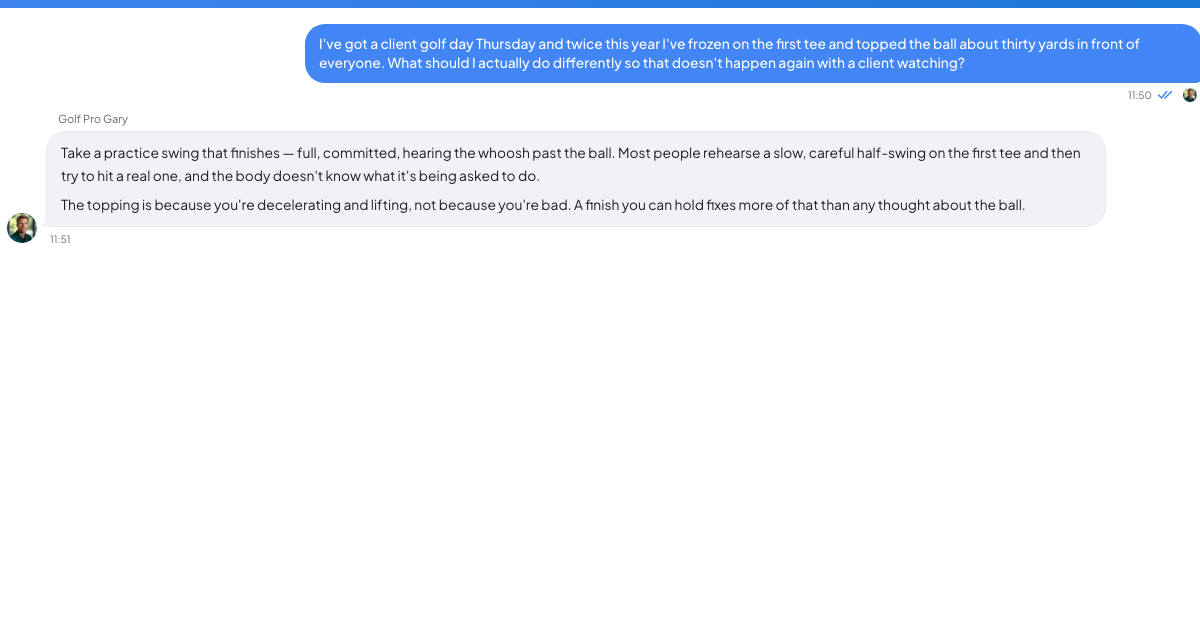
TrueTalk has an advisor called Golf Pro Gary, an AI persona specialised in golf instruction, course management and equipment. It is not a human professional or a coach beside you, so it cannot see your swing. On Wednesday night, though, you can say that you dread the event and build a first-tee plan immediately. The free tier includes ten conversations and one hundred messages per day.
A result worth planning for
A realistic round begins with a hybrid travelling 165 yards down the middle of the first hole, continues through a seven, and becomes a decent afternoon with a client quietly relieved that somebody else is not very good either. That is a successful outcome.
When you walk off 18, buy the first round and keep the conversation on them.