They Just Handed You the Wine List in Front of the Client
The ninety seconds, second by second: four sentences, one gesture, and what the tasting pour is actually checking. Plus the wine advice worth ignoring.


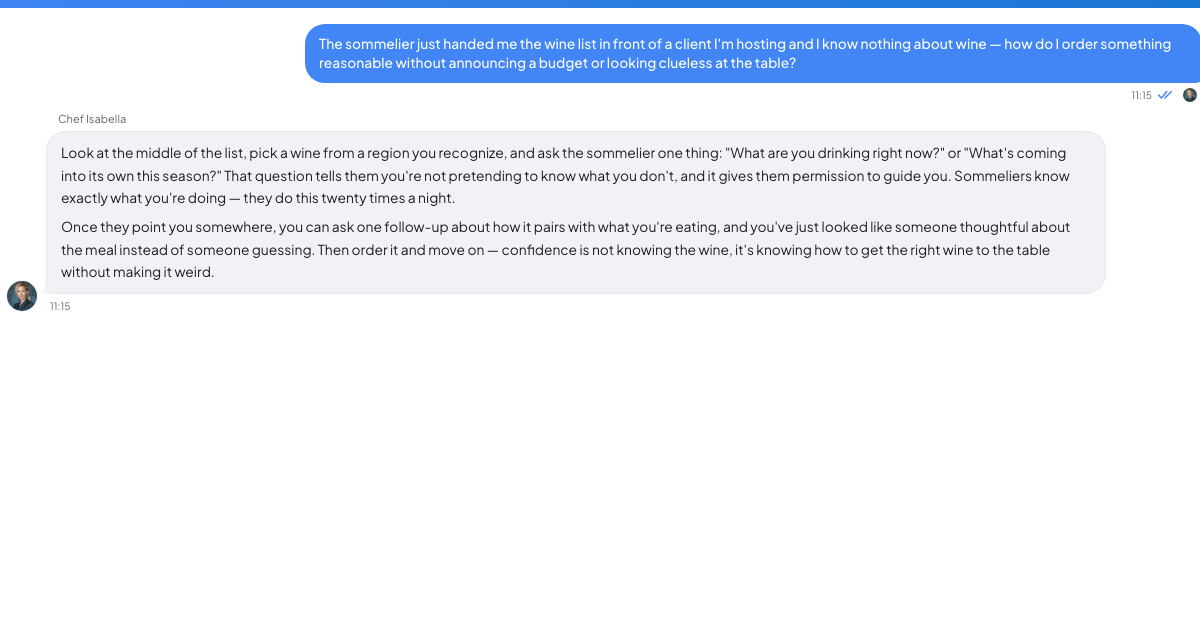
The list arrives in front of you
The sommelier walks the length of the table and puts the leather-bound thing down by your elbow, because you made the booking and that makes you the host.
Say there are four of you, and one of them is the reason the dinner exists. The list has a page of things at £30, a page of things at £400, and eleven pages in between with words on them you cannot pronounce with any confidence.
Both ways this goes wrong are already in your head. Order cheap, look like someone who cannot host a client. Order expensive, look like someone who cannot be trusted with a budget. And at some point in the next few minutes a small amount of wine gets poured into your glass and the table stops talking to watch you drink it.
Ninety seconds, the whole event. Here it is second by second.
0:00 — you are holding the list
Do not read it. Reading it in silence is what the ninety seconds is made of, and you were not going to find anything in there anyway.
Nobody at that table invited you for your wine knowledge and nobody is going to leave thinking about the bottle. What registers, and it registers hard, is whether a small piece of hosting went smoothly or visibly stalled.
Every article on this tells you to learn a few grape varieties so you can sound informed. That advice is what creates the failure. Performed knowledge invites a follow-up question, and a follow-up question is where you get found out, in front of the client, mid-sentence. A question cannot do that to you. Asking is what hosts do.
Four sentences and one gesture, then. You need no wine lesson this afternoon.
0:04 — to the table
"Red or white? Or shall we do one of each?"
Two seconds, and now everyone's involved and you have a direction. Somebody will say "either" and somebody will say "whatever you are having", and one of them will have an actual preference, which is your answer.
0:10 — to the sommelier
List open, finger resting on a bottle in your price range.
"You will know this list far better than I do. We are having the fish and the beef, there are four of us — could you suggest a couple of things around here?"
The finger is the gesture and it does all the work. You never say a number out loud. You point at a price on the page and hand the list across, and it is read instantly, because walking people through a list is the job.
That single move solves the budget problem: the client never hears a figure, and you never get walked up to a bottle at four times what you meant.
0:40 — they come back
Two or three options, usually. Pick one out loud.
"The second one, thank you. That sounds right."
Do not put it to a vote. Do not ask whether it is good. You asked a professional to shortlist inside a range and they did, and the decision takes two seconds. Hesitating here is the only part of the ordering that can look uncertain.
While you have got their attention: water for the table, and ask out loud whether anyone would like something non-alcoholic. When you do this now, the colleague who is not drinking never has to announce it later. Costs you nothing and gets noticed by exactly the person it is aimed at.
1:10 — the pour
The tasting pour is a quality-control check, asking whether the bottle is faulty in about four seconds. The WSET Level 2 specification treats appearance and nose as service checks and lists cork taint, closure failure, and heat damage as common faults; its food-pairing factors include sweetness, umami, acid, salt, fat, flavour intensity, and chilli heat.
Swirl once. Nose in the glass. Sip.
You are looking for wet cardboard or damp-cellar aromas and fruit that seems switched off. WSET's guide to common wine faults identifies TCA, or trichloroanisole, as the chemical behind cork taint, says tainted cork is its most common source, and notes that sensitivity differs from person to person. Cork taint is the wine fault you are most likely to encounter; cork fragments alone do not mean the wine is corked. Two others are worth recognising — a vinegary or nail-polish sharpness, and a flat, browned, sherry-ish character in a wine that's meant to be young.
Almost always it is fine. In which case:
"That's lovely, thank you."
They pour, and the ninety seconds is over.
1:20 — if something's wrong
"I think this one might be corked — would you mind having a look?"
That hands the judgement back to the professional, which is where it belongs and where you want it. You are not making a scene by asking someone to check their own product, and the sommelier would rather you said something than let the table drink it.
What you cannot do is send it back because it is not to your taste. That's the line people are unclear about, and the uncertainty about where it sits is most of what makes the tasting pour feel like an exam.
What you can stop worrying about
The second-cheapest bottle. The story is that it is the one restaurants mark up hardest, so never order it. It gets repeated everywhere and I've never seen solid evidence behind it. Markups vary by restaurant and by bottle. Order by range. Where a bottle sits in the running order of the list is not information.
Spending too little. A £45 bottle chosen with the sommelier reads better than a £150 bottle chosen at random, because the first one comes with a story about hosting and the second one comes with a story about guessing. Unless your client reads the list, they do not know what you spent — and if they do read it, what they are reading is whether you spend a client's evening sensibly.
Spending a lot to signal that the relationship matters. Reads as showing off, or as being loose with somebody else's money. Neither is the impression you are after in your second year at a firm.
The performance bits. Holding the glass up to the light, sniffing the cork, saying "good legs". None of it produces information you can act on, and all of it invites someone to ask you what you found.
What to spend
It depends, and anyone giving you a fixed number is guessing about your industry, your client and your employer.
Two things that are actually true. Check your company's expense policy before dinner rather than after — some have a per-head limit, some have rules specifically about alcohol, and the expenses tool a week later is a genuinely bad place to learn either. And if the budget is tight, arrive five minutes early and say so quietly to the sommelier or the maître d' before anyone else sits down. That conversation is invisible, and it removes the entire problem for the rest of the night.
There is a common rule of thumb that the bottle should sit around the price of a main course. That is folklore rather than law, but it remains a defensible place to put your finger on the page when you have nothing else to go on.
The versions where the script does not fit
No sommelier and a waiter who does not know the list. Then ask "what do people order most from here?", or choose the house red and white by the bottle. Both are workable, and nobody has ever lost an account over the host choosing house wine. Use the red-or-white preferences you collected at 0:04 to decide between them.
The client turns out to know a great deal about wine. Hand it straight over — "You clearly know more about this than I do, would you choose for us?" — and let a senior person be good at something in public. Guests generally enjoy being asked.
The client orders the £400 bottle themselves. Keep your face still and deal with it in expenses on Monday. If that conversation is going to be difficult, have it with your manager before the dinner.
You are at the table but the budget belongs to somebody else who's sitting there. In that case, slide the list across without commentary.
Rehearsing it out loud
At another table, somebody else will be holding a wine list and dreading the same task. For your own rehearsal, TrueTalk has an advisor called Chef Isabella — an executive chef and culinary consultant persona whose areas include Italian cooking, pasta and wine pairing. It is an AI persona rather than a real sommelier, which for this particular job is close to the point: you can say the four sentences twenty times over, with your restaurant and your menu and your budget in them, and there is nobody in the room to think less of you on the twentieth. Web and app. The free tier includes ten conversations and one hundred messages per day.
Return your attention to the conversation
The sommelier fills four glasses, says something pleasant about the beef, and moves on to another table. Your client picks his glass up mid-sentence because he was talking about a supplier in Rotterdam when the wine arrived and has not stopped; your job now is to listen to him.