Three Hundred Applications, Two Auto-Rejections, and a CS Degree You're Starting to Regret
A fifty-one-minute rejection usually reflects an application rule, not a code review. Audit the form, strengthen your project evidence, and reallocate your search.


Fifty-one minutes
You submitted at 9:04 on Tuesday night, and the rejection arrived at 9:55. In those fifty-one minutes, no person could have meaningfully read the application.
Your spreadsheet proves the count has passed three hundred; most cells in its "heard back" column remain blank. You finished a CS degree fourteen months ago and have two projects you value, including one with actual users. You also have no former colleague to vouch for you because you have not worked yet, which makes most standard job-search advice unusable.
Around application two hundred, you began blaming yourself instead of the market.
What a fifty-one-minute rejection actually is
The fifty-one-minute rejection was a rule firing. Tracking systems can apply knockout questions about work authorisation, location, minimum experience, required qualifications or a salary number entered into a field. Those rules can run before a person participates and reject the third-best candidate exactly as they reject the worst. The EEOC confirms that employers use software to score applicants' resumes and warns that automated tools can screen out qualified disabled applicants without safeguards (EEOC).
That fifty-one-minute no tells you almost nothing about your code and much more about the completed form.
Audit the last five applications once, carefully, and identify the field capable of eliminating each one. Years of experience is the usual suspect. A junior posting's "2+ years" is often a template default rather than a genuine bar. When the form makes it a hard filter, nobody sees that you could do the work.
You will see a widely repeated statistic for the share of CVs that never reach a person. Ask for its source and refuse to build a plan around an untraceable number.
Sit in the other chair for a minute
Take the hiring seat.
You run an eleven-person company with one junior opening, perhaps eighteen months of runway behind it, paying what the business can afford rather than what you wish. The role goes live Tuesday morning and has four hundred and twelve applications by Thursday lunch. You are not a recruiter. You must also ship the product, calm this week's two unhappy customers and run payroll.
You have an afternoon.
Two or three trusted names arrive through a former colleague, an investor's cousin or last year's runner-up. You place them first because a known person's judgement carries information a CV cannot. Before opening the applicant list, you have allocated four of six interview slots.
You open the remaining pile and skim each application for seconds, looking for a reason to pause.
Few provide one. Nearly all share the same shape: the cohort's three standard portfolio projects, repeated phrasing and a tidy summary without character.
Applicants rarely hear that a tired reviewer is sorting them among four hundred similar-looking people rather than measuring them against an abstract bar.
What breaks the pattern from that seat
Use four signals.
Lead with something deployed and used by other people: a working URL with users, however few. Ten strangers using your product says more than a clean architecture diagram. It proves that you shipped, explained the product and handled a bug report from someone with no obligation to be kind.
Connect a project to the company's real problem. Use the product, identify a specific detail and offer an observation rather than flattery.
Show evidence that you can face an annoyed person without worsening matters. Support tickets from a non-tech job. A customer you dealt with. In a small company, junior work is often customer-facing and integration-shaped—the why-is-this-API-returning-a-500-on-Tuesdays problem—where explanation matters about as much as code.
Finally, find a person who knows both sides.
The reallocation, and the three places it runs out
Stop grinding algorithm problems. Your data says ability is not the current bottleneck: a fifty-one-minute rejection never assessed it, while a genuine skill gap would first get you to a screen that you then failed.
Reduce the weekly total from fifteen applications to five. Target companies small enough for a person to read submissions and specific enough that you can describe their product without checking. Use the reclaimed hours so one real person knows your name before you apply: attend meetups, contribute to open source and answer forum questions instead of announcing a search. This takes months rather than weeks: go where relevant people gather and be useful without asking for anything. The U.S. Department of Labor's CareerOneStop defines a portfolio as evidence of work and advises describing each project's contribution and results; it also says a portfolio can support networking and distinguish an application (CareerOneStop).
Three places it runs out, and you should know them before you commit a quarter to it.
If you are rural, or your country's industry occupies three cities, referrals are too slow to be your only plan. Include remote-first employers, while recognizing that remote hiring is its own harder problem.
When your visa or rent permits eleven weeks rather than eleven months, long strategy becomes a luxury. A bridge job is not defeat; many people enter through support, QA or internal tools at a company that is not itself a tech company.
Sometimes the hiring year is the constraint. Thin entry-level years affect whole cohorts, and personal optimisation cannot undo that market. Not everyone here is doing something wrong.
Someone to run the pile past
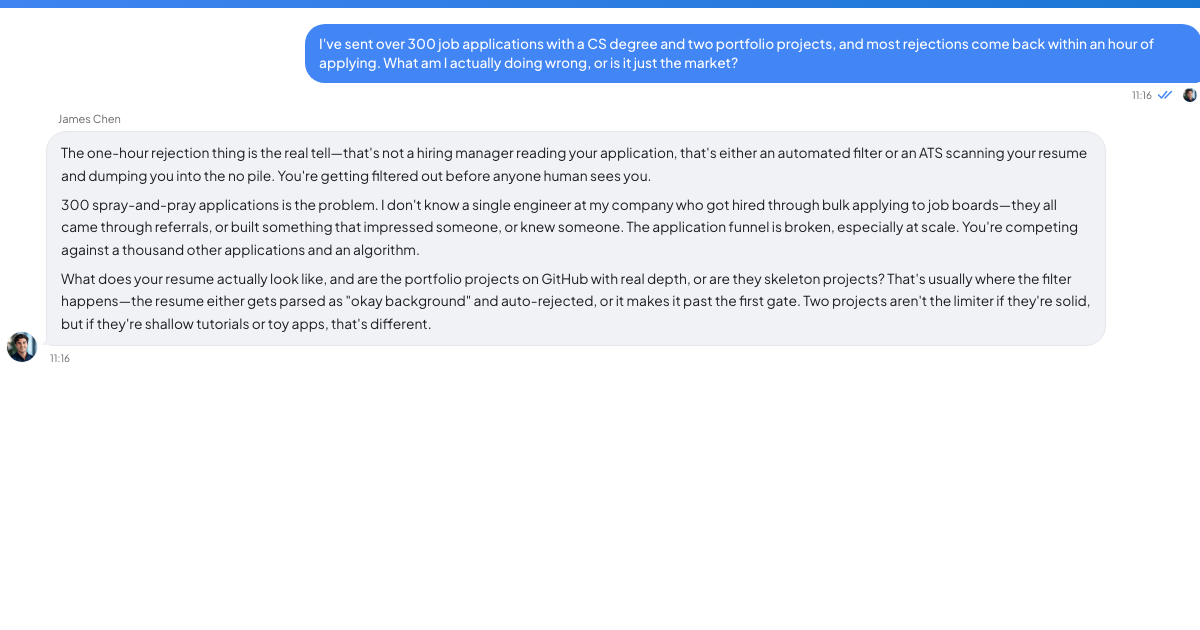
TrueTalk has James Chen — a tech startup founder and CEO persona whose areas include startups, venture capital and product development. It is an AI persona, not a founder who personally reduced four hundred CVs to six. The free tier includes ten conversations and one hundred messages per day.
Give it both projects and the next company, then ask which project should lead and why.
Two of the six slots are still open
At the eleven-person company on Thursday afternoon, four hundred and twelve applications compete for six interviews; four were allocated before the list opened. The two remaining slots go to applicants who make the tired reviewer stop scrolling.
Your spreadsheet proves that your current method never reaches that Thursday afternoon. Three hundred rows bought that lesson at high cost, and the evidence is still useful.
Next week, send five applications rather than fifteen, including four to companies whose products you opened. On Thursday, attend the meetup with twelve people and answer one useful question before mentioning your search.